


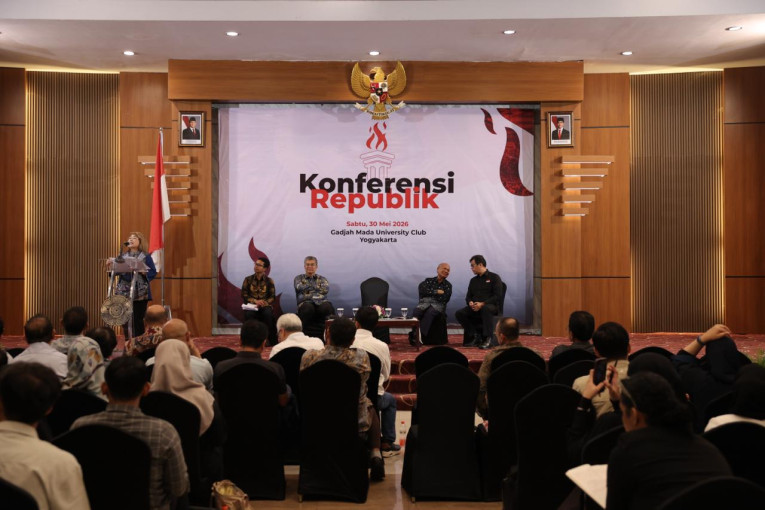
Strengthening the role of civil society has once again come into the spotlight amid the various challenges Indonesia is currently facing. The active involvement of diverse community groups is considered a key factor in ensuring that democracy remains substantive and serves the broader public interest. This issue was highlighted during the Republic Conference: Meneguhkan Civil Society Pilar Republik (Affirming Civil Society as a Pillar of the Republic), held on Saturday (May 30) at the University Club Hotel UGM (UC UGM).
The conference served as a forum that brought together blended elements of society to reflect on the state of the nation and formulate collective steps to strengthen the role of civil society as a guardian of democracy and Indonesia’s future.
Sociologist and UGM Vice Rector for Student Affairs, Community Service, and Alumni, Dr. Arie Sudjito, stated in his remarks that Indonesia was not born merely from political elites’ agreements or power struggles, but from the relentless struggle of organized grassroots groups.
History records that social organizations such as Budi Oetomo, Sarekat Islam, Muhammadiyah, Nahdlatul Ulama, along with various youth organizations, became forces that fostered national consciousness and resisted colonialism.
“Civil society is not merely a spectator on the stage of Indonesian history. They are the main actors as well as the architects who formulated the ethical ideals of this republic,” he said.
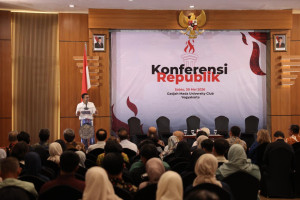
However, nearly three decades after the Reformasi era, Dr. Sudjito noted that democracy in Indonesia continues to face increasingly complex challenges. According to him, the country is currently at a crossroads due to emerging signs of democratic regression and the reproduction of neo-authoritarianism. Therefore, he encouraged strengthening spaces for discussion, particularly on university campuses.
“We must restore the function of universities, not as factories’ labor, but as moral and intellectual fortresses that dare to speak the truth in the face of power,” he emphasized.
Chair of the Republic Conference 2026 Organizing Committee, Sudirman Said, stated that the conference serves as a shared platform for members of society from different generations. According to him, diversity is an important asset in building a collective way of thinking to address the many national issues that have emerged.
“Bringing together ideas across generations is certainly not easy. But collective thinking will produce ideas that are deeper, better, and more meaningful for the nation’s future journey,” he said.
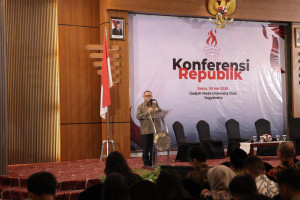
Sudirman Said believes that Indonesia now possesses far greater social and intellectual capital than during previous periods of struggle. Therefore, he encouraged civil society to strengthen consolidation and build collective movements to safeguard the nation’s development.
“Now is the time for civil society to organize itself. I understand how fragmented civil society is, but perhaps through this Republic Conference we can achieve greater consolidation,” he stressed.
Former Minister of Trade and founder of Ancora Group, Gita Wirjawan, emphasized the importance of education, openness, and human resource development as the primary foundations for supporting Indonesia’s progress amid global geopolitical changes. He argued that Indonesia must build an education system capable of producing highly skilled human resources while fostering openness to ideas, innovation, and knowledge.
“Problem recognition is the beginning of problem resolution. And openness is the only foundational element that allows us to combine the power of innovation with the power of preservation,” he said.
The quality of primary and secondary education deserves particular attention by strengthening the role of teachers, recognizing them as a crucial factor in shaping the character, ambition, and capabilities of younger generations. Investment in teacher quality must become a national priority if Indonesia hopes to improve its competitiveness.
“If teachers are paid only Rp2.8 million per month, honorary teachers Rp500,000, and recruitment comes from the lowest-performing segment, we should not expect to scale cognition, intelligence, skills, and sensitivity,” Gita explained.
Gita stressed that Indonesia’s future will be determined by its ability to develop excellent human resources through quality education, encourage openness to ideas and innovation, and ensure that the benefits of development are distributed equitably across society. Openness is a critical prerequisite for healthy exchanges of ideas and the creation of innovation without becoming trapped in polarization.
“Openness to democratize ideas, not polarize ideas. Openness to combine the power of innovation with the power of preservation,” he emphasized.
Wrapping up his presentation, Gita argued that the success of democracy should not be measured solely by the conduct of elections or the distribution of political power, but also the state’s ability to distribute the benefits of development fairly among its citizens.
This includes access to education, welfare, and healthcare, as well as the strengthening of moral and social values that form the foundation of national progress.
“Only when we succeed in distributing public goods in the form of intellect, intelligence, health, welfare, moral values, and social values can we take pride in being the world’s third-largest democracy,” he concluded.
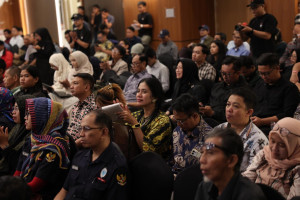
In the closing session, Chair of the UGM Professorial Council, Professor M. Baiquni, reaffirmed that civil society plays a strategic role in guiding the nation’s trajectory. The various national challenges facing Indonesia today must be addressed through strengthened knowledge, collaboration, and active public participation in overseeing development.
“As civil society, we have discussed how to revitalize the role of civil society amid the nation’s current circumstances and how we can convey to our leaders the importance of returning to the voice of the people and truly listening to it,” he said.
Furthermore, Professor Baiquni emphasized that change cannot be achieved solely through discussion and idea exchange; it must be followed by concrete actions with a tangible impact on society. Knowledge must emerge from field realities and provide solutions to the nation’s problems.
“This is a commitment for all of us to continue taking concrete action. The best theory is one built from empirical experience in the field, not merely text-based thinking, but one grounded in empirical evidence and real-world conditions,” he concluded.
Author: Cyntia Noviana
Editor: Gusti Grehenson
Post-editor: Jasmine Ferdian
Photo: Firsto