


Amid growing threats of coastal erosion and climate change along Yogyakarta’s southern coastline, hundreds of university students, school students, community groups, and local residents joined forces to plant 1,000 mangrove trees in the coastal area of Jangkaran, Kulon Progo, Special Region of Yogyakarta (DIY), on Saturday (May. 24). The activity, titled “Plant Today, Protect Tomorrow,” was organized by Universitas Gadjah Mada (UGM) through its Graduate Student Association (HMP UGM) as a tangible expression of concern for the environmental crisis and the increasingly alarming degradation of coastal ecosystems.
Approximately 250 participants from diverse backgrounds took part in the collective action. Mangrove planting was chosen as a concrete ecological prevention measure due to the plant’s ability to absorb blue carbon while serving as a natural barrier that protects shorelines from erosion and the impacts of climate change.
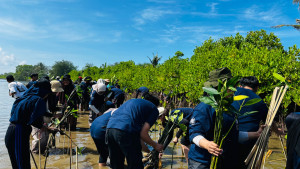
For HMP UGM, planting mangroves today is not merely about planting trees but also about planting hope so that future generations can continue to enjoy sustainable coastlines and a well-preserved environment.
Norol Latifah, Chair of HMP UGM, emphasized that the initiative was not simply a ceremonial tree-planting event but part of a broader moral movement to build ecological awareness among the public amid the increasingly evident threat of climate change. She referred to a 2020 G20 report indicating that global temperatures had risen by approximately 1.4 degrees Celsius and could reach 3.9 degrees Celsius by 2100 if no concrete action is taken.
“Through the small action we are taking today, we hope to create a significant impact on environmental sustainability in the future. Protecting the environment cannot be done alone; it requires collaboration among all elements of society,” she said on Sunday (May. 31).
Norol also stressed that the activity aligns with UGM’s vision of advancing the implementation of the Sustainable Development Goals (SDGs) through active student involvement in initiatives that generate tangible impacts. At the end of her remarks, she expressed hope that the trees planted would continue to be cared for and become an environmental legacy for future generations.
“Our hope is that the trees planted today will be maintained collectively and become a legacy of environmental stewardship for the people of Kulon Progo in the future,” she concluded.
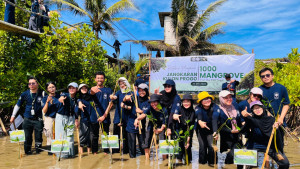
Kulon Progo Deputy Regent Ambar Purwoko praised the initiative as an effort to preserve the coastal environment. Purwoko expressed hope that the concern demonstrated through the activity would continue to inspire broader environmental conservation efforts.
“I would like to thank Universitas Gadjah Mada for its concern, participation, and support in protecting nature. Hopefully, Indonesia’s natural environment will always be preserved, and the country will remain sustainable with a well-maintained ecosystem,” he said.
Positive responses were also expressed by participants and local residents. One volunteer shared gratitude for having a platform through which young people can contribute directly to environmental conservation.
“We are pleased to have a space to channel our concern for nature. Our desire to protect the environment can be realized through concrete actions such as this mangrove-planting initiative,” the volunteer said.
Warso, a resident of Jangkaran, also expressed his sincere appreciation for the participants’ concern for the environment in his village.
“Thank you for visiting and caring about the natural environment in our village. Hopefully, this small effort can bring a significant impact on the environment,” he said.
Meanwhile, Musthofa Anshori, Secretary of the Directorate of Student Affairs, viewed student involvement in environmental initiatives as a tangible implementation of the Tridharma of Higher Education, particularly in community service.
Contributor: Naja Ganiswara Ramadhani/HMP
Author: Leony
Editor: Gusti Grehenson
Post-editor: Jasmine Ferdian
Photo: HMP UGM