


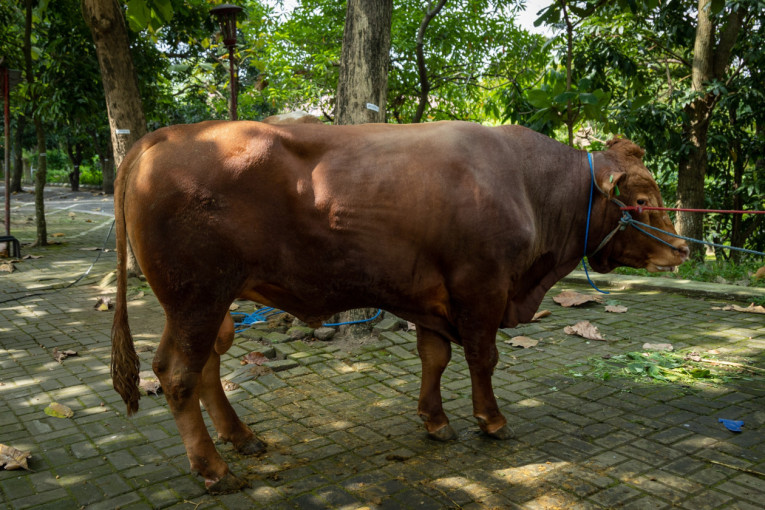
The spirit of Eid al-Adha 1446 H was strongly felt throughout Universitas Gadjah Mada (UGM). To commemorate this year’s Festival of Sacrifice, UGM once again donated two Limousin cattle, each weighing approximately 500 kilograms, to the UGM Campus Mosque (Maskam). The handover ceremony was conducted directly by UGM Vice Rector for Planning, Assets, and Information Systems, Arief Setiawan, S.T., M.Eng., Ph.D., to the Chair of the UGM Campus Mosque Management Board, Dr. M. Yusuf, M.A.
Arief Setiawan explained that the two cattle donated this year came from different sources. One was the university’s annual institutional contribution, while the other was funded by members of the university leadership.
“The donation of sacrificial animals is an annual activity. This year, we are donating two cattle, one from the UGM institution and the other funded through contributions from university leaders,” he said on Wednesday (May 27).
The donation forms part of the broader Eid al-Adha celebrations on campus. Earlier in the day, the Eid prayer was held at Pancasila Field and attended by a large congregation.
Yusuf explained that the UGM Campus Mosque had received a total of 12 cattle, 21 goats, and 49 sheep. All slaughtering activities were scheduled to take place simultaneously on Thursday (May 28), beginning at 6:00 a.m. and continuing until completion.
“The slaughtering will take place tomorrow, Thursday. It will begin at around 6:00 a.m. and continue until it is finished. The meat will then be distributed around midday or before the Asr prayer,” he explained.
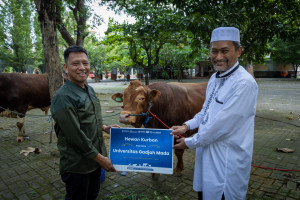
To ensure quality, hygiene, and compliance with Islamic law, the UGM Campus Mosque once again partnered with certified professional halal slaughterers (Juleha). Yusuf explained that the Juleha team would handle the slaughter process, including cutting and separating the meat from the bone.
“We are working with certified professional halal slaughterers. They will assist with slaughtering and separating the meat from the bones. They will also be supported by the Eid al-Adha committee, most of whom are students,” he said.
Yusuf further explained that not all sacrificial animals would be slaughtered on campus. Some would be distributed to villages in need across the Special Region of Yogyakarta (DIY).
“A total of 11 cattle, 22 sheep, and 9 goats will be slaughtered at the Campus Mosque, while the rest will be slaughtered in five villages assisted by the mosque. The meat processed on campus will later be distributed to approximately 350 beneficiaries,” he explained.
He added that in distributing the meat, the UGM Campus Mosque collaborated with RZIS to ensure that aid reached the intended recipients.
“We work with RZIS. They maintain a database of orphanages, underdeveloped villages, orphans, and underprivileged communities. We use that database for distribution,” he said.
Several sacrificial animals had already been distributed to villages across Yogyakarta. In Bantul Regency, the committee distributed six sheep and three goats to Al Ikhlas Prayer Hall in Sedayu District. Meanwhile, in Gunungkidul Regency, distributions were made to Al Maarif Mosque in Gedangsari, which received six sheep, and Al Iman Mosque in Tepus, which received four sheep and three goats.
In addition to working with local mosque administrators, UGM distributed sacrificial animals through collaboration with campus organizations. Through Jamaah Shalahuddin, one cow, nine sheep, and four goats were distributed to Rongkop District in Gunungkidul. Meanwhile, in collaboration with the Muslim Family Association of the Faculty of Cultural Sciences (KMF FIB), the committee distributed two sheep and three goats for slaughter at Baiturrahim Mosque in Purwosari District, Gunungkidul.
With the momentum of Eid al-Adha, the university hopes that the distribution of sacrificial animals will strengthen social bonds while easing the burden on those in need.
“We hope activities like this during every Eid al-Adha celebration can provide benefits to the community and to students,” Arief Setiawan said.
Meanwhile, the Universitas Gadjah Mada Employees Corps (Korpagama) held its own sacrificial slaughtering event on Friday (May 29). The activity began at 7:00 a.m. in the backyard of the Korpagama Office at Bulaksumur B6. During the event, one cow was slaughtered as a sacrifice from several contributors, consisting of UGM lecturers and educational staff. The slaughtering process was also attended by Arief Setiawan Budi Nugroho, S.T., M.Eng., Ph.D., Vice Rector for Planning, Assets, and Information Systems.
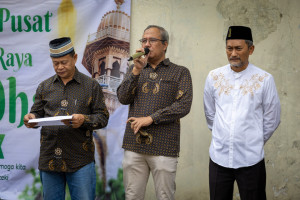
Arief Setiawan Budi Nugroho stated that several faculties across UGM also conducted sacrificial slaughtering activities on the same day. He expressed his appreciation and gratitude to Korpagama for organizing the event.
“On this occasion, several faculties are also conducting sacrificial slaughtering activities today. I would also like to thank UGM, particularly Korpagama, for organizing this event,” he said.
He expressed hope that the activity would benefit those in need while also strengthening devotion to Allah SWT.
“The meat will certainly be distributed to those who need it and become a good deed for all of us. Hopefully, this activity will serve as a good deed for the donors, benefit communities in need, and become a means of drawing closer to Allah SWT,” he said.
The Chair of Korpagama, Professor Achmadi Priyatmojo, explained that the slaughtering activity was rooted in a spirit of kinship and solidarity. In addition to fulfilling a religious obligation, he hoped the activity would serve to share and strengthen relationships among Korpagama members. He added that the sacrificial meat would also be distributed equitably to communities around UGM.
“The meat will be distributed to nearby communities and Korpagama members in need. We hope this will help members get to know one another better, foster a sense of family, and facilitate our work together in the future,” he explained.
Professor Priyatmojo noted that the activity aligns with Korpagama’s vision of improving employee welfare.
“The essence of sacrifice is how we interpret it as a foundation for providing the best possible service to society, students, and fellow colleagues. One of Korpagama’s visions is to improve employee welfare, both financially and morally,” he concluded.
Authors: Aldi Firmansyah and Diyana Khairunnisa
Editor: Gusti Grehenson
Post-Editor: Zabrina Kumara
Photo: Donnie