


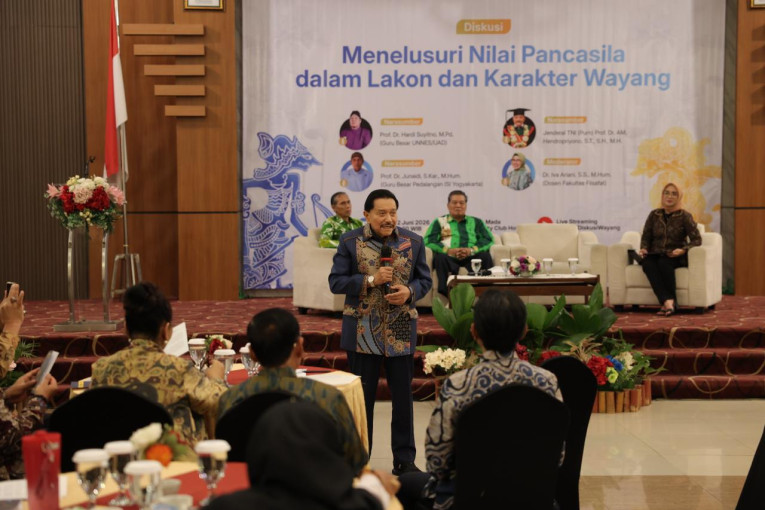
Our nation is currently facing various challenges, including a crisis of public ethics, the spread of hoaxes, growing individualism, and the weakening of moral role models. Therefore, a cultural approach must become an important part of efforts to strengthen national character. As an archipelagic nation, Indonesia possesses a wealth of stories, wisdom, and historical experiences that can serve as sources of inspiration in addressing both national and humanitarian issues.
These ideas emerged during the discussion “Menelusuri Nilai Pancasila dalam Lakon dan Karakter Wayang” (Tracing Pancasila Values in Wayang Stories and Characters) held on Tuesday (Jun. 2) at the Gadjah Mada University Club Hotel (UC UGM). Organized as an event leading up to the 59th Anniversary of the Faculty of Philosophy at Universitas Gadjah Mada (Philosophy UGM), the discussion also served as a tribute to Professor Lasiyo, who has dedicated his career as a lecturer and Head of the UGM Wayang Studies Center (Studi Wayang UGM) and is approaching retirement. The forum brought together academics, cultural figures, students, cultural observers, and members of the UGM academic community concerned with promoting national values through culture.
Dean of the Faculty of Philosophy (Philosophy UGM), Professor Rr. Siti Murtiningsih stated that wayang is not only a cultural heritage of the nation but also a source of wisdom that can help society navigate changing times.
“We live in an era rich in information but often poor in reflection and meaning. We have increasingly advanced technology, yet not necessarily accompanied by stronger morality and wisdom. Wayang is a school of ethics that has lived for centuries within the culture of the archipelago,” she said.
Professor Murtiningsih added that the values of Pancasila have long been embedded in various expressions of Indonesian culture, including wayang stories and characters. She hoped that the discussion would go beyond cultural appreciation and encourage all parties to apply the values contained in wayang traditions to everyday life.
UGM Rector, Professor Ova Emilia, emphasized that wayang is a learning medium rich in life lessons. Pancasila values such as belief in God, humanity, unity, and social justice are found throughout wayang narratives.
“Through wayang, we can learn the values of compassion, honesty, etiquette, sacrifice, and many other virtues that reflect human life. Therefore, preserving wayang and fostering a new generation of wayang practitioners are important efforts that must continue,” she said.
Chair of the UGM Academic Senate, Professor Muhammad Baiquni, delivered introductory remarks, emphasizing the importance of revisiting the intellectual heritage of the Indonesian archipelago to respond to global challenges. Indonesia, as an archipelagic nation, possesses a wealth of stories, wisdom, and historical experiences that can serve as sources of inspiration in addressing both national and humanitarian issues.
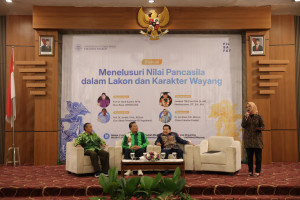
Former Head of Indonesia’s State Intelligence Agency (BIN), Professor Hendropriyono, explained that wayang is a reflection of the civilization of the Indonesian archipelago, encompassing philosophy of life, ethics of power, character education, and leadership strategies. He stressed that the values of Pancasila had long existed within the archipelago’s cultures before Indonesia gained independence.
“Wayang teaches us that power without morality leads to destruction, and intelligence without wisdom leads to arrogance,” he said.
He further highlighted the values of leadership and unity reflected in wayang stories. Professor Hendropriyono explained that wayang mirrors the civilization of the archipelago through its teachings on philosophy of life, ethics of power, character education, and leadership strategies.
“Wayang teaches us that power without morality leads to destruction, and intelligence without wisdom leads to arrogance,” he concluded.
Professor of Puppetry at the Indonesian Institute of the Arts Yogyakarta (ISI Yogyakarta), Professor Junaidi, discussed how wayang stories and characters act as a way to explore Pancasila values. He explained that the Pandawa characters represent virtues that closely align with the principles of Pancasila.
Yudhishthira, for example, embodies piety, honesty, and compassion. Bima reflects courage and humanity. While Arjuna represents the spirit of unity and the ability to embrace differences. According to him, wayang has tremendous potential as a medium for character education.
“Therefore, various innovations are needed to ensure that the values contained in wayang can be embraced by younger generations, including the development of animated wayang models and learning media that are closer to children and adolescents,” he concluded.
Author: Ika Agustine and Gloria (Faculty of Philosophy Public Relations)
Editor: Gusti Grehenson
Post-editor: Jasmine Ferdian
Photo: Firsto