


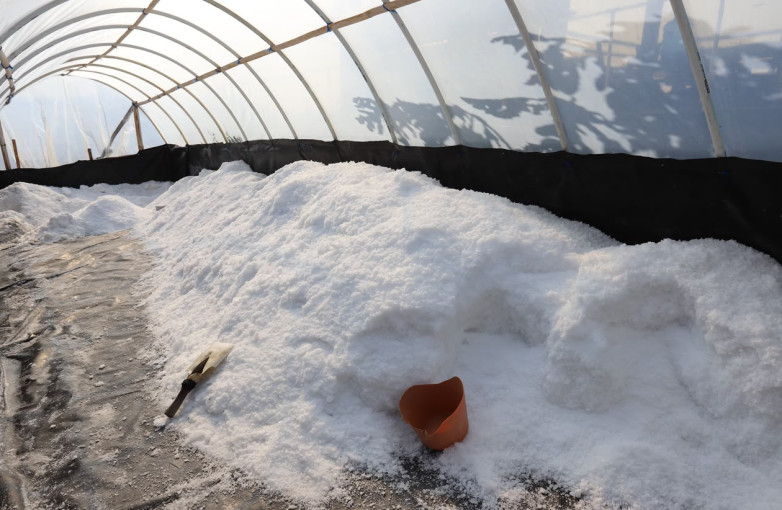
Indonesia continues to face significant challenges in achieving salt self-sufficiency despite having one of the world’s longest coastlines. The issue extends beyond production processes and is influenced by various factors, including production technology, climate conditions, distribution systems, and the socioeconomic circumstances of coastal communities.
“It turns out that increasing salt production is not easy, which is why we still rely on imports for nearly half of our salt needs,” said Professor Alim Isnansetyo of the UGM Faculty of Agriculture during a Focus Group Discussion (FGD) titled “Integrasi Pemanfaatan Air Tawar pada Produksi Garam Laut dengan Teknologi SWRO (Seawater Reverse Osmosis) sebagai Air Minum”, (Integration of Freshwater Utilization in Sea Salt Production Through SWRO (Seawater Reverse Osmosis) Technology for Drinking Water), held on Wednesday (Jun. 17) in Kulon Progo.
As part of efforts to address this challenge, Professor Isnansetyo introduced Seawater Reverse Osmosis (SWRO) technology by integrating salt production with freshwater provision. Through this technology, seawater can be utilized not only as a raw material for salt production but also processed into clean water for coastal communities that continue to face limited access to freshwater.
“We hope this technology can help increase both the quantity and quality of salt production, make use of freshwater resources, improve social and economic conditions, and ultimately enhance the livelihoods of people engaged in the salt industry,” he said.
Director of the Directorate of Community Service, Dr. Rustamadji, stated that the development of the national salt industry has long been a concern for UGM and remains a priority program. Despite numerous efforts, the salt industry still faces various challenges in meeting domestic demand independently. Therefore, he emphasized that UGM supports technological development and community empowerment initiatives that can strengthen national salt production capacity.
“We strongly support activities along the Southern Coast because we hope the salt production model developed here can later be applied to small islands across Indonesia,” he said.
As part of UGM’s community service initiatives, Dr. Rustamadji noted that the discussion forum serves as a platform to connect university research outcomes with the real needs of coastal communities. Through collaboration among academics, government institutions, salt farmer groups, and business actors, he hopes the innovation can be implemented directly to improve productivity and community welfare.
“Hopefully, through this discussion, we can better understand the challenges and identify solutions for future salt industry development,” he explained.
Head of the Purworejo Environmental and Fisheries Agency, Wiyoto Harjono, expressed appreciation for UGM’s efforts in developing SWRO technology integrated with salt production in the southern coastal region of Purworejo. Although the quality of Purworejo’s salt is already considered quite good, he emphasized that the primary challenge remains increasing production volume and continuity to meet market demand sustainably. He noted that local salt production has yet to reach its full potential because strong connections between producers and markets have not been fully established.
“Salt development along the Southern Coast has often been like the Javanese expression sing tuku ora teko-teko, sing teko ora tuku-tuku, buyers do not come, and those who come do not buy. Therefore, I hope this forum can open broader opportunities for collaboration to strengthen the salt ecosystem, from production and processing to marketing and investment development based on the Southern Coast’s potential,” he said.
During the discussion session, Professor Tri Winarni Agustini, a professor of fisheries technology at Diponegoro University, explained that national demand for salt continues to increase across various sectors, including the food, pharmaceutical, and cosmetics industries. However, the quality of domestically produced salt remains a serious challenge because it often fails to meet industrial standards. As a result, Indonesia continues to selectively import salt to meet industrial requirements.
“In reality, most salt production is still driven by micro- and small-scale salt farmers using conventional methods. It is concerning that we still have to rely on imports,” she said.
As a solution, Professor Agustini encouraged technological transformation through the use of geomembrane (HDPE) technology and greenhouse systems to improve the quality and quantity of national salt production. She also emphasized the importance of adopting a zero-waste approach, using concentrated brine waste to produce derivative products, thereby supporting Indonesia’s goal of achieving salt self-sufficiency by 2029.
Meanwhile, Dr. Mohammad Zaki Mahasin, Coordinator for Seawater Utilization and Pharmacology at the Directorate General of Marine Spatial Management, stressed that Indonesia’s salt challenges are closely linked to the country’s geographical and climatic conditions. Consequently, national salt production continues to face a gap between demand and production capacity. He believes that the salt processing technology developed by UGM can serve as an alternative solution to improve the quality and productivity of community-based salt production while creating opportunities for salt-based derivative products.
“Through the utilization of SWRO technology, products can be diversified to generate salt-based derivatives that increase the economic potential of salt farmers,” he explained.
Marsino, Head of the Pandowo Limo Salt Business Group (KUGAR), shared his group’s efforts to develop processed salt products, including table salt, organic salt, and therapeutic salt, as well as salt extracts with various applications. Although the quality of their products already meets the required standards, product development continues to face challenges due to the substantial costs of certification.
“I hope this collaborative support can help local salt products compete in a much larger market,” he said.
Author: Cyntia Noviana
Editor: Gusti Grehenson
Post-editor: Zabrina Kumara
Photo: Jesi