


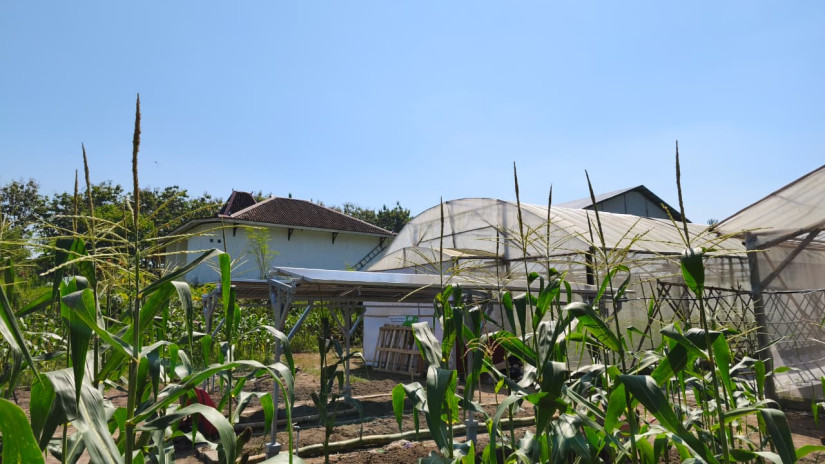
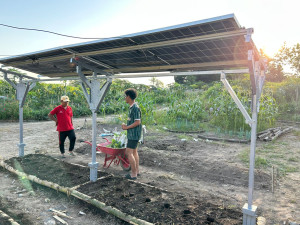
A team of researchers from Universitas Gadjah Mada (UGM) has installed Agrovoltaic solar panel technology in Pandowoharjo Village, Sleman Regency, Special Region of Yogyakarta (DIY). The technology was deployed to support the development of a smart farming initiative managed by a village-owned enterprise (BUMDes) and a women farmers group.
“This program is being implemented as part of efforts to develop a renewable energy-based village through the application of Hybrid Solar Power Plant (PLTS) technology and the agrivoltaic concept integrated with community empowerment,” said Dr. Ahmad Agus Setiawan, head of the research team, on Wednesday (Jun. 10).
The renewable energy expert and Head of the Renewable Energy Laboratory (RELab) at the Department of Nuclear Engineering and Engineering Physics, Faculty of Engineering (FT UGM), explained that the implementation of this technology is part of efforts to develop technology-based villages through applied research conducted by academics. It is expected that the agrovoltaic system will help the energy access limitations faced by BUMDes Amarta and the Wastajap Bersinar Women Farmers Group in Pandowoharjo Village.
Dr. Setiawan, fondly known as Aas, explained that BUMDes Amarta manages 1,376 square meters of village-owned agricultural land. Nearby, the Wastajap Bersinar Women Farmers Group cultivates 587 square meters of farmland. These village enterprises actively manage two greenhouses that produce melons and a range of horticultural crops, including papaya, chili peppers, corn, peanuts, sweet potatoes, taro, and eggplant.
As a vital sector supporting the local economy, BUMDes Amarta is pursuing the Green Independent Village designation to strengthen the foundation of its business units.
“Such productivity requires adequate operational standards while still considering the capacity of managers and farmer groups,” he said.
PLTS Hybrid Agrovoltaic is expected to help optimize energy costs, although the project underwent adjustments from the original 3.3 kWp capacity to 2.6 kWp. The change was made to reduce expenses amid geopolitical tensions in the Middle East, which have driven up global solar energy component prices and intensified the impact of the US dollar’s strength against the Indonesian rupiah.
Another member of the research team, Professor Bayu Dwi Apri Nugroho, an expert in agrometeorology, climate change, and smart farming innovation from UGM’s Faculty of Agricultural Technology (FTP UGM), stated that the agrovoltaic technology offers a practical solution for BUMDes Amarta, which is largely managed by millennial farmers, as well as the Wastajap Bersinar Women Farmers Group. To expand the initiative’s impact and collaboration potential, the project involves international partners from the Solar Research Institute (SRI) of Universiti Teknologi MARA (UiTM), Malaysia.
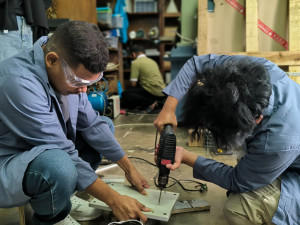
Professor Nugroho explained that he and the research team, comprising lecturers and students, had conducted a series of observations and evaluations to determine the most suitable PLTS Hybrid model for installation on agricultural land.
Compared to PLTS On-Grid, which is directly connected to the electricity network, the battery backup system in the Hybrid reduces electricity costs by using grid power only when battery reserves are depleted.
Meanwhile, the team assessed that PLTS Off-Grid, which relies entirely on batteries as its energy source, would be less suitable given the land conditions and operational capacity of BUMDes Amarta.
“There has been a surge in component prices amid global political dynamics and the weakening value of the rupiah,” he explained.
As a technology that has not yet been widely adopted, Professor Nugroho noted that PLTS Hybrid requires particular attention in both operation and maintenance. Therefore, the team involved community members, youth organizations, and the technical unit of BUMDes Amarta in the assembly process.
Furthermore, an IoT-based monitoring module (RiTx) will be used to record real-time soil and weather data for remote monitoring.
“We involved BUMDes Amarta in developing a simple Standard Operating Procedure (SOP) to ensure the sustainability of the program,” he said.
According to Professor Nugroho, this community service program, which integrates PLTS with agrovoltaic practices, represents one effort to mitigate the impacts of climate change on the agricultural sector. The initiative aims to strengthen farmers’ adaptive capacity, which is increasingly necessary to maintain optimal crop yields under changing environmental conditions.
Author: Ika Agustine
Editor: Gusti Grehenson
Post-editor: Jasmine Ferdian
Photo: Agrovoltaic Team Documentation