


According to Statistics Indonesia (BPS) data from 2021, at least 89.54% of Indonesia’s agricultural land does not meet sustainable productivity standards due to excessive chemical use, intensive land cultivation, overuse of water resources, and social conflicts. At the same time, farmers continue to face the impacts of climate change, including the threat of drought caused by prolonged dry seasons linked to El Niño, which is expected to persist until early 2027.
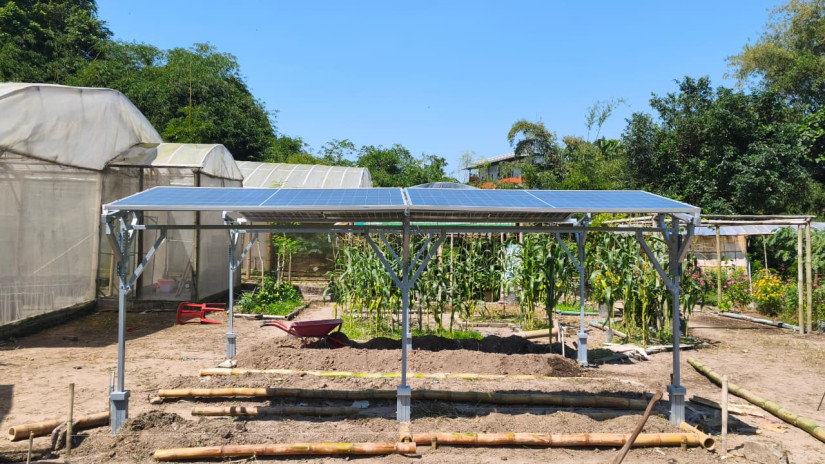
As a solution for more efficient agricultural land use, the Head of UGM’s Renewable Energy Laboratory, Ahmad Agus Setiawan, introduced the concept of agrivoltaics, integrating solar panels above agricultural land. The concept was inspired by the success of the Cirata Floating Solar Power Plant, which has a capacity of 149-190 MW.
Setiawan, commonly known as Aas, explained that the technology has been implemented in Pandowoharjo Village, Sleman, where it is operated directly by locals and utilized by farmers. The technology is planned to be introduced by the UGM Community Service Program (KKN-PPM UGM) serving in remote areas.
“They will bring a package that combines solar panels as an energy source and Starlink to provide internet access for local communities. We hope students can grow together with the communities they serve,” he said during the international seminar titled “Smart Agrivoltaic Nusantara: Membangun Kedaulatan Pangan, Energi, dan Air Berbasis Teknologi Hijau dari Desa untuk Indonesia” (Smart Agrivoltaic Nusantara: Building Food, Energy, and Water Sovereignty Through Green Technology from Villages for Indonesia), held at the UGM Faculty of Engineering (FT UGM) on Wednesday (Jun. 24).
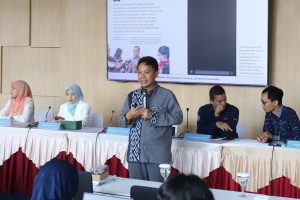
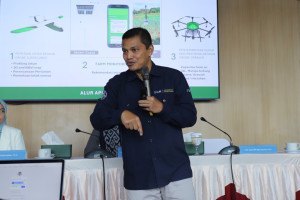
The agrivoltaic technology innovation was developed in collaboration with Professor Bayu Dwi Apri Nugroho from the UGM Faculty of Agricultural Technology (FTP UGM). According to Professor Bayu, this smart farming technology is built upon three main pillars: a Management Information System (MIS) for decision-making, precision agriculture, and optimization and robotics.
Through the implementation of smart farming, Professor Bayu believes numerous benefits can be achieved, including increased productivity, more accurate, real-time data collection, greater efficiency, simplified monitoring and control, and improved product quality.
“Smart farming makes it easier for us to obtain information through installed sensors. For example, if soil lacks nitrogen, farmers can apply nitrogen fertilizer specifically rather than potassium fertilizer,” he explained.
However, implementing the technology in open fields is more challenging than in greenhouses due to unpredictable weather. Therefore, Professor Bayu has developed an integrated system that combines drones, both surveillance drones for mapping and spraying drones for crop treatment, with above-ground weather sensors and portable underground soil sensors. This integration provides precise, real-time information on crop needs.
Professor Nofri Yenita Dahlan, Director of the Solar Research Institute (SRI) Malaysia, revealed that the use of agrivoltaic technology in large-scale solar farms operated by the institute has successfully reduced electricity costs on campus.
According to Professor Nofri, agriculture can support solar energy systems, and vice versa. One example is the cultivation of creeping plants such as pegaga beneath chest-high solar panels to prevent soil erosion in solar farm areas. Electricity generated by solar panels powers environmental control technologies in greenhouses, enabling automated cherry tomato cultivation based on temperature sensor data.
“In this situation, solar energy helps reduce electricity consumption,” she explained.
In his opening remarks, the Director of Community Service (DPkM UGM), Dr. Rustamadji, hopes this technology could be introduced across Indonesia through UGM’s Community Service Program (KKN-PPM). He emphasized that such technologies should be implemented directly in communities so that affordable energy supplies are accessible to people from all socioeconomic backgrounds.
“The implementation of appropriate technology in communities should not merely focus on introducing technology. It must also involve preparing communities and creating a supportive ecosystem that enables the technology to function effectively,” he stressed.
Author: Fatihah Salwa Rasyid
Editor: Gusti Grehenson
Post-editor: Jasmine Ferdian
Photo: Hanifah