


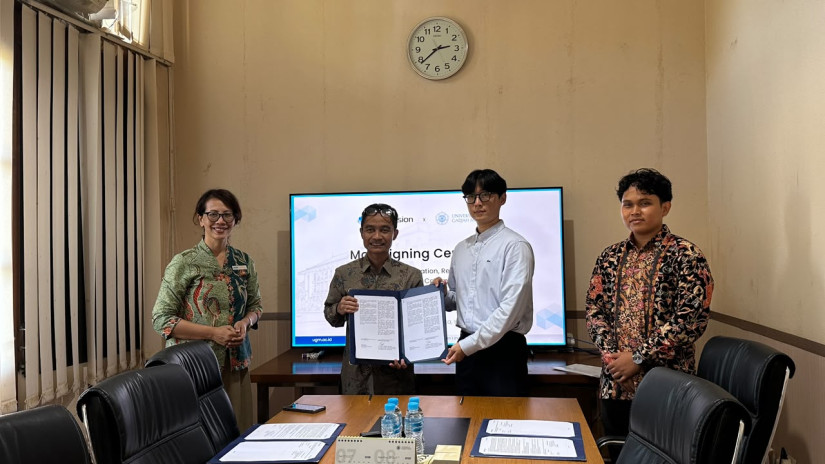
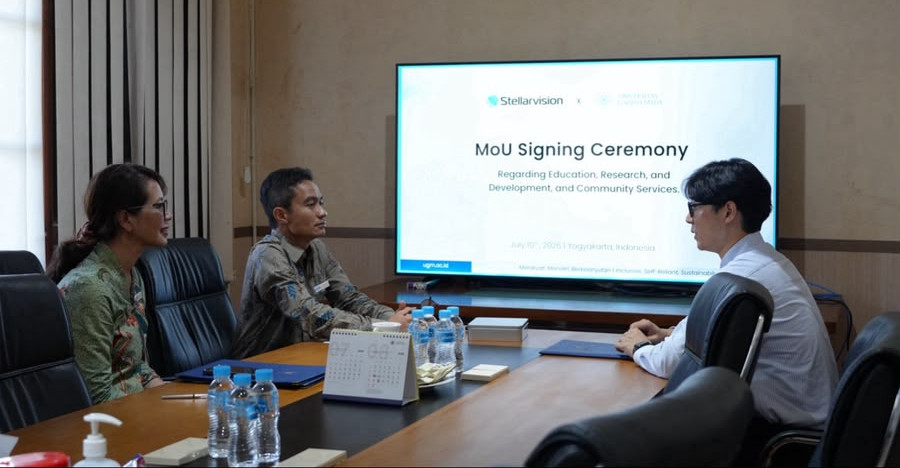
Universitas Gadjah Mada (UGM) has officially established a strategic partnership with the South Korean technology company Stellarvision to develop satellite-image-based technology for detecting underground water pipe leaks. The collaboration was formalized through the signing of a Memorandum of Understanding (MoU) and a Proof of Concept (PoC) Agreement on Friday (Jul. 10) at the UGM campus, marking the first step toward more efficient and sustainable water resource management.
The signing ceremony was attended by Stellarvision delegates, including researcher Junse Oh, the UGM delegation led by Dr. Danang Sri Hadmoko, Vice Rector for Research, Business Development, and Partnerships, and other university officials.
Dr. Danang expressed his appreciation for the partnership between UGM and Stellarvision. He said the collaboration represents a strategic synergy expected to deliver innovative solutions to the longstanding challenge of detecting underground water pipe leaks, which have been difficult to identify and have resulted in significant water loss. The partnership is further strengthened by the involvement of a UGM alumnus who is currently pursuing a professional career at Stellarvision and is directly engaged in the collaboration.
“We appreciate the trust placed in UGM to jointly develop research and technology that can help address one of the major challenges in water governance, particularly the detection of underground water pipe leaks that have long been difficult to identify,” said Dr. Danang in a statement released to the media on Tuesday (Jul. 14).
Through this collaboration, Stellarvision’s FluidVision technology, which utilizes Synthetic Aperture Radar (SAR) satellite imagery, will be integrated with the testing facilities at UGM’s Agrotechnology Innovation Center (PIAT) in Sleman. The integration will support a six-month technology trial to test controlled underground pipe leak simulations and advance the project’s main objective.
Throughout the research period, UGM will ensure that all activities and simulations are conducted professionally and in accordance with the principles of good research governance. Protecting Intellectual Property Rights (IPR) and maintaining the confidentiality of both parties’ data will also remain key commitments throughout the collaboration.
“UGM is committed to ensuring that all research activities and leak simulations conducted over the next six months are carried out professionally. The protection of Intellectual Property Rights and the confidentiality of both parties’ data will be fully guaranteed in accordance with UGM’s internal regulations and the applicable laws of Indonesia,” he emphasized.
On the occasion, Dr. Danang also expressed his appreciation to everyone involved in preparing the collaboration, particularly the team from PIAT, the Inter-University Center of Excellence (PUAPT) Working Group on Water Security, and all parties who contributed throughout the planning process leading to the signing of the agreement.
He expressed hope that the partnership, built on trust, synergy, and integrity, would proceed successfully and produce innovations that support more effective and sustainable water resource management.
“We hope this first step, founded on the spirit of synergy and integrity, will progress smoothly and deliver real benefits to society through the development of more effective and sustainable water resource management technologies,” Dr. Danang concluded.
Author: Jelita Agustine
Editor: Gusti Grehenson
Post-Editor: Priyanandaningrat
Photo: Documentation of BMS UGM