


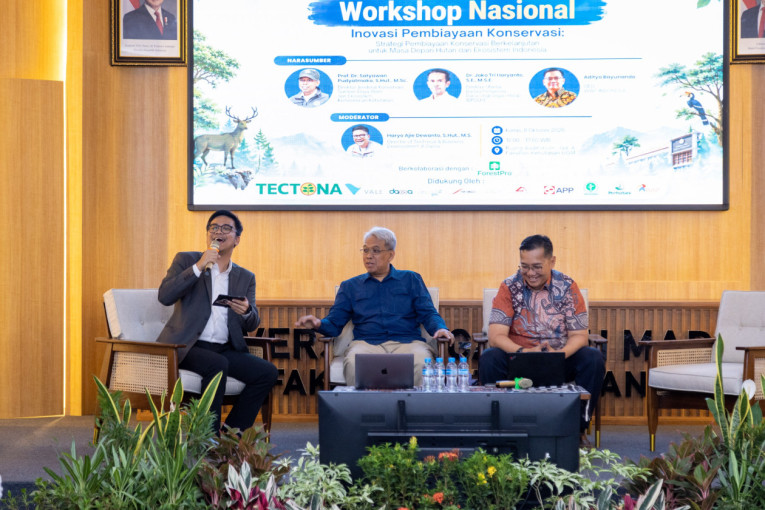
National park conservation area management has become an important concern in efforts to ensure their long-term sustainability. Despite substantial spending, their management is considered not optimal, and the allocated budgets have yet to deliver significant direct benefits to local communities. Currently, 13 national parks and three priority landscapes have been proposed to become self-sustaining conservation areas.
“Indonesia’s conservation areas have long provided significant global benefits, but local communities have yet to experience those benefits,” said Professor Satyawan Pudyatmoko, Director General of Natural Resources and Ecosystem Conservation at Indonesia’s Ministry of Forestry, during the National Workshop on “Inovasi Pembiayaan Konservasi: Strategi Pembiayaan Konservasi Berkelanjutan untuk Masa Depan Hutan dan Ekosistem Indonesia” (Conservation Financing Innovation: Sustainable Financing Strategies for the Future of Indonesia’s Forests and Ecosystems). The workshop was held on Thursday, October 8, in the Auditorium of Building A, Faculty of Forestry, Universitas Gadjah Mada (Forestry UGM).
Professor Satyawan said several national parks have generated benefits for surrounding communities and become financially self-sustaining, including Komodo National Park, Mount Rinjani National Park, and Bromo Tengger Semeru National Park.
“All three have also transitioned into Public Service Agencies (BLUs), meaning they are considered capable of securing their own funding,” he said.
To support national park management financing, President Prabowo Subianto issued Presidential Decree No. 8 of 2026 on the Task Force for Innovative National Park Management Financing, which aims to make national parks financially self-sustaining over the long term. Professor Satyawan explained that the task force focuses on two areas: financing innovation and regulatory reform.
“Through this task force, we hope that the 13 national parks and three landscapes will no longer focus solely on financing but instead become assets that can independently generate economic growth,” he added.
Aditya Bayunanda, President Director of the World Wide Fund for Nature (WWF) Indonesia, explained that revenue generated by national parks that have not become Public Service Agencies is currently transferred to the state treasury as non-tax state revenue (PNBP) and is not directly reallocated to conservation. One of the task force’s missions is therefore to change the regulations so that conservation revenue can be used directly to finance conservation activities.
“This would allow each national park to have independent and sustainable funding. Achieving this requires substantial innovation and careful consideration, as well as credible and accountable monitoring processes,” he explained.
Aditya said that over the next three years, feasibility studies would be conducted for at least six national parks to map their potential for carbon-related initiatives, biodiversity conservation, and tourism.
“Four national parks have already attracted interest in receiving funding. If we can demonstrate success over these three years, the initiative can continue under the next administration,” he said.
Dr. Joko Tri Haryanto, President Director of the Environmental Fund Management Agency (BPDLH), explained that the agency serves as a National Climate Country Platform. It manages funds from various sources through a range of financing instruments, including grants, catalytic funding, loans, endowment funds, blended finance, and de-risking facilities.
BPDLH is currently focusing on innovative financing for 13 national parks and three landscapes. It also manages the Indonesian Coral Reef Bond, the Green Pearl Economy (GPE) initiative, which monetizes peatland carbon, and the Indonesian Biodiversity Funds (IBioFund), a blended-finance platform. Dr. Joko added that the conservation areas are divided into three tiers based on their readiness and capacity.
“Our hope is that we can tell the world that Indonesia now has a biodiversity endowment fund. We must work together to establish a new paradigm in which biodiversity is viewed as a source of revenue rather than a cost center,” he said.
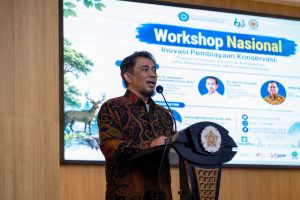
The Dean of Forestry UGM, Dwiko Budi Permadi, said that conservation areas are being encouraged to become financially self-sustaining. He expressed hope that the workshop would provide a deeper understanding of conservation, its institutional and financial architecture, and unconventional financing opportunities.
“We hope these national parks and priority landscapes can generate innovative financing models, cross-sector collaboration, clear benefit-sharing mechanisms, and social safeguards that protect local communities, leading to recommendations with meaningful impact,” he said.
The workshop concluded that most funding for national park management still comes from overseas sources in the form of grants and investments. Domestic funding sources therefore need to be explored through compensatory or commercial mechanisms, such as partnership schemes.
The National Park Management Innovation Program must also be implemented with a strong commitment to mitigating conflicts of interest. This requires robust safeguards and assurances that conservation and community welfare receive the greatest possible benefits. Safeguards for tourism development must also be given serious consideration.
Author: Jesi
Editor: Gusti Grehenson
Post-Editor: Priyananda
Photo: Donnie