


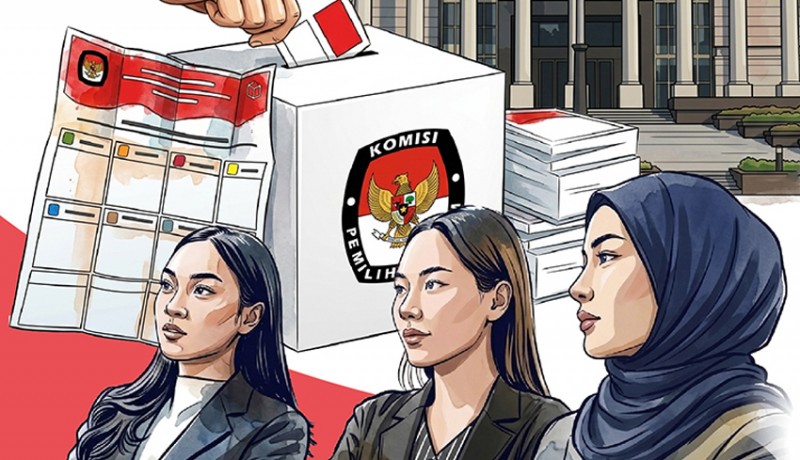
Women’s representation in politics cannot be achieved simply by meeting the minimum 30% quota. Strengthening women’s capacity, improving political party recruitment and leadership development, and changing societal attitudes are necessary to ensure that women have equal opportunities to participate in public decision-making.
Sri Wiyanti Eddyono, an expert in law and women’s rights at Universitas Gadjah Mada’s (FH UGM), said affirmative action policies must be accompanied by concrete measures to ensure that women’s representation goes beyond meeting numerical targets.
“Quotas are important, but they mean little without other measures to make them meaningful,” she said in an interview with UGM’s Public Relations Office on Tuesday (October 13).
According to Sri Wiyanti, these measures can include leadership training, political vision development, and continuous leadership development within political parties. Parties need to ensure that women members have opportunities to grow and occupy strategic positions, while the government should encourage and oversee the implementation of these efforts.
“The essence of affirmative action is not just quotas, but also temporary special measures to help ensure that those quotas can be met,” she explained.
Sri Wiyanti emphasized that women’s representation matters because laws and public policies emerge from political processes in which different interests intersect. When women lack adequate opportunities to participate in these processes, their experiences and needs risk being overlooked in policymaking.
“Without balanced representation, groups that are not represented will not benefit from the policies being made,” she explained.
She identified patriarchal culture as one of the fundamental barriers preventing women from entering politics. This culture positions politics and leadership as male domains, while women are more commonly associated with domestic roles. Such views reinforce stereotypes that lead women to be judged differently when they express leadership ambitions.
“When a woman says, ‘I want to be a leader,’ people ask, ‘Who does she think she is? She’s so ambitious.’ But when a man says, ‘I want to be a leader,’ people see it as perfectly normal,” she said.
Sri Wiyanti stressed that these barriers are not simply a matter of women’s capabilities, but also stem from societal attitudes that restrict their opportunities. Efforts to encourage women to enter politics must therefore be accompanied by broader acceptance of women in leadership roles.
“The issue is not just about changing the women who enter politics; society’s attitudes toward women must also change,” she emphasized.
In addition to social barriers, Sri Wiyanti highlighted the high cost of political participation as another obstacle. These costs can limit women’s ability to compete. Women from lower- and middle-income backgrounds, particularly those without strong financial backing and political networks, face greater difficulties entering and remaining in political competition.
“When politics is expensive, women from lower-income backgrounds will find it difficult to remain in the competition,” Sri Wiyanti said.
This issue is also linked to the internal culture of political parties. According to her, connections with party elites, financial support, and the openness of recruitment and leadership development processes can influence an individual’s opportunities to advance. Women party members who lack adequate networks and support may struggle to access the same opportunities to run for office.
Sri Wiyanti also recounted cases in which women party members had helped mobilize votes, only for more senior figures to benefit from their efforts. In her view, these experiences highlight the need for fairer and more transparent relationships within political parties.
“Party culture has a significant influence,” she said.
Political parties must therefore improve their recruitment and leadership development processes and ensure that opportunities are allocated transparently. Meeting quotas must be accompanied by meaningful opportunities for women party members to develop their abilities, advance their ideas, and participate in decision-making.
From a human rights law perspective, Sri Wiyanti explained that Indonesia ratified the Convention on the Elimination of All Forms of Discrimination against Women (CEDAW) in 1984. The convention provides a foundation for the country’s commitment to eliminating discrimination against women, including in political life and public decision-making.
According to her, this commitment must be translated into policies and programs that can be implemented and evaluated. She also highlighted General Recommendation No. 40, issued by the CEDAW Committee in 2024, which provides guidance on equal and inclusive representation in decision-making.
“The problem is the lack of political will to implement international standards that have already become part of national law,” she said.
Sri Wiyanti believes the government needs to strengthen implementation of these commitments, including by promoting training and leadership development for women within political parties and monitoring the effectiveness of affirmative action policies. This would help ensure that women’s political rights are not merely guaranteed in legal documents but are realized in practice.
“The success of women’s representation should not be measured solely by the number of women holding political office. Equally important are the opportunities available to them to express their ideas and advocate for their interests in decision-making,” she concluded.
Author: M. Aidil Syahputra
Editor: Gusti Grehenson
Post-Editor: Priyananda
Photo: Antara Illustrations