


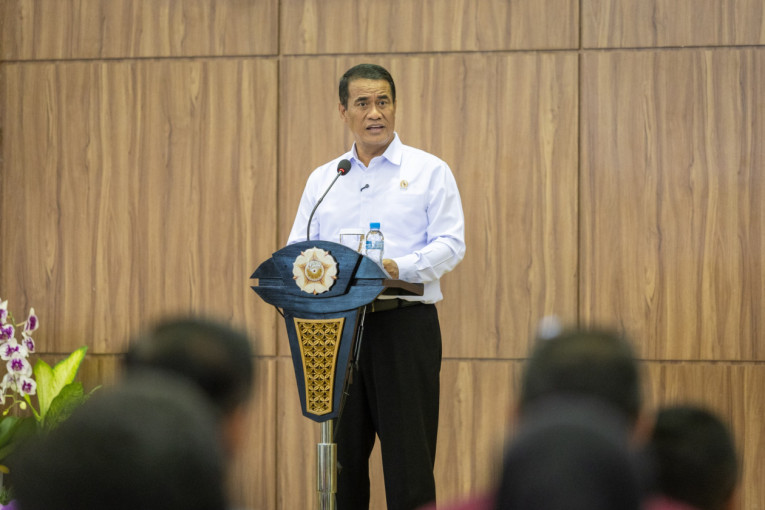
Indonesia’s Minister of Agriculture, Andi Amran Sulaiman, has called for stronger collaboration between the government and universities to accelerate sustainable food self-sufficiency. He made the statement during a public lecture at the Faculty of Agriculture, Universitas Gadjah Mada (Agriculture UGM), on Thursday (Oct. 15), titled “Prioritas Pembangunan Pertanian dan Strategi Pencapaian Swasembada Pangan Berkelanjutan” (Agricultural Development Priorities and Strategies for Achieving Sustainable Food Self-Sufficiency).
During the lecture, Amran outlined several national agricultural development priorities, ranging from increasing food commodity productivity and optimizing land use to advancing downstream processing. He also emphasized the role of universities in generating innovations and technologies that can be directly applied to address challenges in the agricultural sector.
The visit also followed up on Amran’s meeting with UGM at his private residence in June 2026. At the time, they discussed Gamagora rice and several promising commodities through research and development collaboration. During this visit, they again discussed commodity development, including soybeans and Gama cattle, which are expected to serve as models for other countries.
Amran expressed his appreciation for the collaboration established with UGM, particularly in agricultural commodity development. He considered increasing soybean productivity a strategic step toward reducing Indonesia’s dependence on imports. Therefore, existing development efforts need to continue until higher production targets are achieved.
“We are proud of UGM. Earlier, we saw the soybean demonstration plot. Thank you, Dean. The yield can reach three tons per hectare,” Amran said.
He also encouraged UGM to play a greater role in addressing Indonesia’s dependence on imports of several food commodities, including rice, soybeans, milk, and garlic. Amran specifically called for student involvement in soybean development, from research to field innovations. The government is ready to support these efforts by providing funding and guaranteeing purchase of the resulting produce.
“Let us work together. UGM should be the first to help Indonesia overcome its soybean dependency. We will provide the funding. Once you produce the soybeans, we will buy them and distribute them to farmers,” he said.
In addition to increasing food production, Amran outlined the government’s commitment to regulating land ownership and control and optimizing land use to support national food security. He said enforcement actions against problematic land control are part of efforts to safeguard the state’s interests. Such measures require courage because they involve the interests of various parties.
“Around four million hectares of oil palm plantations have been seized. That is no easy task,” he said.
Amran emphasized the need to act against legal violations in the agricultural sector without letting personal relationships influence law enforcement. Action against parties that harm the state must continue in the public interest.
At the same time, land optimization must be accompanied by direct field inspections and careful data collection to ensure that land is used in accordance with its legal status and designated purpose.
Some of the land being cultivated again had previously been cleared but was not being used productively. The government therefore needs to verify actual land conditions before deciding on its development.
“The land we are cultivating again is not forest land. It had already been cleared and had become overgrown with shrubs,” he explained.
In agricultural development, Amran also highlighted the need for policy continuity so that successful programs can be carried forward by subsequent administrations. Programs funded by the state, he said, should deliver long-term benefits and should not be discontinued simply because leadership changes.
He also stressed the importance of respecting community land ownership rights in land development. Data collection is necessary to verify ownership status and provide a basis for land-use planning. In this way, productivity improvements can go hand in hand with protecting community rights.
“This land belongs to the people, not the government. That is why we are collecting data to verify ownership,” he concluded.
Furthermore, Amran identified downstream processing as a key development priority for increasing the added value of agricultural and plantation commodities. The commodities receiving government attention include oil palm, coconut, and gambier.
Processing agricultural products into higher-value goods can create broader economic opportunities than selling raw materials.
In developing the coconut industry, the government has built several factories, including facilities in North Halmahera and Manokwari. Indonesia’s position as one of the world’s largest coconut producers presents an opportunity to strengthen domestic processing industries.
“If we process coconuts, their value can increase a hundredfold. We have already built several coconut processing factories because we are one of the largest coconut producers,” he said.
Speaking to students, Amran also shared his experience as a former agricultural extension worker to encourage younger generations to become directly involved in agricultural development. He emphasized perseverance in learning and facing challenges. Student involvement needs to be strengthened so that academic knowledge can be applied to address farmers’ needs and improve agricultural productivity.
As part of the government’s support for agricultural education and research, Amran pledged to provide UGM directly with research funding, research land, and facilities to support agricultural education. He also offered support facilities for agricultural extension workers and financial assistance toward the Single Tuition Fee (UKT) for one UGM student.
Meanwhile, UGM Secretary Dr. Andi Sandi Antonius Tabusassa Tonralipu emphasized the public lecture as a collaborative forum connecting academic studies with national agricultural development policies and strategies. The forum also creates opportunities to apply knowledge in the field while expanding research collaboration between universities and the government.
“On behalf of the university leadership, we welcome the organization of this public lecture. UGM has consistently sought to strengthen its research and innovation ecosystem, including by strengthening research institutions, developing facilities and infrastructure, and expanding research partnership networks,” he concluded.
Author: Zabrina Kumara
Editor: Gusti Grehenson
Post-editor: Jasmine Ferdian
Photo: Donnie