


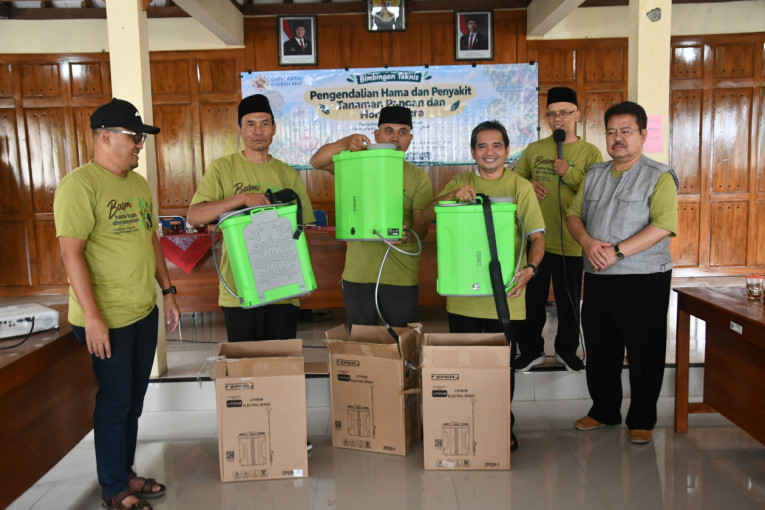
Universitas Gadjah Mada (UGM) has partnered with the National Research and Innovation Agency (BRIN) and the Natural Resources Conservation Agency (BKSDA) to help farmers in Gunungkidul Regency address crop pests, plant diseases, and wildlife disturbances. The collaboration took the form of a technical training session on pest and disease management in food crops and horticultural plants, held at Wunung Village Hall in Wonosari District on Saturday (Oct. 24).
Organized by the Organic Chemistry Laboratory, Department of Chemistry, Faculty of Mathematics and Natural Sciences (FMIPA UGM), the event was attended by farmers and growers from Wunung, Duwet, and Mulo villages. The program was part of UGM’s community service initiative under its Village Development Scheme, which aims to strengthen farmers’ capacity to address agricultural challenges.
Farmers in the three villages cultivate a variety of crops, including rice, corn, peanuts, chili peppers, shallots, and fruits such as avocados and mangoes. However, various pests and diseases threaten crop productivity, including leaf borers, stem borers, and rice neck blast disease.
Local communities also face disturbances from invasive small iguanas and long-tailed macaques (Macaca fascicularis), which damage agricultural crops and plantation produce. These challenges require appropriate management to control the damage while safeguarding public safety and environmental sustainability.
To help farmers identify and manage crop problems, the training featured Dr. Suputa, S.P., M.P., a pest management expert from UGM’s Faculty of Agriculture (Agriculture UGM), and Dr. Sri Wahyuni Budiarti, S.P., M.Si., a plant disease researcher from BRIN.
They provided training on pest and disease recognition, identifying infestation symptoms, and selecting prevention and control strategies based on crop characteristics and field conditions. Through the training, farmers are expected to detect problems early and determine appropriate management measures.
“Farmers need to understand the symptoms of pest infestations and plant diseases from the outset so they can determine control measures suited to the condition of their crops. Appropriate control measures are expected to reduce the risk of crop losses and maintain agricultural productivity,” Suputa said.
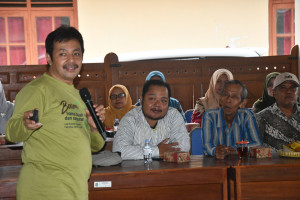
Long-tailed macaque disturbances received particular attention because addressing them involves crop protection, human safety, and wildlife conservation. To discuss the issue, the event featured Edi Warsito from the Gunungkidul regional office of the Yogyakarta Special Region Natural Resources Conservation Agency (BKSDA Yogyakarta).
He explained efforts to manage monkey populations, which have long challenged local communities. Addressing wildlife disturbances requires coordination among residents, village administrations, and the relevant authorities to ensure that measures comply with conservation regulations.
“Wildlife disturbances need to be addressed with consideration for both public safety and wildlife protection. Therefore, coordination among communities, village administrations, and relevant agencies is essential to finding appropriate solutions,” Edi explained.
Dr. Endang Astuti, M.Si., Head of the Organic Chemistry Laboratory, Department of Chemistry, FMIPA UGM, said the activity was part of an ongoing community service program in Wunung, Duwet, and Mulo villages.
The Village Development Scheme is designed to build relationships with local communities through activities that address their on-the-ground needs. University experts, researchers, conservation agencies, and village administrations are expected to provide communities with relevant knowledge and support to address agricultural challenges.
“We carry out this Village Development Scheme to strengthen community capacity and improve well-being through activities that address local needs. We hope the knowledge shared can be applied to help resolve agricultural and plantation-related problems in Wunung, Duwet, and Mulo,” Endang said.
As part of the initiative, the FMIPA UGM Organic Chemistry Laboratory also provided electric sprayers to representatives of Wunung, Duwet, and Mulo villages. The equipment supplements the technical training the community service program provides to farmers and growers. Through the Village Development Scheme, UGM seeks to connect academic knowledge with community needs to support more productive agricultural management.
Collaboration with BRIN, BKSDA, village administrations, and local communities is expected to lay the groundwork for appropriate and sustainable responses to agricultural challenges.
Author: Triya Andriyani
Post-editor: Zabrina Kumara
Photo: FMIPA UGM Documentation