


The Sanusa Team from the Faculty of Forestry, Universitas Gadjah Mada (Forestry UGM), won first place in the Business Plan Competition category at the 2026 Indonesian Forestry Student Olympiad (OMKI). The national-level competition was held from October 17 to 22, 2026, at the Faculty of Forestry and Environment, IPB University.
The Sanusa Team consists of Nafi’a Febia Rahma from the Department of Forest Resource Conservation, as well as Aditya Prayoga Setiawan and Muhammad Abdurrahman from the Department of Forest Management.
All members are from batch 2024 and collaborated to develop an idea for sustainable forest-based economic development through the utilization of environmental services.
Nafi’a Febia Rahma explained that the team presented a business plan entitled “Pemanfaatan Jasa Lingkungan untuk Ekonomi Kehutanan Berkelanjutan di Taman Nasional” (“Utilizing Environmental Services for Sustainable Forestry Economics in National Parks”).
Inspired by the potential of environmental services to generate economic value without compromising the ecological functions and sustainability of forest areas.
Developed as a pilot project in Kali Talang, within Mount Merapi National Park. Designed to develop an environmental services management model tailored to the area’s natural potential and specific needs.
“The proposed activities include ecotourism, biodiversity conservation, carbon trading, and the utilization of non-timber forest products with economic value,” she said on Monday (Nov. 16).
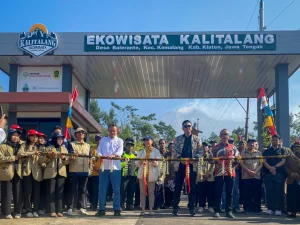
The Sanusa Team proposed a cross-sectoral approach that integrates environmental management, tourism, education, technology, and business.
“Through this approach, the utilization of environmental services is expected to offer an alternative for developing the local economy in communities surrounding forest areas while supporting conservation efforts,” she said.
Looking ahead, this concept can be further developed and implemented in 57 national parks across Indonesia. Adapted to the ecological characteristics, environmental service potential, and social and economic conditions of the communities in each area.
During the preparation process, the Sanusa Team faced several challenges, particularly amid each member’s academic commitments. Differences in departments and areas of specialization also brought diverse perspectives that needed to be reconciled when developing the business plan.
Nevertheless, these different academic backgrounds became a strength, enriching the team’s ideas and helping produce a more comprehensive proposal.
Through communication, coordination, and a clear division of responsibilities, the three team members worked to bring their respective perspectives together and develop an idea capable of competing at the national level.
“Cross-disciplinary collaboration was one of the key factors in developing our idea and ultimately winning first place,” she recalled.
For Rahma, the team’s achievement also demonstrates that forest management can be developed through economic approaches that remain focused on environmental sustainability.
The appropriate utilization of environmental services can not only generate added value for forest areas but also create opportunities to improve the well-being of surrounding communities.
Author: Adinda Putri Rahma
Editor: Gusti Grehenson
Post-editor: Jasmine Ferdian
Photos: Courtesy of the team and UGM Public Relations