


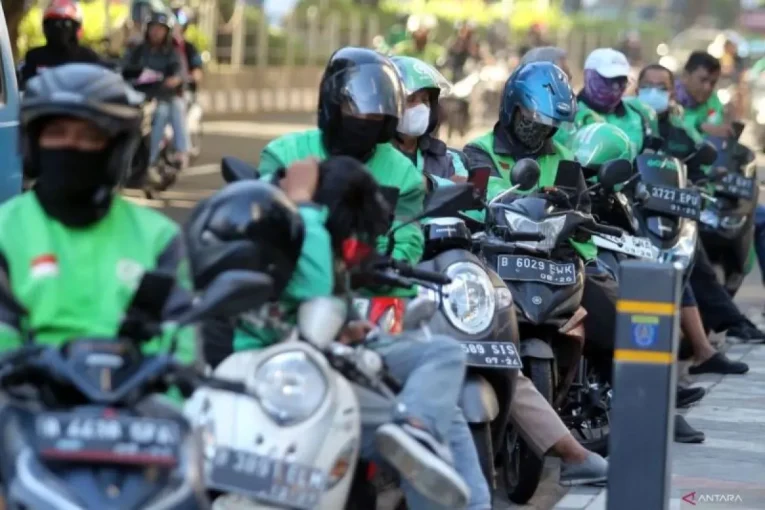
The policy reducing the platform fee, or the fee charged for using online motorcycle taxi applications, from 20% to a maximum of 8% took effect on July 1, 2026. The policy implements Presidential Regulation No. 27 of 2026 on the Protection of Online Transportation Workers, announced by the president on May 1, 2026, during International Workers’ Day commemorations. To assess the policy implementation, two researchers from the Department of Civil and Environmental Engineering at the Faculty of Engineering, Universitas Gadjah Mada (FT UGM), Professor Danang Parikesit and Dr. M. Rizka Fahmi Amrozi, conducted a study examining its impact on the welfare of partner ride-hailing drivers in five major cities.
The survey, conducted from September 8 to October 2, 2026, involved 2,120 respondents, comprising 1,040 driver partners and 1,080 customers across five cities: Jakarta (33.3%), Yogyakarta (18.8%), Makassar (14.8%), Bandung (15.7%), and Surabaya (14.7%). Cochran’s sampling method was used for both driver and customer respondents, with a 95% confidence level and a 5% margin of error.
The respondents represented five service segments: online motorcycle taxis, online taxis, food delivery, and two-wheeled and four-wheeled delivery services. Among the ride-hailing drivers surveyed, most used GoRide (44%) and GrabBike (38%).
Rizka explained that findings from the online motorcycle taxi segment, which included 249 drivers, showed that most full-time drivers (75%) relied on online transportation platforms as their primary source of livelihood rather than as a side job. Their work intensity was high: 52% worked 8–10 hours per day, 55% completed 11–15 orders, and their travel distances ranged from 31 to 90 kilometers.
“The study also shows that fuel is the largest daily expense, followed by vehicle maintenance costs, which are unpredictable but unavoidable,” Rizka said in a statement sent on Wednesday (Oct. 14).
He highlighted the projected monthly financial balance as a key finding. For drivers working 8–10 hours per day, the reported gross daily income range was Rp150,000–Rp250,000, resulting in estimated monthly gross earnings of Rp3.6 million–Rp6 million based on 24 working days.
After deducting daily operating costs and setting aside funds for vehicle maintenance, ride-hailing drivers’ net monthly income was estimated at Rp2.4 million–Rp4.8 million. Monthly expenses ranged from Rp1.2 million to Rp3.2 million, depending on the number of working days and unexpected costs.
For online motorcycle taxi drivers who rent or finance their vehicles at Rp1.2 million per month, estimated net income falls to Rp1.35 million–Rp3.75 million per month. This is equivalent to only 24–65% of Jakarta’s provincial minimum wage of Rp5,729,876 per month.
“These findings show that vehicle ownership or usage costs must be taken into account when calculating drivers’ net income. Under this scenario, their earnings remain below Jakarta’s minimum wage,” he said.
The findings indicate that daily and periodic operating expenses, including fuel, meals, servicing, spare parts, and vehicle rentals, continue to erode drivers’ earnings, leaving little room for savings or independently funded social protection.
“Ultimately, welfare is not about how much money people earn, but how much they have left to support their families and secure a decent future,” he explained.
Meanwhile, Danang said the initial evaluation of the 8% policy showed a positive response from driver partners, although its benefits had yet to translate into tangible improvements in their welfare. 62% of drivers agreed or strongly agreed with reducing the platform fee to 8%.
“In terms of gross income, the survey found that 52% of drivers reported no significant change, 27% experienced a slight increase, and 18% reported a decline,” he said.
Across the five surveyed cities, most drivers welcomed the 8% policy, but operating costs not covered by the regulation absorbed much of its potential benefit. Higher gross earnings do not automatically improve driver welfare when fuel, servicing, and spare parts continue to reduce take-home income.
“This research is not intended to undermine an existing policy, but to ensure that the government continues to monitor and improve regulations while balancing the welfare of driver partners, the benefits to service users, and the sustainability of investment and innovation in digital transportation services,” Danang said.
Author: Jesi
Editor: Gusti Grehenson
Post-editor: Jasmine Ferdian
Photo: Antara