



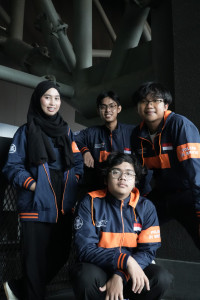
Four students of the Gadjah Mada Aerospace Team (GMAT) have been selected to participate in the Fellowship Programme for Drop Tower Experiment Series (DropTES), a research program investigating very low-gravity conditions. Organized by the United Nations Office for Outer Space Affairs (UNOOSA) in collaboration with the Center of Applied Space Technology and Microgravity (ZARM) at the University of Bremen, Germany.
Through this program, the UGM Gadjah Mada Aerospace Team (GMAT) will investigate how water moves between silica sand grains when the sand is subjected to vibration under microgravity conditions. The experiment is scheduled to take place at the Bremen Drop Tower in Germany in February 2027.
The GMAT team’s research is titled “Experimental Investigation of Moisture Redistribution in Partially Saturated Granular Media under Mechanical Excitation in Microgravity.” In brief, the study aims to determine how water moves and spreads between sand grains when the sand is vibrated under conditions of near-zero gravity. This allows researchers to study water movement without the gravitational influence normally experienced on Earth.
GMAT team member Rendy Dwi Nugraha explained that the team’s interest in space exploration sparked the research idea. Understanding how materials such as sand and water behave beyond Earth is important for supporting various space exploration activities.
“We have been following various space exploration missions, including the Artemis program, which seeks to support exploration beyond Earth. Based on previous studies, we identified aspects that could be further investigated through microgravity experiments. We want to understand how these materials behave under conditions that differ from Earth’s gravity,” Rendy said in an interview on Monday (Oct. 19).
In this study, the GMAT team will use silica sand to investigate how water moves between sand grains under vibration in microgravity, where the effects of gravity are greatly reduced.
“We chose silica sand because it can serve as a model for materials such as regolith found on the Moon and Mars. From there, we want to observe how water distribution changes when the sand is vibrated under microgravity conditions,” Rendy said.
Rendy explained that the team had designed a box-shaped experimental apparatus divided into three compartments. Each compartment will contain silica sand at different moisture contents: 5%, 10%, and 15%.
“The three samples will then be vibrated using a specialized device to observe how water spreads between the sand grains,” he explained.
During the experiment, a high-speed camera will record changes in the sand. The footage will then be used to observe water movement in each sample and understand how its behavior differs when gravitational effects are reduced.
The experiment will take place at the Bremen Drop Tower in Germany, which enables the team to conduct tests under microgravity conditions. One of the main challenges is ensuring that all components of the apparatus, from the vibration system to the camera, operate simultaneously within a very short period of approximately 9.3 seconds.
“Given this challenge, we need to ensure that every component works properly before the experiment begins. We hope the data obtained will provide a foundation for further research supporting lunar and Martian exploration, including studies of the potential use of water and materials in space environments,” he said.
GMAT’s involvement in the DropTES program grew out of the research and development activities. GMAT is a UGM student community focused on aerospace activities, including research, engineering, and participation in international competitions and space-sector programs.
“Since the beginning of the year, we have been looking for international programs and competitions relevant to our field. We considered several factors, including participant eligibility and the support offered by the organizers. During this search, we discovered the program run by UNOOSA in collaboration with ZARM and began developing an experimental concept that could be carried out under microgravity conditions,” Rendy said.
The proposal submission process began around April 2026. At the initial stage, the team developed a research framework and submitted an experimental concept for evaluation by the organizers. The proposal later received technical feedback the team needed to address before resubmitting.
“The proposal we submitted did not proceed directly to the announcement stage. It went through an evaluation process and technical meetings to discuss aspects that needed improvement, ranging from the research variables and experimental concept to its contribution to the Sustainable Development Goals (SDGs),” Rendy explained.
After making revisions, the team resubmitted the improved proposal. In September 2026, GMAT received confirmation that it had been selected as one of the teams to conduct an experiment in Germany.
The GMAT team comprises four students from different academic disciplines. The team includes Alessander Aritonang (Nuclear Engineering) as team leader, Rendy Dwi Nugraha (Agricultural Engineering), Idam Sholikhah (Instrumentation and Control Engineering Technology), and Muhammad Riza Cetta Oegama (Engineering Physics).
Their diverse academic backgrounds are one of the team’s strengths in designing the experiment. The research requires not only an understanding of material properties and moisture content but also mechanical structure design, electronic system development, sensor integration, device programming, and data processing.
Rendy explained that his involvement as an Agricultural Engineering student stems from his interest in the potential development of agriculture in space. Knowledge of soil, land resources, and water can help determine research variables that align with the experiment’s objectives.
“Although we come from different academic disciplines, we complement one another. Some of us focus on mechanical aspects, others handle electronics and instrumentation, and others contribute to writing and data processing. We discuss things together and help one another whenever something is not yet clear,” he said.
The GMAT team is currently finalizing its experimental apparatus and preparing for its trip to Germany. The team plans initial testing at UGM in late November or December 2026 to ensure the apparatus functions properly and meets safety standards.
“We aim to have the apparatus ready for preliminary testing at UGM by late November or December. Meanwhile, we are also preparing travel documents and visas for the trip. We have received an invitation letter from the organizers, and further coordination regarding travel arrangements will follow,” Rendy said.
After the experiment, the team hopes to process the resulting data into a scientific publication. The findings are expected to serve not merely as an achievement in participating in an international program but also as a foundation for further research.
“We hope this research will contribute to the advancement of aerospace science. We also want to show other students that opportunities to learn about space exploration are not limited by their academic backgrounds. With a willingness to learn and collaborate, people from different disciplines can all contribute,” Rendy concluded.
Author: M. Aidil Syahputra
Editor: Gusti Grehenson
Post-editor: Jasmine Ferdian
Photos: Magnific, GMAT Team