


Wolbachia technology has proven effective in helping control dengue. Universitas Gadjah Mada (UGM) is launching the SHIELD Project to support its expansion across Indonesia.
Indonesia continues to face a high burden of dengue. In 2025, Indonesia ranked second globally in the number of dengue-related deaths, recording 703 fatalities, or approximately 17% of all dengue deaths worldwide. This situation has driven more effective, sustainable dengue control strategies, including implementing Wolbachia technology.
“The high burden of dengue in Indonesia is one of the reasons behind the implementation of Wolbachia technology in five cities,” said Dr. Fadjar Surya M. Silalahi, Head of the Zoonotic Vector-Borne Diseases, Venomous Animal Bites, and Poisonous Plants Working Team at the Indonesian Ministry of Health, in a statement sent to journalists on Tuesday (Nov. 3).
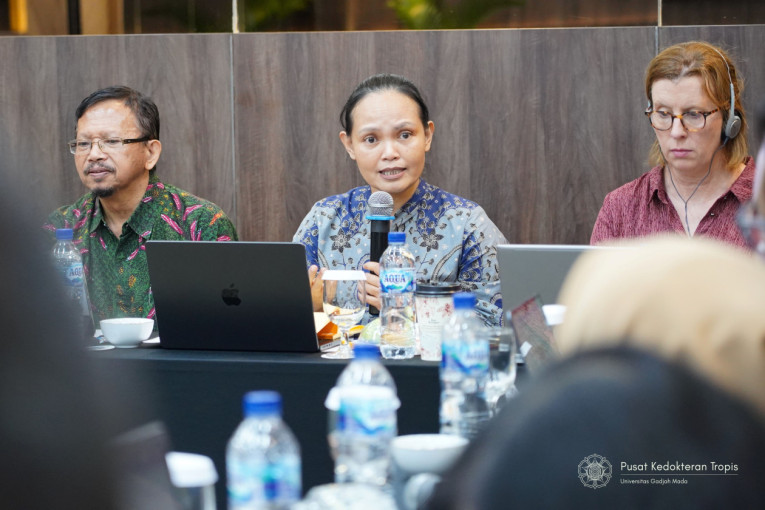
During the kick-off meeting of the Scaling Health Interventions for Effective Long-term Dengue Control (SHIELD) Project, initiated by UGM’s Center for Tropical Medicine (PKT UGM), Fadjar explained that the implementation of Wolbachia technology was based on research findings in Yogyakarta, which showed a 77% reduction in dengue incidence and an 86% decrease in hospitalization rates. He also presented positive results from its implementation in Semarang.
“A downward trend in dengue cases has been recorded alongside a stable proportion of Wolbachia-carrying mosquitoes exceeding 60%,” he added.

Evidence of Wolbachia’s effectiveness extends beyond the initial research findings in Yogyakarta. Katie Anders, Ph.D., from Monash University and Assistant to the SHIELD Project’s Principal Investigator, explained that Wolbachia implementation reduced dengue transmission in Yogyakarta for up to seven years after the release of Wolbachia-carrying mosquitoes.
“This is supported by monitoring results from 2023–2024, which showed that the proportion of Wolbachia in the Aedes aegypti mosquito population had reached 89%,” Katie explained.
During the five years following the full-scale implementation of Wolbachia in Yogyakarta, dengue incidence was recorded at 76% lower than in other cities across Java with different interventions. Nevertheless, Wolbachia does not completely eliminate the risk of dengue transmission.
“Therefore, its implementation must remain part of an integrated dengue control strategy, alongside other prevention and control measures,” she said.
Against this background, the SHIELD Project was designed to better understand how Wolbachia implementation can be effective and sustainable across different regional contexts.

SHIELD Project Principal Investigator and UGM Center for Tropical Medicine researcher Dr. Citra Indriani explained that the study builds on Indonesia’s long-standing development of Wolbachia technology.
“Through SHIELD, we aim to draw lessons from implementation in five cities as a basis for developing strategies to expand Wolbachia deployment at both the national and global levels,” Citra said.
To achieve these objectives, SHIELD operates through four complementary working groups: Implementation Research, Entomology, Epidemiology, and Modeling. The Implementation Research Working Group focuses on identifying factors that facilitate or hinder Wolbachia implementation, as well as the key components that determine its success.

Meanwhile, the Entomology Working Group examines factors that influence Wolbachia’s success and sustainability in mosquito populations, including the intervention’s resilience under extreme heat.
The Epidemiology Working Group evaluates incorporating Wolbachia into dengue control programs and its impact on dengue transmission and public health across regions with different characteristics.
On the other hand, the Modeling Working Group conducts cost-benefit analyses and develops scenarios for integrating Wolbachia with other dengue control strategies, including vaccination, to maximize public health benefits and support policymaking.
Through this cross-disciplinary collaboration, SHIELD is expected to generate insights that not only strengthen the scientific evidence on Wolbachia but also support planning and policymaking for its broader implementation.
“We hope this project will produce findings that can be used to strengthen policies for expanding Wolbachia implementation in Indonesia,” Citra said.
Author: Agito Sitepu
Editor: Gusti Grehenson
Post-editor: Jasmine Ferdian
Photos: Center for Tropical Medicine, UGM