


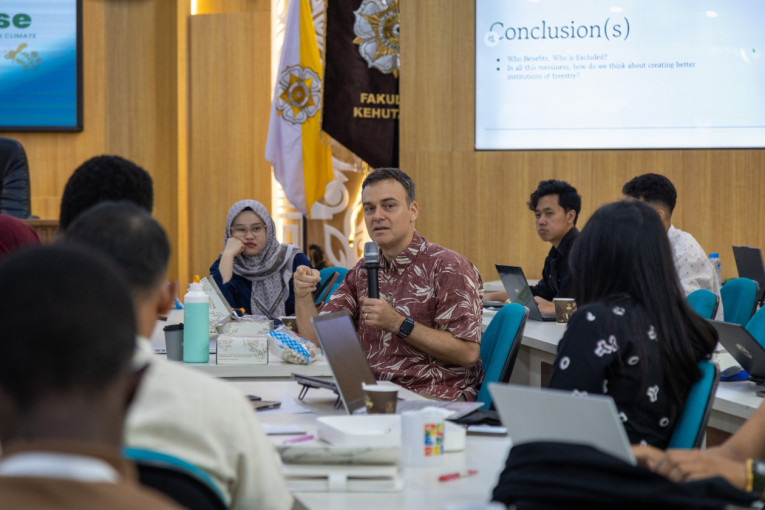
To strengthen international collaboration and deepen understanding of sustainable forest management, the Faculty of Forestry at Universitas Gadjah Mada (Forestry UGM) is hosting the 10th International Forestry Summer Course (FSC) from July 7 to 20. The program brings together 12 international lecturers, 10 Indonesian lecturers, and professionals from universities, research institutions, and organizations in the forestry and environmental fields. This year’s course welcomes students and academics from 22 countries across Asia, Africa, Europe, and the Americas.
Dr. Ni Putu Diana Mahayani, coordinator of the Forestry Summer Course, thanked participants for their enthusiasm throughout the online sessions and welcomed all international participants to Yogyakarta.
“This program is designed to enrich participants’ learning experiences through direct interaction, cross-cultural discussions, and stronger academic collaboration in the field of forestry,” said Dr. Mahayani on Friday (July 17).
On the opening day, the course featured three public lectures on ecosystems and the environment. The morning session began with Dr. Hatma Suryatmojo, who presented “The Tropical Forest & the Water Cycle: Managing Watershed Health, from Raindrop Mechanics to Landscape-Scale Resilience.” He highlighted the vital role of tropical forests in maintaining watershed health and regulating the water cycle, noting that healthy forest cover softens the impact of rainfall, improves water infiltration, and helps prevent floods and droughts — making forest degradation a serious threat to hydrological balance.
“Various case studies in Indonesia have shown that forest degradation can alter a landscape’s hydrological balance, increasing the risks of flooding, sedimentation, and drought,” he said.
Next, Associate Professor Maria Lourdes T. Lardizabal of Universiti Malaysia Sabah delivered a talk titled “Six-Legged Indicators: How Climate Change Reshapes Forest Insect Communities and the Services They Provide.” She discussed how climate change affects forest insect communities, explaining that insects are highly sensitive bioindicators of shifts in temperature and weather. When climate anomalies disrupt insect populations, she said, essential ecosystem services — including pollination, nutrient cycling, and natural pest control — are put at risk.
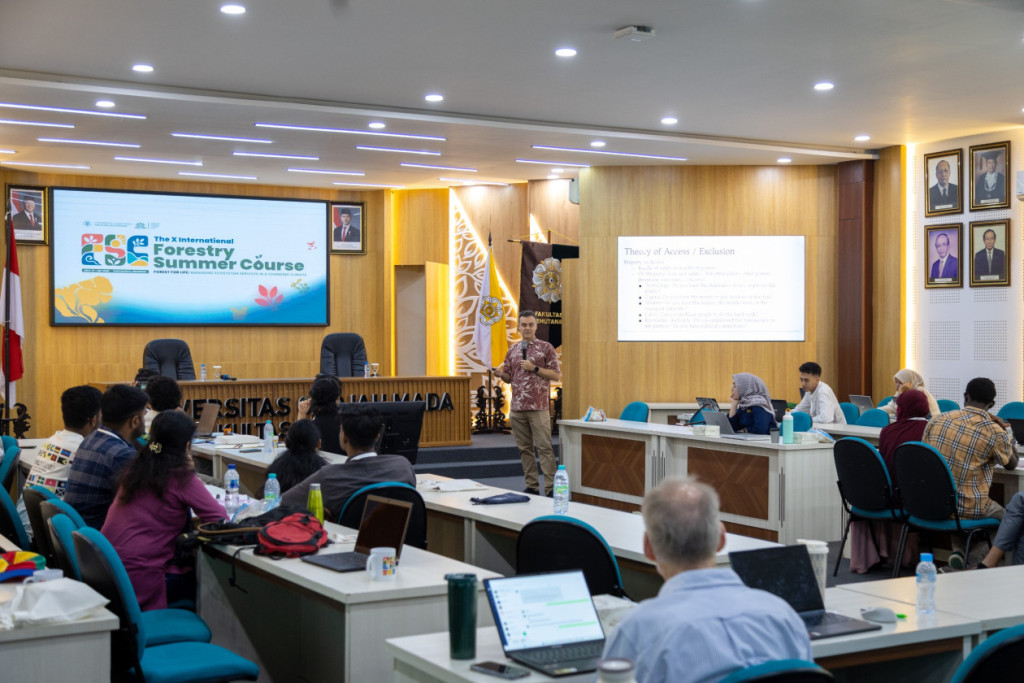
In the afternoon, Professor Digby Race of The Australian National University closed the first day with a lecture on ecosystem services in agroforestry. Agroforestry, he explained, not only produces economically valuable commodities such as food and timber but also contributes significantly to carbon storage and biodiversity. He called for management approaches that balance social and environmental benefits and are supported by policy instruments such as Payment for Ecosystem Services (PES) to promote sustainable landscapes.
On the second day, Wednesday (July 15), Dr. Micah R. Fisher of the University of Hawaiʻi at Mānoa presented “Community-Based Forest Management: Highlighting Successful Models of Local Stewardship.” He underscored the role of local communities in conserving forests. He challenged the long-standing assumption of the Tragedy of the Commons, which has often been used to justify unilateral state control over land-management rights. Forest degradation and deforestation in regions such as Kalimantan and Sulawesi, he argued, are driven primarily by global capital, unequal access to technology, and international market demand — particularly for palm oil — rather than by Indigenous or local communities.
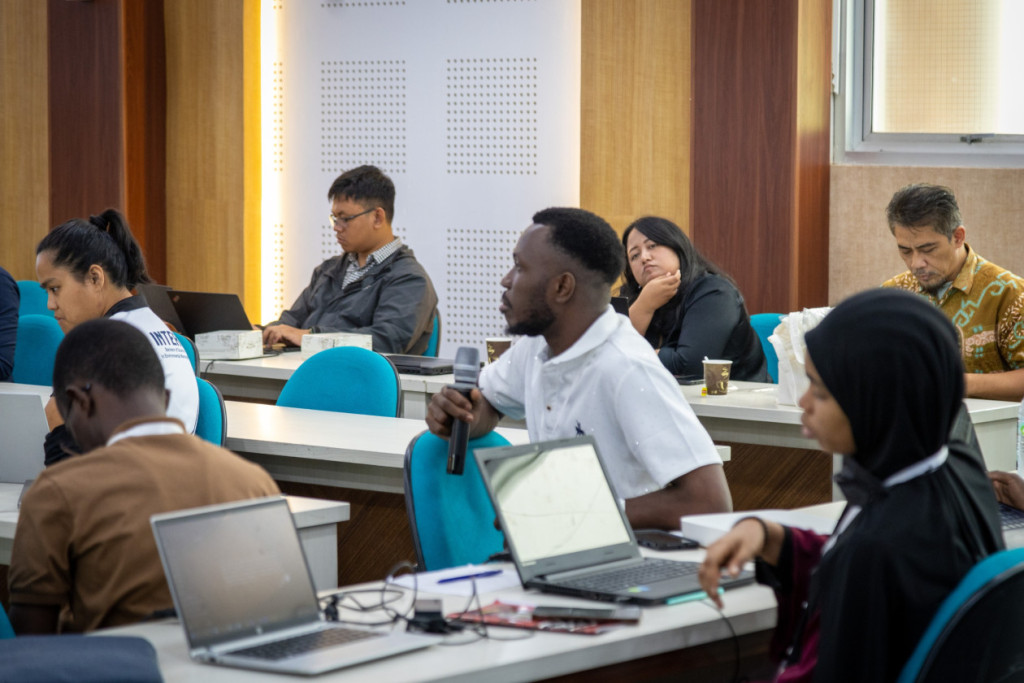
Drawing on the principles of communal resource management developed by Nobel laureate Elinor Ostrom, Dr. Fisher urged academics and policymakers to evaluate environmental regulations by asking a critical question: who benefits, and who is excluded? Conservation initiatives such as Social Forestry, he said, should genuinely empower the local communities that have protected forests for centuries.
“From the perspective of political ecology, the greatest drivers of environmental degradation are global market demand, such as for palm oil, and international investment. The expansion of large-scale industries often forces local communities onto increasingly limited land. Therefore, it is unfair to blame local communities without recognizing the major actors behind environmental destruction,” he explained.
The program continued with Dr. Dwi Laraswati of UGM, who delivered a lecture titled “Gender in Forestry and Climate Change.” She discussed gender equality in managing scarce natural resources, distinguishing sex, a biological characteristic, from gender, a sociocultural construct — a distinction, she said, that is crucial to preventing inequality in community roles. Because cultural norms often limit women’s participation in community decision-making, she stressed that inclusive governance is essential to address exclusion in its many forms, from socioeconomic discrimination to geographic barriers.
“Gender roles also change from one generation to another. Therefore, they are closely linked to national and cultural contexts, as well as socioeconomic conditions and political rights,” she explained.
An ideal approach to natural resource management, Dr. Dwi added, should not stop at equality, which distributes resources evenly, but should pursue equity by accommodating the specific needs of different groups.
Author: Leony
Editor: Gusti Grehenson
Post-Editor: Priyanandaningrat
Photo: Donnie