


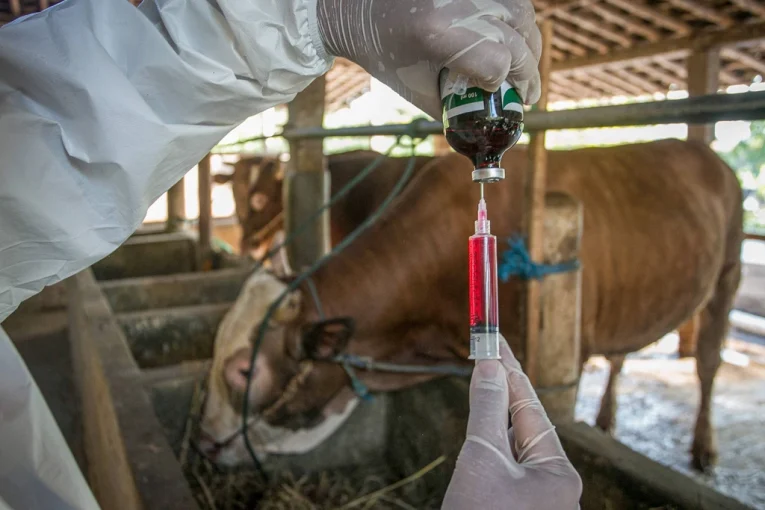
The brandu tradition involves collecting money from the community to help livestock farmers whose animals have become ill or died. Farmers who receive this assistance then slaughter their dead livestock and distribute the meat among locals. It originally stemmed from strong solidarity and cooperation among locals. However, brandu can also become a major route of anthrax transmission from animals to humans, as occurred in Gunungkidul Regency in September.
Gunungkidul Health Office reported that four patients who had previously tested positive for anthrax had recovered after receiving intensive medical care. Earlier, seven people in Semanu Village, Gunungkidul, had been identified as suspected cases after coming into contact with livestock that had become ill and died suddenly.
Professor Widagdo Sri Nugroho of the Department of Veterinary Public Health at UGM’s Faculty of Veterinary Medicine (FKH UGM) explained that the brandu tradition reflects social concern and the spirit of cooperation in helping livestock owners who have suffered losses. In local communities, livestock are also regarded as rojokoyo, or valuable economic assets. However, when livestock die from anthrax, slaughtering, skinning, distributing, and consuming their meat can expose the community to infection.
“The concept behind brandu is good because it helps ease the burden on people whose livestock, or rojokoyo, have died. It is a way of helping one another and practicing cooperation. However, in anthrax cases, the community also bears the risk,” he explained on Monday (Oct. 12).
Widagdo explained that anthrax is caused by the bacterium Bacillus anthracis, which can form spores when exposed to air or oxygen. These spores can survive in the environment for decades, meaning that areas with a history of anthrax cases may face similar problems again.
Anthrax can be transmitted to humans through three routes: the skin, respiratory tract, and digestive tract. Skin infection can occur when the bacteria enter through wounds, including tiny cuts that may not be visible. People who slaughter or skin infected livestock face this risk because they may come into contact with the bacteria while handling the carcasses.
“The first route is through broken skin. Even microscopic lesions that are not visible can allow the bacteria to enter and cause a wound at the site of infection. This is what we call cutaneous anthrax,” he explained.
Meanwhile, transmission through the digestive tract can occur when someone consumes meat from an infected animal. Common cooking methods cannot guarantee that anthrax spores have been destroyed.
“This means that the brandu tradition, when practiced with livestock infected with anthrax, can become a route of anthrax transmission to humans,” he said.
Anthrax Control
Anthrax cases in Gunungkidul remain a shared challenge because they recur almost every year. Although the number of people affected may vary, each occurrence highlights the need for public education and preventive measures.
“In Gunungkidul, controlling anthrax remains a shared responsibility, particularly to ensure that the disease is no longer transmitted to humans,” Widagdo said.
From an animal health perspective, intensive vaccination efforts have been carried out. However, continued monitoring is necessary, particularly for livestock brought in from other regions and newborn animals that have not yet been vaccinated. Residents should promptly report livestock that have not received vaccinations so that authorities can take appropriate action.
“When it comes to animals, vaccination is the key,” he explained.
Widagdo also emphasized preparing for seasonal transitions, which can increase the risk of new cases. Livestock vaccination should be planned several months before the change of seasons, alongside ongoing public education through collaboration between the animal and human health sectors.
As part of broader control efforts, FKH UGM plans to contribute through veterinary health services. Collaboration with UGM’s Faculty of Medicine, Public Health, and Nursing (FK-KMK UGM), particularly in public outreach, raising community awareness, and strengthening the role of community health centers (puskesmas).
Education takes time and requires an appropriate approach to change public understanding and habits. While livestock farmers have traditionally been a primary target, future initiatives also plan to reach women, adolescents, and children so awareness of animal disease risks can be fostered from an early age.
“Until now, our efforts have mainly targeted livestock farmers. I believe the next groups we need to reach are younger generations and women in particular. That is the direction we are planning to take,” he said.
The spirit of cooperation underlying brandu can be preserved while prioritizing public safety. Solidarity can still be expressed in ways that do not increase the risk of disease transmission from animals to humans.
“We should continue to uphold cooperation, but when it comes to animal diseases that pose risks like these, people must find ways to help one another while avoiding exposure,” he said.
Livestock Movement and Economic Factors
From a human health perspective, Riris Andono, Ph.D., a lecturer in the Department of Biostatistics, Epidemiology, and Population Health at FK-KMK UGM, explained that anthrax is a zoonotic disease caused by the bacterium Bacillus anthracis. The clinical manifestations in humans depend on the route of transmission: through the skin, digestive tract, or respiratory tract. Cutaneous anthrax can cause serious skin lesions, while gastrointestinal and inhalational anthrax carry a higher risk of death.
“The latter two forms have high fatality rates. Cutaneous anthrax has a lower fatality rate than intestinal or respiratory anthrax, but its clinical manifestations, particularly the skin lesions, can be quite severe,” he explained.
A researcher at UGM’s Center for Tropical Medicine (PKT UGM), the recurrence of anthrax cases in Gunungkidul is associated with several factors, including livestock movement between regions, farmers’ economic circumstances, and the presence of spores in contaminated environments.
Gunungkidul is part of a livestock trading route that includes animals originating from East Java and Pacitan. Moving livestock from endemic areas can increase the risk of spreading anthrax to other regions if adequate monitoring is not in place.
“One clear factor is livestock movement. Livestock are traded, and Gunungkidul is part of a livestock trading route,” she said.
It is important for livestock authorities to monitor animal transportation. Livestock traded between regions must be accompanied by health certificates in accordance with applicable regulations. If a case is detected, authorities should also restrict the movement of livestock into and out of affected areas to reduce the risk of further spread.
Besides livestock movement, economic circumstances can influence how people respond when their animals become ill or die. For farmers, livestock represent both an investment and a store of wealth. When an animal becomes sick or dies, its owner may try to minimize financial losses by selling it at a low price or distributing its meat to neighbors.
“In Javanese culture, livestock are known as rojokoyo. The term reflects their role as a form of savings or stored wealth,” Riris explained.
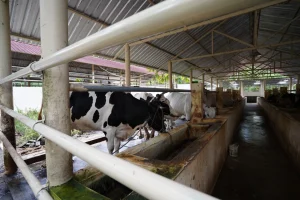
Economic interventions could also help prevent losses. Gunungkidul previously implemented livestock insurance to help farmers cope with financial losses. With compensation provided under the terms of an insurance policy, farmers would be less likely to sell or distribute meat from infected animals to recover their losses.
Another challenge is the persistence of anthrax spores in the environment. Contaminated areas require special treatment. However, evacuating people from or clearing contaminated areas is difficult in Indonesia because residents continue to live and carry out their daily activities there. Therefore, procedures for handling infected animal carcasses, burying them, and decontaminating the surrounding environment must be properly implemented to control the risk of exposure.
Recognizing Symptoms and Taking Precautions Before Contact
To prevent transmission to humans, it is important to recognize anthrax symptoms in animals and use protective equipment when handling livestock suspected of infection. Members of the public, particularly farmers and livestock owners, need to understand the signs of the disease so they can take preventive measures before potentially hazardous contact occurs.
“People, especially farmers, should understand the symptoms of anthrax. If they suspect that their livestock have anthrax, they should use protective equipment,” he explained.
Contact with an infected animal does not automatically mean that a person will contract the disease, although the risk of infection can be very high. The risk depends on whether exposure to the spores actually occurs, while the severity of the disease is also influenced by the level of exposure.
“I am not saying that infection is automatic, but the likelihood can be high. Sometimes, when we come into contact with an animal infected with anthrax, we do not know whether that contact has exposed our bodies to the spores. So we cannot say that infection is inevitable, but the risk is very high,” Riris explained.
For this reason, wearing protective equipment before handling an animal suspected of being infected should take priority over relying solely on measures taken after contact has occurred.
“If we know that an animal has anthrax, we should wear protective equipment. We should not make contact first and then rely on washing our hands and taking other measures afterward,” he said.
An integrated approach to animal and human health is essential for controlling anthrax. This requires monitoring livestock movement, vaccination, proper management of contaminated environments, economic protection for farmers, and public education. Cross-sector collaboration is key to reducing recurrent cases and preventing anthrax transmission to humans.
Author: Zabrina Kumara
Editor: Gusti Grehenson
Post-editor: Jasmine Ferdian
Photos: Antara, UGM Public Relations