


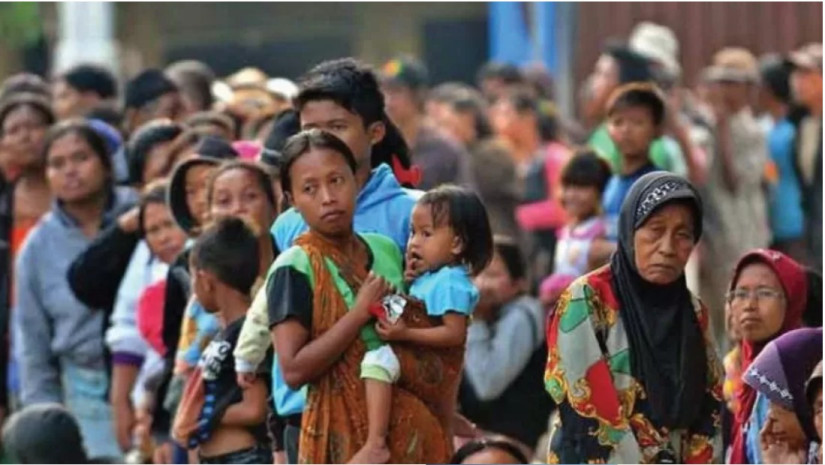
The National Institute of Public Administration (LAN) has released a blueprint outlining the institutional design for poverty alleviation and the elimination of extreme poverty, in line with Presidential Instruction (Inpres) No. 8 of 2025. The initiative aims to reduce extreme poverty in Indonesia to zero percent by 2026.
It states that one of the key strategies emphasized is shifting from the distribution of social assistance to social empowerment. Continuous provision of social assistance without empowerment, it notes, risks perpetuating structural poverty.
Responding to the initiative, a lecturer in Social Development and Welfare (PsDK) at the Faculty of Social and Political Sciences of Universitas Gadjah Mada (Fisipol UGM), Nurhadi, Ph.D., said that the issuance of this blueprint indicates that the Presidential Instruction is being implemented and followed up by various government institutions, ministries, and agencies. However, he concluded that publishing a blueprint alone is insufficient; strong political and administrative commitment from development implementers is required to ensure effective execution.
Nevertheless, Nurhadi appreciated the shift in the fundamental paradigm from administrative delivery to outcome-based orchestration.
“I believe the spirit is positive, because previous poverty alleviation strategies tended to focus on social assistance distribution, cross-ministerial administrative compliance, budget absorption, and program outputs,” he said on Sunday (Mar. 1).
He emphasized the need for orchestration through collaboration among various parties within a unified and mutually supportive framework. Orchestration, he added, requires measurable outcomes, complementary interventions, and cross-sector impact-based monitoring.
Nurhadi explained that the blueprint signals a paradigm shift. Whereas success was previously measured by the amount of assistance distributed, the number of beneficiaries, and the accuracy of administrative reporting, the focus has now shifted to how many families genuinely escape poverty, avoid falling back into poverty, and ultimately achieve economic independence.
Furthermore, Nurhadi highlighted that for this approach to function effectively, cross-sector outcome indicators must be agreed upon collectively. Graduation measures may vary across institutions and programs.
“Therefore, cross-sector outcome indicators must be jointly agreed upon because we are moving toward addressing multidimensional poverty,” he said.
Nurhadi stressed the need for reform in results-based planning and budgeting systems, as orchestration cannot operate in isolation. Equally important is data integration that enables dynamic tracking of families. He underscored that data integration remains a crucial issue. In addition, local governments must be involved in policymaking.
The challenge, however, lies in ensuring that all policy instruments from data and budgeting to monitoring are genuinely directed toward outcomes, namely sustainable graduation rather than mere administrative reporting.
Regarding graduation strategies, he explained that previous policy periods applied three approaches: reducing expenditures, increasing income, and eliminating pockets of extreme poverty.
“All three require different strategies, but they must be integrated,” he said.
Nurhadi also shared insights from his visit to the Bangladesh Rural Advancement Committee (BRAC) in Bangladesh. The organization developed a graduation approach by implementing five pillars of poverty alleviation, including targeting, coaching and mentoring (training and assistance), asset transfers (business capital support), and graduation itself. All five components form a comprehensive package, although assistance is tailored based on assessment results.
“If at a certain stage they no longer need expenditure-reduction support, then further assistance is unnecessary,” he explained.
According to Nurhadi, effective empowerment requires accurate targeting through a unified data system and comprehensive interventions. Assessments must be conducted regularly to determine when one phase should end and another continue. This approach aims to prevent communities from feeling entitled to social assistance, which may foster dependency.
“We must avoid the perception that ‘I am poor, so it is unfair if I am not assisted.’ That kind of mentality needs to change,” he cautioned.
Nurhadi added that efforts to eradicate extreme poverty must involve cross-sector and multi-actor collaboration. The government cannot work alone due to limited resources, while poverty remains a complex issue.
“Beyond the government, there are corporations with CSR funds and communities with significant resources. These are substantial assets to accelerate progress,” he concluded.
He also warned against policy centralization, even though responsibility now lies directly with the President.
“Over-centralization will expand bureaucracy, hinder coordination, and potentially suppress local-level innovations and initiatives that have been working effectively,” he advised.
Author: Leony
Editor: Gusti Grehenson
Post-editor: Jasmine Ferdian
Photo: DKI Jakarta Provincial Government