


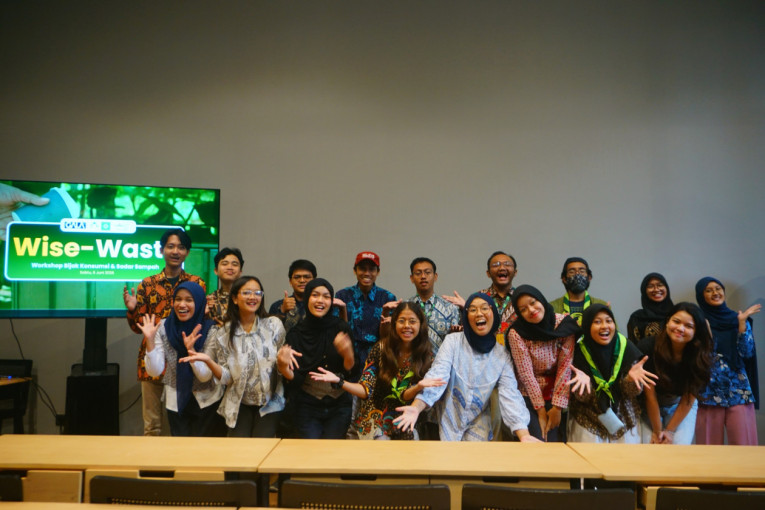
UGM students have responded to the waste management crisis by compiling a database of waste banks across Yogyakarta. The initiative received direct support from the Gelanggang Inovasi dan Kreativitas (GIK UGM) through funding incentives and leadership character development programs. One of the initiatives that emerged from this support is DaurKita, a platform that stores a database of waste banks in Yogyakarta to improve public access to waste collection facilities. The DaurKita team introduced the initiative during the “Workshop Bijak Mengelola Sampah” (Wise Waste Management Workshop) held in collaboration with Lokalogi by UGM Scout Movement on Saturday (Jun. 6).
Daurkita’s teams, awarded funding through the GIK Advanced Leadership Arena (GALA), invited Lokalogi to introduce alternative lifestyle practices relevant to the current waste management crisis. Designed by students for students, DaurKita, a team of 12, launched a website featuring a directory of waste banks in Yogyakarta and the surrounding areas. Under the Digital Waste Bank concept, DaurKita currently provides information on 18 partner waste banks across six districts.
“There are four types of waste that can be managed by DaurKita partners: organic, inorganic, hazardous and toxic waste (B3), and residual waste. We hope DaurKita can bridge UGM students with the nearest waste management facilities. In this way, barriers related to access and information can be reduced,” said Project Officer Jeffryta Nasya Sanjaya.
In addition to introducing participants to the DaurKita platform and its partner directory, the event provided a waste management framework presented by Lokalogi. Established by the UGM Scout Movement in 2024, Lokalogi has consistently supported waste management efforts at major student events, including Pionir, Gelex, Porsenigama, Culfest, and various annual concerts. Through these activities, Lokalogi collects data on waste generated by visitors after it has been sorted and categorized.
“Residual waste can usually be minimized during the first or second day because visitor numbers are still relatively low. Waste volumes typically surge during the closing phase of an event. This happens because visitor numbers increase, while the number of Lokalogi Heroes monitoring waste bins remains limited,” explained Yudhistira, one of Lokalogi’s representatives.
Yudhistira further noted that the preparation phase is another important aspect of event waste management, as waste generated during event setup often goes unmonitored and unrecorded.

Welcoming the DaurKita team’s initiative, another Lokalogi representative, Abiyyi, emphasized the importance of waste banks and individual waste-sorting practices. Decentralized waste banks are a necessary intervention in areas where waste collection systems do not yet separate waste by category. Second, there remains a gap in the supply chain between consumers and recycling factories, especially given the limited number of recycling facilities, making waste banks an important intermediary. Third, when public interest in waste sorting remains low, waste banks can provide incentives.
“Sorted waste still has economic value and should be sellable, even if its value decreases. Of course, this circular system cannot function without waste sorting by consumers or waste generators as the primary source,” he said.
At the end of the event, DaurKita and Lokalogi invited participants to learn about waste management concepts at various scales through a card-based game. The session was conducted interactively, with facilitators assisting each group.
Student-led initiatives are important because they help identify waste management obstacles and challenges from the perspective of fellow young people. DaurKita represents a new movement that can support the development of a more environmentally conscious student ecosystem at UGM by encouraging greater responsibility in waste management.
More information about DaurKita and its directory of waste banks is available on the platform’s website and on its official Instagram account, @daurkita.
Author: Ika Agustine
Editor: Gusti Grehenson
Post-editor: Jasmine Ferdian
Photo: DaurKita Team