



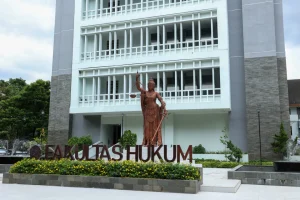
The Faculty of Law, Universitas Gadjah Mada (FH UGM), has strengthened its global reputation by ranking 151-200 worldwide in the QS World University Rankings by Subject 2026 for Law & Legal Studies.
The achievement marks an improvement from the previous year, when the faculty was ranked in the 201–250 range globally. At the national level, the FH UGM is ranked second, after Universitas Indonesia, which ranks 96th globally, and followed by Universitas Airlangga in third place (151-200 globally).
The Vice Dean of the FH UGM, Dr. Heribertus Jaka Triyana, considers this achievement part of a long-standing commitment, particularly in improving the quality of the Three Pillars of Higher Education (Tridharma Perguruan Tinggi): education, research, and community service.
For Dr. Triyana, the ranking achieved by the faculty is not the ultimate goal, but rather a commitment that continues to be strengthened, facilitated, and communicated across the entire academic community of the FH UGM.
Dr. Triyana explained that the FH UGM’s indicators of success lie in research and community service, including international and national publications in reputable international journals. This has been a consistent achievement for the UGM Faculty of Law over the years, particularly with faculty publications increasing by 10-15%. This year, he noted that the Faculty of Law is striving to improve citation metrics from publications in international journals, which serve as an important indicator for ranking improvement.
“At present, we are working to increase citations from publications in reputable international journals, which will continue to grow as an indicator year by year,” he explained on Wednesday (April 15).
He further elaborated that the FH UGM continues to improve the quality of its citation system in indexing by conducting benchmarking studies with more advanced universities and applying the lessons learned to institutional improvement. In addition, faculty participation in international conferences is further encouraged, despite challenges posed by tighter budget allocations.
To address these challenges, the UGM has intensified both bilateral and multilateral partnerships with institutional partners. Establishing collaborations with overseas institutions is expected to positively impact academic reputation, research, publications, and alumni reputation.

“The cooperation models we are developing are expected to provide both direct and indirect contributions to strengthening the institution’s branding,” he said.
Dr. Triyana also noted the increasing number of visits by prominent academic figures from both domestic and international institutions. The faculty currently has eight research centers that can collaborate on projects and research publications.
“I believe this potential can become an even greater strength in the future,” he explained.
Dr. Triyana emphasized that the FH UGM will continue to increase the number of visiting lecturers, encourage student participation in international competitions, and strengthen international collaborations, with these efforts expected to grow in both quantity and quality.
“The challenges ahead will be greater. However, our commitment is to continue moving forward and improving,” he concluded.
Author: Fatihah Salwa Rasyid
Editor: Gusti Grehenson
Post-editor: Rajendra Arya
Photo: Donnie and FH UGM Documentation