


Since the early 20th century, agrarian reform has been an effort to modernize land systems and the socio-political ties that have existed since the establishment of states and kingdoms. Agrarian reform successfully eliminated the feudal patron–client system embedded in the apanage (tanah lungguh) land system. Under this system, land cultivation was carried out by the people under the authority of land managers through a profit-sharing scheme.
Indonesia and South Korea both adopted policies to build agrarian stability in the post-independence period from 1945 to 1960. Three common policies were implemented: eliminating discriminatory land systems, modernizing land administration, and decolonizing land systems.
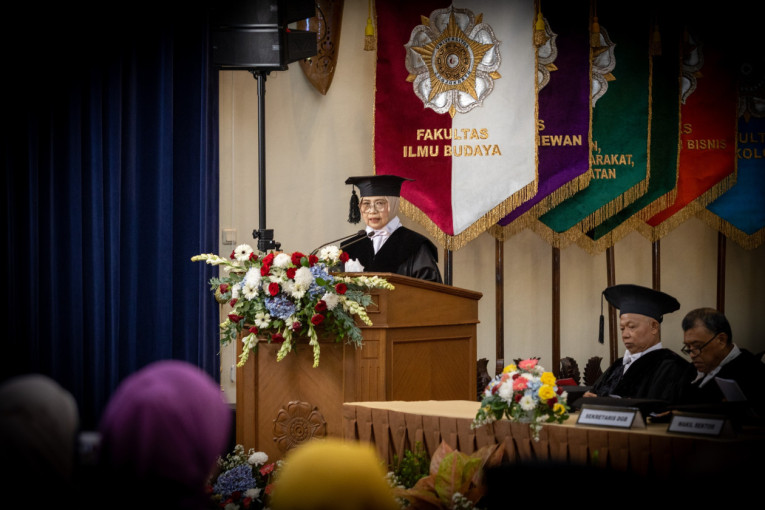
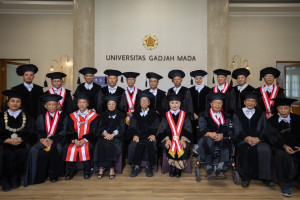
“Land system reform in the process of land redistribution to build post-independence agrarian stability from 1945 to 1960 was carried out by transforming policy and ownership systems,” said Professor Nur Aini Setiawati, a lecturer at the Department of History, Faculty of Cultural Sciences, Universitas Gadjah Mada (FIB UGM), during her inauguration as Professor of Agrarian History on Tuesday (Apr. 14) at the UGM Senate Hall.
In her inaugural speech titled “From Agrarian Reform to Agricultural Development: Indonesia and Korea,” Professor Setiawati explained that the implementation of agrarian reform in South Korea began in 1950 through the “Land Reform Act of Korea (LRA)” to address income inequality. The LRA was implemented through four programs: land acquisition, compensation for landlords, land distribution, and land conservation.
In Indonesia, agrarian reform was initiated through the enactment of the Basic Agrarian Law (UUPA 1960), replacing the Dutch Agrarian Law of 1870. The 1960 law transformed the state’s domain principle with a new politico-legal concept known as the State’s Right to Control, in accordance with Article 33, Paragraph 3 of the 1945 Constitution.
The implementation of agrarian reform in Indonesia and South Korea in the 20th century (1960–1984) faced complex challenges.
“Both countries sought to achieve equitable land ownership and increase agricultural productivity as the foundation of national economic development,” she said.
In Indonesia, agrarian reform was hindered by the legacy of the colonial legal system, which differentiated land ownership between Europeans and indigenous people. Meanwhile, the legal basis for redistribution was only established in 1960, resulting in delays in implementation and weak policy legitimacy. In contrast, South Korea implemented reform earlier through Law No. 108 of 1950 with support from the United States government.
“Despite resistance from aristocratic elites and landowners, the Korean government managed to distribute nearly 40 percent of the targeted land to small farmers,” she explained.
Professor Setiawati noted that the challenges experienced by Indonesia and South Korea had implications for agricultural productivity. Agrarian reform in South Korea during the 20th century (1960–1984) laid the foundation for national economic development. The Korean government created a productive agricultural ecosystem through comprehensive supporting policies, including irrigation development, provision of superior crop varieties, mechanization, and the production of fertilizers and pesticides.
In contrast, agrarian reform in Indonesia was partial and institutionally weak, hampered by bureaucracy, resistance from landowners, and limited technological and capital support. As a result, agrarian inequality remained high, productivity was low, and rural communities did not become drivers of industrialization.
“The success of agrarian reform depends on integrated policies that link land redistribution with sustainable economic development,” Professor Setiawati concluded.
Author: Jesi
Editor: Gusti Grehenson
Post-editor: Rajendra Arya
Photo: Donnie