


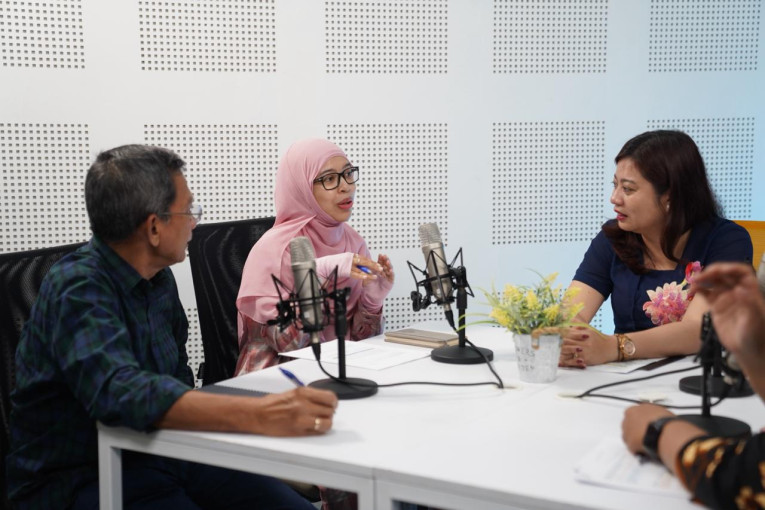
Informal workers continue to dominate Indonesia’s employment structure, yet the social protection they receive remains inadequate. The issue became a major focus in discussions with the International Labour Organization (ILO) regarding workers in the informal economy and the role of social protection. Changes in the labor landscape are occurring far more rapidly than existing regulations can accommodate. Amid the growth of platform workers, freelancers, and content creators, social protection systems are still largely centered on conventional formal employment relationships.
“If we truly want to support social protection, then it should be based on work, not status. Anyone who works and creates economic value, regardless of the form of employment, should still have the right to basic protection,” said UGM International Relations lecturer Suci Lestari Yuana on Friday (May 22).
She views the issue of informal workers as inseparable from global constructions surrounding the definitions of formal and informal work. Yuana, who is commonly known as Nana, explained that the concept of informal workers initially developed from European perspectives and was later adopted as a universal standard.
As a result, many forms of work commonly found in developing countries are categorized as informal. According to Nana, current global discussions have begun to shift from merely distinguishing between formal and informal work to ensuring decent work for all.
In her research on platform workers in the ASEAN region, Nana found that Indonesia already has a considerable number of regulations related to digital worker protection. However, the implementation of those regulations remains weaker than in several other Southeast Asian countries.
She believes many policies have not been supported by institutions capable of ensuring effective protection in practice. As a result, platform workers such as ride-hailing drivers continue to face significant vulnerabilities despite the increasing number of regulations.
“In Indonesia, the regulations are actually quite extensive, but the problem is that the institutions responsible for implementing them are still weak. As a result, workers remain vulnerable even as more regulations continue to emerge,” she said.

UGM Faculty of Economics and Business (FEB UGM) lecturer Qisha Quarina explained that the definition of informal workers has become increasingly complex. According to her, informal workers are not always associated with informal sectors, as workers in formal sectors can also experience informal working conditions.
She pointed out that many workers still lack employment contracts or social protection despite working for formal companies. Quarina noted that around 30 percent of formal workers still do not have either a verbal or a written employment contract.
She added that informality can no longer be understood solely in terms of employment status. From an international perspective, informal workers are also identified by the absence of labor protection, social security, and certainty in employment relationships. According to her, the issue demonstrates the large number of vulnerable workers in Indonesia who remain insufficiently protected. Quarina also believes social protection systems need to become more adaptive to emerging work patterns characterized by unstable income.
“In the future, permanent employees may become less common, while jobs such as freelancers, content creators, and platform workers will continue to grow. Therefore, social protection systems must also evolve and become more adaptive to current work patterns,” she said.
From a social protection perspective, Kris Panjaitan of the International Labour Organization emphasized that it is a fundamental human right. He explained that social protection differs from private insurance because it is based on solidarity and collective financing. According to him, social protection is designed to ensure that individuals can continue to survive when facing risks such as illness, unemployment, or emergency situations. The system, he argued, should apply to all workers regardless of whether they are formally or informally employed.
“Social protection is fundamentally a human right. Therefore, regardless of one’s occupation, whether formal or informal, everyone should still have access to protection when facing risks in life,” Kris emphasized.
Kris also argued that the greatest challenge today no longer lies in the concept of social protection itself, but rather in its implementation. The unstable income patterns of informal workers often make it difficult to maintain consistent monthly contribution schemes. Therefore, he encouraged the development of more flexible and adaptive social protection systems for informal workers. Kris stressed that the state needs to adjust social protection mechanisms to changing employment patterns.
“Informal workers often have unstable incomes. Some work seasonally, while others only earn income after several months of work. That is why we need to think about how social protection systems can become more flexible and adaptive to their conditions,” he said.
Meanwhile, labor law advocate Nabiyla Risfa Izzati argued that the root of the problem in protecting informal workers lies in the definition of employment relationships in Indonesia’s labor regulations. She explained that the current Labor Law still relies on the conventional concept of employment relationships between workers and employers.
As a result, many freelancers, platform workers, and other informal workers struggle to fit within existing labor protection schemes. According to her, this situation leaves millions of workers without access to basic rights such as fair wages, social security, and labor protection.
“The definition of employment relationships in our current law is no longer adaptive to the needs of a rapidly changing labor market. Today, forms of work are far more flexible than when the regulation was first drafted,” she explained.
Nabiyla believes the momentum for revising labor regulations should be used to update definitions of employment relationships so they better reflect current realities. She stated that the world of work has changed drastically since labor regulations were first drafted decades ago. According to her, many workers today operate flexibly, without fixed work arrangements as envisioned in older employment concepts. Therefore, worker protection should no longer depend solely on the formal status of employment relationships.
“What we need to question now is actually quite simple: what does an employment relationship mean amid today’s changing world of work? Because if existing regulations are unable to protect a growing number of workers, then there is clearly something fundamental that needs to be fixed,” Nabiyla concluded.
Author: Triya Andriyani
Post-editor: Zabrina Kumara
Photo: Firsto