


Digital financial literacy today is no longer limited to understanding savings, credit, insurance, or digital assets, but also to assessing risks amid the rapid development of digital technology. The ease of access provided by technology must be balanced with risk awareness to prevent people from becoming financially vulnerable.
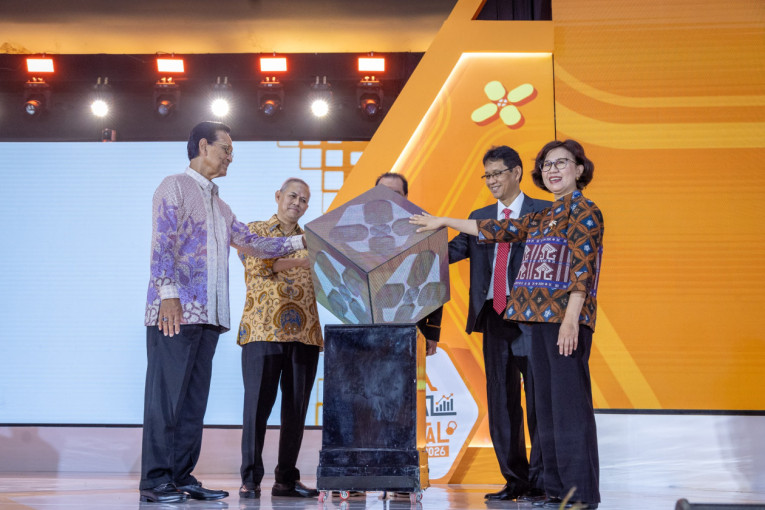
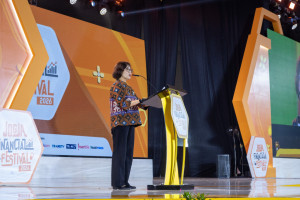
“The development of digital technology not only provides easier access, but also introduces new risks. Therefore, understanding these risks is essential so people do not become financially vulnerable,” said Rector of Universitas Gadjah Mada (UGM), Professor Ova Emilia, during the opening of the Jogja Financial Festival 2026 at the Jogja Expo Center (JEC) on Friday (May 22), alongside Indonesian Minister of Finance Purbaya Yudhi Sadewa, Chair of the Board of Commissioners of the Indonesia Deposit Insurance Corporation (LPS) Anggito Abimanyu, and Governor of the Special Region of Yogyakarta (DIY) Sri Sultan Hamengkubuwono X.
Professor Ova Emilia stated that various cases at several universities indicate that many students are still trapped in difficult financial situations.
“Therefore, strengthening digital financial literacy has become an important necessity for the younger generation,” she said.
According to Professor Ova Emilia, Yogyakarta has developed into a center for the creative and digital economy, with universities serving as the backbone of the local economy. Students are expected not only to solve financial problems but also to become innovators, entrepreneurs, investors, and creators of value for society.
“Financial risk management is a fundamental provision. As the largest university in Yogyakarta, UGM has successfully produced talented young Gen Z investors,” she explained.
Strengthening the capacity of young talent is crucial because the demographic bonus will only become a strength if young people possess knowledge, character, and the ability to make wise decisions. UGM has also continued to develop various financial literacy programs for its academic community through seminars, workshops, and collaborations with multiple partners.
“UGM has conducted numerous financial literacy programs for the university community through various activities. We continue to organize seminars, workshops, and literacy programs for students, educational staff, and lecturers in collaboration with various partners,” she said.
In addition, UGM continues to expand access to education through various scholarship programs. One of them is the Sahabat UGM program, which benefited 19,232 students in 2025 and 11,380 students in 2026. Professor Emilia noted that nearly 75 percent of UGM students receive scholarship subsidies in various forms of educational support.
Professor Ova Emilia emphasized that financial literacy is related to building social solidarity and expanding educational opportunities for the wider community. She invited all stakeholders to foster smart and ethical financial literacy, encourage productive financial inclusion, and position young people at the center of Indonesia’s economic transformation.
LPS Board Chairman, Professor Anggito Abimanyu, also expressed his appreciation to the Yogyakarta provincial government and UGM for organizing the festival. He hopes the festival will become a progressive, open, and grounded movement for financial literacy and inclusion.
“We extend our highest appreciation to the Yogyakarta provincial government, Universitas Gadjah Mada, and all strategic partners for presenting the Jogja Financial Festival as a progressive, open, and grounded movement for financial literacy and inclusion,” he said.
For Professor Abimanyu, developments in financial technology must be balanced by literacy and public responsibility in financial management. He observed that young people today are given extensive access to investment opportunities and digital financial services, yet many still lack the capacity to formulate sound financial plans. Therefore, he noted the importance of ensuring that literacy, ethics, responsibility, and technology develop side by side.
“We must not allow technology to grow faster than our ethics, literacy, and financial responsibility as a nation,” he said.
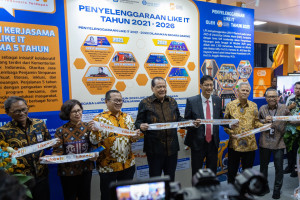
Meanwhile, the Governor of DIY, Sri Sultan Hamengkubuwono X, emphasized the importance of building financial literacy that is oriented not only toward economic growth but also toward humanistic and cultural values. Sri Sultan welcomed the Jogja Financial Festival as an important forum for bringing together policy, knowledge, culture, and technology so that economic development remains grounded in human dignity.
“I welcome the presence of this forum as a way to shape how policy, knowledge, culture, and technology can come together so that economic growth does not become detached from human dignity,” he said.
Sri Sultan also highlighted the Javanese philosophy of gemi nastiti ati-ati as the foundation of economic behavior, prioritizing prudence, carefulness, and self-restraint. According to him, these values are becoming increasingly relevant in the digital era, which encourages impulsive consumption and the growing popularity of buy-now, pay-later schemes.
“The philosophy of gemi nastiti ati-ati teaches restraint in consumption for long-term goals. It becomes increasingly clear that financial freedom is not about the ability to buy, but about the ability to restrain oneself,” he explained.
Sri Sultan believes financial literacy must be strengthened across all levels of society so that people are not vulnerable to illegal online loans and other predatory financial practices.
“Therefore, financial literacy must reach the grassroots of society,” he said.
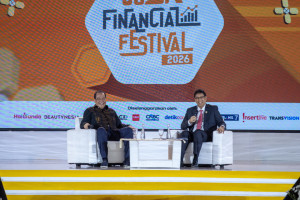
Transmedia Group collaborated with UGM and several national financial regulatory institutions to organize the opening of the Jogja Financial Festival 2026 at Jogja Expo Center (JEC) on Friday (May 22). After successful events in Surabaya and Medan in 2025, Yogyakarta became this year’s host city.
The two-day event, held on May 22-23, 2026, featured a combination of talk shows, exhibitions, and educational classes as effective and inclusive media for building public trust and expanding financial literacy outreach to the community.
Organized by Transmedia Group, the festival also involved national financial regulators and industry institutions, including the Ministry of Finance of the Republic of Indonesia, Bank Indonesia, Financial Services Authority, and LPS, to broaden financial literacy and inclusion among the public.
Author: Zabrina Kumara
Editor: Gusti Grehenson
Post-editor: Jasmine Ferdian
Photo: Donnie