


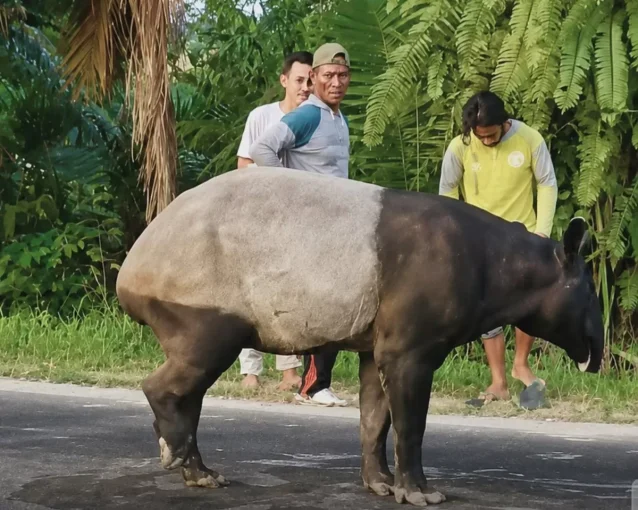
The Chair of the Indonesian Biology Consortium (KOBI) and Dean of the UGM Faculty of Biology, Professor Budi Setiadi Daryono, Ph.D., condemned and expressed deep concern over the recent killing of a Malayan tapir (Tapirus indicus) in Lampung.
“The killing of Tapirus indicus is both a violation of the law and a setback for Indonesia’s biodiversity conservation efforts. This act cannot be justified under any circumstances,” said Professor Daryono on Monday (July 7).
The Malayan tapir is a large herbivorous mammal that plays a vital role as a seed disperser in the lowland tropical rainforests of Sumatra and Kalimantan. In Lampung, the species serves as an important indicator of forest health. Tapirus indicus is the only tapir species found in Asia and is protected under Minister of Environment and Forestry Regulation No. P.106/MENLHK/SETJEN/KUM.1/12/2018. In the wild, its population continues to decline due to habitat loss, poaching, and human-wildlife conflict. The International Union for Conservation of Nature (IUCN) has classified the species as Endangered.
In response to the incident, KOBI has issued an official statement as a form of protest against the inadequate protection of wildlife in Indonesia. KOBI urged the Lampung Regional Police and the Lampung Natural Resources Conservation Agency (BKSDA) to conduct a thorough investigation, apprehend the perpetrators, and prosecute them under Law No. 5 of 1990, as amended by Law No. 32 of 2024, concerning the Conservation of Biological Natural Resources and Their Ecosystems. According to KOBI, firm legal sanctions are necessary to create a stronger deterrent effect.
In addition to urging authorities to thoroughly investigate the case, KOBI also called for stronger public education and more decisive measures to mitigate conflict.
“Many cases of wildlife hunting stem from a lack of public awareness and land-use conflicts,” Professor Daryono added.
“The loss of a single tapir means the loss of future reproductive potential for an already declining population,” Professor Daryono concluded.
KOBI also expressed its readiness to collaborate with local governments, academics, and communities to strengthen conservation education, habitat monitoring, and human-wildlife conflict resolution initiatives in the Lampung corridor. As part of these efforts, KOBI encouraged the public to actively participate in protecting wildlife. Wild animals are an integral part of the ecosystem and the nation’s natural heritage. KOBI also urged the public to report any hunting or illegal trade involving protected species through the official BKSDA 112 hotline or to the relevant local authorities without delay.
KOBI believes that conserving Tapirus indicus is not solely the government’s responsibility but also a moral obligation shared by all Indonesians.
KOBI and its members in Lampung will continue to monitor the legal process surrounding the case while expanding opportunities for research collaboration and conservation efforts, particularly in Lampung.
Author: Jelita Agustine
Editor: Gusti Grehenson
Post-Editor: Zabrina Kumara
Photo: Infosumsel