



Manungsa tanpa tenger (Human Without Sign) refers to the concept of a human being who can distance themselves from attachment to tenger (identity), as taught in Kawruh Jiwa (Soul Dictionary), a philosophy introduced by Ki Ageng Suryomentaram.
The human ego, or selfhood, can become a source of inner suffering when it is not recognized and controlled. However, the journey toward becoming manungsa tanpa tenger is a fluctuating one and never reaches a fixed point. The process is continually changing and strongly influenced by feelings, social relationships, and the environment in which a person lives.
“The process of becoming manungsa tanpa tenger always rises and falls. This means the journey does not stop at a certain point but continues to shift, so one never remains at the same point,” said Ryan Sugiarto, a doctoral student at UGM’s Faculty of Psychology, during the public defense of his dissertation titled Manungsa Tanpa Tenger: Konsep dan Proses in Room A-203 of the Faculty of Psychology on Wednesday (Jun. 17).
Ryan explained that the concept of manungsa tanpa tenger is operationalized through seven aspects: self-control and self-liberation; the courage to distance oneself from attachment to identity and social expectations; psychological balance and self-maturity; awareness as an observer alongside the release of ego; wholeness of life and deep empathy; flexibility in navigating life; and the structure of consciousness in Kawruh Jiwa.
According to Ryan, the process of reaching the state of manungsa tanpa tenger unfolds through four stages: weruh dewe, krasa dewe, ngerti dewe, and ngelakoni (look it, feel it, understand it, do it).
“This is an internal process experienced by students of Kawruh Jiwa. At this stage, a person can move toward what may be called the realization of their potential,” he said.
Therefore, someone who has reached a certain stage of manungsa tanpa tenger may still fall back into identity attachment or social conflict if they do not continuously engage in self-cultivation.
“A person in the state of manungsa tanpa tenger can still slip into group attachment or conflict if the process of self-cultivation is not carried out continuously,” he explained.

Ryan further explained that the journey toward manungsa tanpa tenger unfolds through two complementary pathways: the external and the inner. The external process involves studying the teachings and writings of Kawruh Jiwa, such as Kondotak and Lengcu Gelingan, as well as practicing writing for self-reflection. Meanwhile, the inner process takes place through the stages of weruh dewe, krasa dewe, ngerti dewe, and ngelakoni.
Furthermore, Ryan revealed that his research produced a new conceptual framework called post-identity theory. This theory was developed to complement existing identity theories, whether focused on social identity or personal identity. In today’s social landscape, identity has become both a necessity and a responsibility, often burdening individuals.
On one hand, identity provides a framework of orientation that strengthens one’s sense of self and reinforces one’s position in social life. At the same time, identity also functions as a mechanism that sharply distinguishes between “self” and “others.” This is where identity becomes problematic. When identity is fully attached to one’s sense of self, criticism feels threatening, difference is perceived as an attack, and change is seen as loss.
Through this research, Ryan offers a new theoretical concept, post-identity theory, which allows individuals to distance themselves from various identity attachments. According to Ryan, the theory offers a new perspective on how individuals can build healthier relationships with their identities without becoming completely attached to them.
In addition, the study also produced the concept of psycho-spiritual-contextuality, which views spirituality as something alive and sustained in everyday life.
“We also formulated the concept of psycho-spiritual-contextuality, namely spirituality that remains alive in everyday relationships, rather than spirituality that emerges from isolation or withdrawal from social life,” he said.
Through this research, Ryan concluded that manungsa tanpa tenger refers to a person who can distance themselves from attachment to identity or ego through continuous external and internal processes.
“A person without tenger is someone who maintains distance from attachment to tenger or identity, through both external and inner processes,” Ryan concluded.
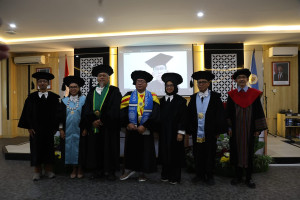
At the public defense, Ryan graduated with cum laude honors after completing his doctoral studies in 3 years, 8 months, and 2 days, with a GPA of 3.86. With this achievement, Ryan officially became UGM’s 7,306th doctoral graduate.
Author: Zabrina Kumara
Editor: Gusti Grehenson
Post-editor: Rajendra Arya
Photo: Magnific