


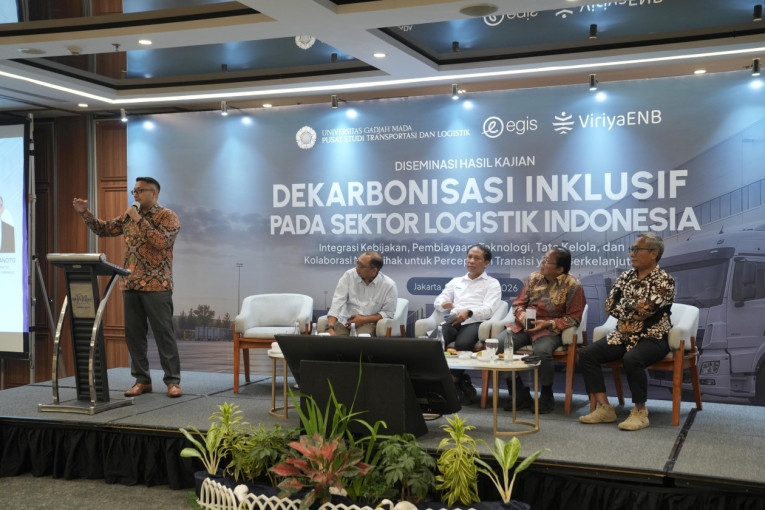
A study by the Center for Transportation and Logistics Studies at Universitas Gadjah Mada (Pustral UGM) and PT Egis International Indonesia found that 79 percent of freight transport emissions along the Java-Bali road corridor are concentrated in West Java, Central Java, and East Java. The finding was presented at a dissemination forum in Jakarta on Monday (Nov. 2) as part of a study titled “Dekarbonisasi Inklusif Sektor Logistik Indonesia: Kerangka Hibrida untuk Pelacakan, Pembiayaan, dan Reformasi Kebijakan” (“Inclusive Decarbonization of Indonesia’s Logistics Sector: A Hybrid Framework for Tracking, Financing, and Policy Reform.”)
The study shows that reducing emissions from the logistics sector can begin by targeting regions and routes with the highest emission contributions.
Secretary of the Deputy for Connectivity Coordination at the Coordinating Ministry for Infrastructure and Regional Development, Rustam Efendi, said logistics transformation should move toward a more efficient, inclusive, and low-carbon system without hindering economic growth.
Trucks currently account for 91.25 percent of national freight transport, while logistics costs remain 14.29 percent of gross domestic product (GDP). The government aims to reduce logistics costs to 12.5 percent by 2029. Rustam also emphasized the importance of coordination among stakeholders in addressing barriers to logistics-sector transformation.
Head of the Pustral UGM study team, Dr. Arif Wismadi, explained that the study involved 14 in-depth interviews and focus group discussions (FGDs) in Jakarta, Surabaya, and Bali, involving 185 institutions. The findings show that businesses, particularly micro, small, and medium enterprises (MSMEs), face several barriers in transitioning from diesel trucks to electric trucks.
These include vehicle prices, resale value, payback periods, financing schemes that do not yet match logistics business models, and limited charging infrastructure.
A survey of 50 MSME freight operators showed that financing schemes influenced their willingness to adopt electric trucks. Under a scenario involving a 30 percent down payment, a 12 percent interest rate, and a land certificate as collateral, only 8 percent of respondents were willing to make the transition.
The figure increased to 56 percent when the down payment was reduced to 15 percent, the interest rate was set at zero percent, and only the truck registration certificate (BPKB) was required as collateral.
The study team subsequently developed three financing prototypes: green credit supported by long-term purchase contracts, fleet leasing without a down payment, and battery subscription schemes.
“All the obstacles raised by businesses throughout the discussions ultimately come down to one thing: cost and financing. Electric trucks will not move from brochures to the road until the numbers make sense for operators,” said Arif.
On emissions projections, Febriani Astari of PT Egis International Indonesia said freight transport emissions along the Java-Bali road corridor are estimated to reach 19.72 million tons of CO₂ in 2026. Without intervention, emissions are projected to increase by 51 percent to 29.80 million tons by 2035, representing annual growth of approximately 4.7 percent.
West Java contributes 31 percent of emissions, followed by Central Java at 26 percent and East Java at 22 percent. The highest emission concentrations are found in the Greater Jakarta area and along the northern coast of Java, particularly Bekasi, Karawang, Indramayu, and Cirebon.
“The study shows that more than three-quarters of emissions are concentrated in three provinces, and more than a quarter comes from ten regencies and cities. The problem turns out to be narrower and more manageable, so our task is to start from these hotspots,” said Febriani.
Charging infrastructure is another aspect that needs attention in the transition toward low-emission freight transport. Vice President of Commercial Product Commercialization at PT PLN (Persero), Ronny Afrianto, said PLN has operated 5,120 four-wheel public electric vehicle charging stations (SPKLU) across 3,257 locations, with 75 percent developed through partnership schemes. PLN has also collaborated with several companies to develop dedicated charging stations for trucks and conducted trials along the Jakarta-Cikampek route.
The relatively fixed routes used by freight transport help plan charging infrastructure more precisely.
In addition to financing prototypes, the Pustral UGM and Egis study produced EQLAS for EV (Equitable Location-Allocation Simulation), a web-based application designed to support more equitable planning of charging infrastructure from both spatial and social perspectives. The application proposes battery-swapping points approximately 100 kilometers apart along the Java-Bali corridor.
The study also highlights the need to test battery-swapping schemes and establish standards so that the technology can be used by various types of electric vehicles. Infrastructure development therefore needs to consider the distribution of freight transport demand rather than simply concentrating facilities in urban areas.
As an initial step, the study team recommends piloting decarbonization efforts in one or two priority corridors or cities, taking operational readiness and costs into account. Implementation could begin with freight segments operating on fixed routes or from depots to prevent transition costs from placing excessive pressure on small operators.
The results of the pilot projects could then serve as a basis for evaluation before the approach is expanded to other areas. A gradual approach is expected to support the transition toward low-emission logistics while considering infrastructure readiness, financing feasibility, and business sustainability.
Reportage/Photo: Pustral UGM
Author: Triya Andriyani
Post-Editor: Zabrina Kumara