


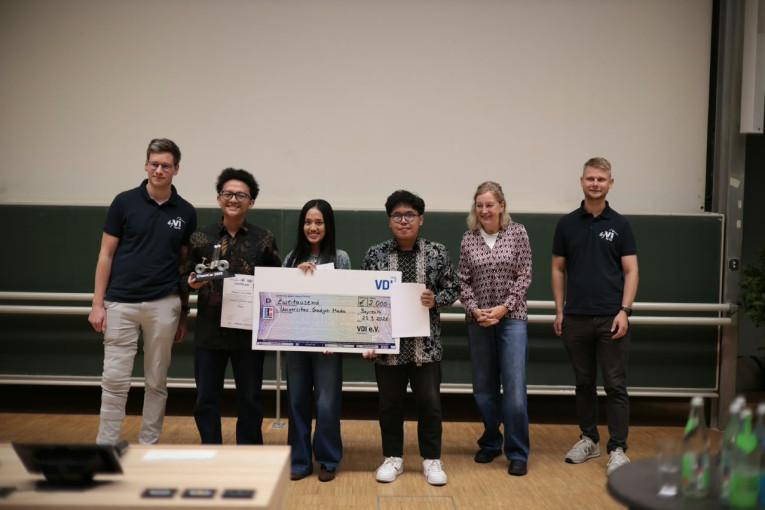
The Reactics team from Universitas Gadjah Mada won first place at the ChemCar Competition by kJVI of the VDI Germany 2026, held on September 22–23, 2026, at the Electrochemistry Centre in Bayreuth, Germany. The competition brought together teams from various countries to develop chemically powered cars and vehicle-stopping systems.
The Reactics UGM team was led by Violin Frastica from the Department of Computer Science and Electronics, with Alvito Rizki Sidartawan and Riyo Yusuf Setyawan from the Department of Mechanical and Industrial Engineering, and Bremani Sirat Atmaja and Ichwan Amirudin from the Department of Chemical Engineering.
Violin Frastica said the team’s achievement resulted from a series of preparations and development processes adapted to the competition’s conditions. As the team captain, Violin said the victory served as a reminder that the greatest achievement comes from growing and going through various processes together as a team.
One of the challenges arose during a trial at night in Germany, when temperatures dropped to 2°C. The conditions differed from the preparation process in Indonesia, affecting the reaction rate used in the car’s system.
“The change caused the stopping time to reach twice the initial estimate,” she said on Thursday (Oct. 1).

To adapt the system to these conditions, the team conducted intensive calibration and data collection. This process remaps the reaction patterns and time parameters to better suit the field.
“Through intensive calibration and repeated data collection in the cold of the night, we were able to remap the reaction patterns and find more precise time parameters. All the fatigue and frustration were ultimately rewarded when our team won first place,” Bremani said.
In the competition, the Reactics car used an Aluminum–Air Battery as its energy source, with aluminum serving as the anode and air providing oxygen at the cathode. The power source focused on a stable electricity supply sufficient to meet the motor’s power requirements while operating.
Meanwhile, the stopping mechanism used Brilliant Blue as an indicator of changes in the solution. As the car moved, the ongoing reaction caused the solution to change color from blue to clear. A sensor detected the change and was used as a signal to automatically activate the stopping mechanism.
The achievement was also significant for Reactics as the team not only won first place but was also the only non-European team. For Alvito, competing at the international level gave the team an opportunity to represent Indonesia among various countries.
“This moment is a very valuable achievement for us because we were able to represent Indonesia, compete, and stand on the highest stage of an international competition,” Alvito said.
Dealing with field conditions also gave the team members experience applying engineering concepts. Temperature changes during the trial required data review and adjustments to previous parameters. The experience demonstrated adaptability, accuracy in assessing field conditions, and an iterative approach to system development.

The achievement was supported by all members of Reactics Chem-E-Car UGM and the faculty advisors Professor Budhijanto, Addin Suwastono, Mokhammad Fajar Pradipta, and Robertus Dhimas Dhewangga Putra, Ph.D. Sponsor partners: PT PLN (Persero), PT Toyota Motor Manufacturing Indonesia, PT Tripatra Engineers and Constructors, Yayasan Tekagama, PT VALE Indonesia Tbk., PT Gagas Energi Indonesia, PT Nissan Motor Indonesia, and PT Pupuk Kalimantan Timur.
After the competition in Germany, Reactics will continue preparing for several upcoming events, including ICHEDECE Ecodays at Universitas Sebelas Maret (UNS), alongside two other Reactics subteams. The team will then prepare for the Annual AIChE Global Chem-E-Car Competition in Minneapolis, United States.
Riyo said that each competition presents different challenges and experiences for the team. These experiences will become part of Reactics’ evaluation and preparation process for future competitions.
“We realize that every competition brings different challenges and lessons, so we will face them with humility, a willingness to learn, and the determination to give our best,” Riyo said.
The victory in Germany marks another step in Reactics’ journey to continue developing its capabilities and competing in future events. The experience gained during the ChemCar-Competition VDI Germany 2026 will serve as valuable preparation for the team to refine its system, evaluate its processes, and once again represent UGM and Indonesia at future international competitions.
Author: Zabrina Kumara
Editor: Gusti Grehenson
Post-editor: Jasmine Ferdian
Photos: Reactics Team