


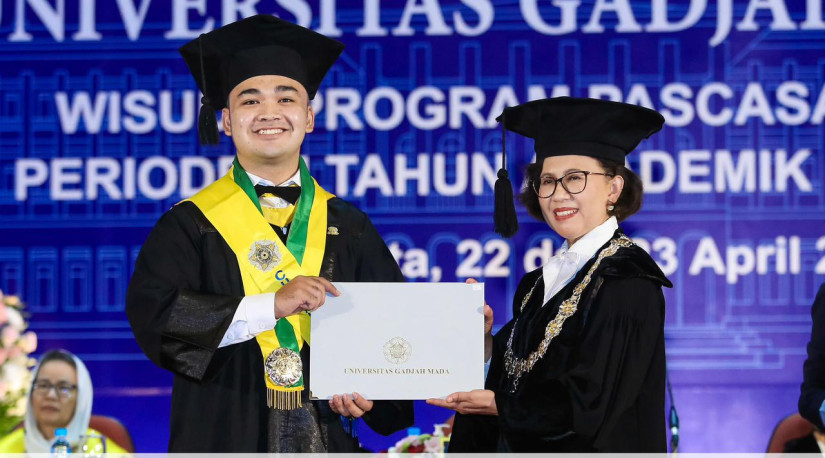
Muhammad Rizky Perwira Zain, a graduate of the Master’s Program in Public Health at the Faculty of Medicine, Public Health, and Nursing Universitas Gadjah Mada (FK-KMK UGM), was named the youngest graduate at the Postgraduate Graduation Ceremony for Period III of the 2025/2026 Academic Year, held on Wednesday (April 22) at Grha Sabha Pramana. He completed his studies at the notably young age of 22 years, 2 months, and 8 days, while the average age of master’s graduates in this period was 29 years, 6 months, and 15 days.
Known as Kiki, he shared his academic journey. He joined the Block Elective program while still pursuing his undergraduate degree in Medicine at UGM. The program gave him the opportunity to shape his academic path, including the option to pursue an accelerated track by beginning his master’s studies in his final undergraduate semester.
He explained that the program integrates undergraduate medical education with a master’s degree in public health within an overlapping timeframe. He had made this decision as early as his sixth semester. However, he acknowledged that it was not a simple choice, as it required extensive discussions with his family. This was because he had to postpone his clinical clerkship (co-assistantship) for one year.
“It was a major decision because I had to delay my clerkship for a year to pursue my master’s degree first,” he said in an interview on Tuesday (April 28).
During his accelerated studies, he faced various challenges, particularly in time management and managing a layered academic workload. At the same time, he was required to complete his undergraduate thesis while attending intensive master’s courses held almost daily. This situation made his study routine far more demanding than that of most students. Despite these academic pressures, he remained active in the Medical Emergency Response Team, a commitment that also required significant time and energy.
“During that semester, I had to finish my undergraduate thesis while also completing the first semester of my master’s program, which was quite intensive,” he explained.
In addition, he faced challenges in adapting to an environment dominated by senior students. This required him to position himself appropriately, maintain proper communication ethics, and build trust in group work without neglecting his own contributions. The pressure increased in the second semester, when he had to conduct fieldwork while simultaneously preparing his initial thesis proposal. This situation led to a period of burnout.
“I did experience burnout due to the number of activities, but I just kept going,” he said.
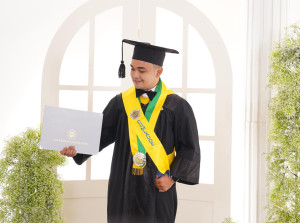
For his thesis, Kiki examined factors associated with successful smoking cessation in Indonesia. He explained that his research utilized national-scale data with 14 variables analyzed, drawing on global sources such as the World Health Organization (WHO). He initially faced a dilemma in selecting a topic that was both realistic and impactful. Ultimately, he completed his thesis with notable findings related to smoking behavior across age groups.
“Younger people tend to try quitting more often, but those who succeed are usually older individuals, often motivated by illness,” he explained.
His motivation to complete his studies was strongly supported by his family and by his awareness of professional responsibility in the health sector. He emphasized that diligence in learning is crucial, particularly in medicine, where it directly affects patient safety.
“If we don’t study seriously, we could make incorrect diagnoses. So, we must be truly committed to learning,” he said.
Kiki stressed that graduating at a young age was not his primary goal. He believes that each individual has their own pace and phase in education, and therefore, age should not be the sole measure of success. What matters more, he noted, is how the knowledge gained can bring real benefits to others. He emphasized that the essence of education lies not in speed, but in impact. “In the end, it’s not about who graduates the fastest, but how the knowledge we gain can benefit others,” he said.
Kiki encouraged students currently working on their final projects to remain consistent in their efforts. He highlighted that the key to success lies not only in intelligence but also in perseverance and discipline throughout the process. He also emphasized the importance of balancing effort with prayer to ensure a smooth academic journey.
“What matters most is perseverance, discipline, diligence, and patience. We must strive our best, and don’t forget to pray and seek our parents’ blessings,” he concluded.
Author: Cyntia Noviana
Editor: Gusti Grehenson
Post-editor: Zabrina Kumara
Photo: Courtesy of Rizky