


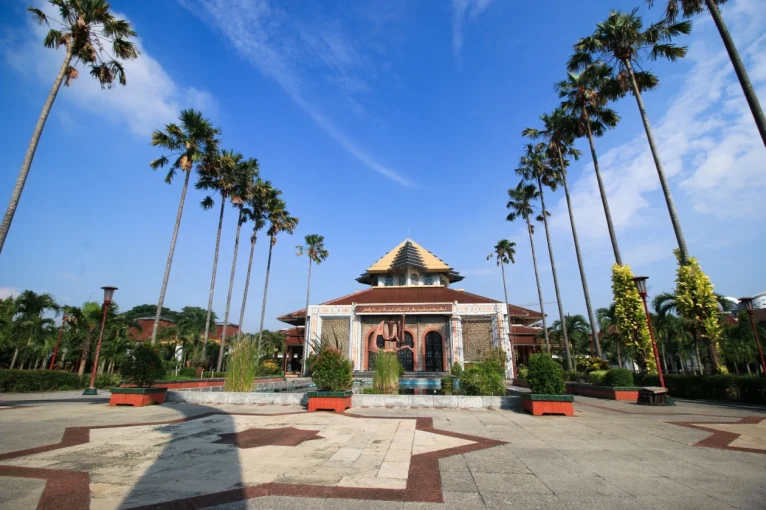
The UGM Campus Mosque (Maskam UGM) serves not only as a place of worship but also as a center for Islamic learning for Muslims. Beyond that, the campus mosque plays an active role in fostering a culture of social responsibility by supporting students from low-income families pursuing their studies at Universitas Gadjah Mada (UGM).
Through the UGM Zakat, Infaq, and Alms House (RZIS UGM), a program managed by Maskam UGM, the institution has remained committed to supporting students’ educational journeys through its scholarship program, which has been consistently implemented since 2008. In addition to providing living allowances, RZIS UGM promotes a culture of social responsibility by engaging scholarship recipients as volunteers serving local communities.
Taufikur Rahman, Deputy Director and Operations Manager of RZIS UGM, explained that the scholarship program has been one of the institution’s flagship initiatives since its establishment. RZIS UGM was founded out of concern for students receiving the Bidikmisi scholarship, now known as the Indonesia Smart College Card (KIP Kuliah), who at the time received tuition waivers but no financial support for daily living expenses.
“In 2008, many students from economically disadvantaged families were admitted to UGM but struggled to meet their daily living needs. That was when the late Professor Sukadji, former Rector of UGM, together with Professor Ainun Na’im, initiated the establishment of a zakat institution at UGM,” said Rahman on Monday (Jun. 29).
Operating under the Special Region of Yogyakarta branch of the National Alms Agency (BAZNAS), RZIS UGM collects zakat contributions from faculty members, educational staff, alumni, and the general public, particularly worshippers at Maskam UGM. Over nearly two decades, its scholarship program has been consistently continued.
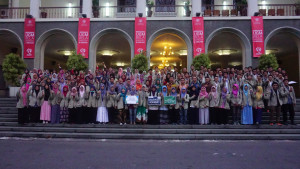
According to Rahman, RZIS UGM supports approximately 200 students each semester. The number of recipients is not determined by a fixed quota but depends on the amount of zakat funds collected.
“The more zakat funds we receive, the more students we are able to support,” he said.
Eligibility requirements for the scholarship are intentionally simple to ensure accessibility for students in need. Applicants must be active undergraduate or applied bachelor’s students at UGM and come from low-income families, as demonstrated by a Certificate of Financial Hardship (SKTM). There are no minimum GPA requirements or semester limits.
“We do not want students to be merely beneficiaries. We also encourage them to become volunteers so they can contribute to society through their time, energy, and compassion,” he explained.
In addition to its regular scholarship program, RZIS UGM also operates the Rescue Program for students whose KIP Kuliah assistance has ended but who have not yet completed their studies. The program provides continued support to help students finish their education despite financial challenges.
The amount of assistance varies. Students receiving KIP Kuliah receive an additional living allowance of approximately Rp150,000 to Rp250,000 per month. Meanwhile, recipients of the regular scholarship receive approximately Rp350,000 to Rp500,000 per month for one semester. Scholarship extensions are granted following a simple evaluation process that requires students to upload their most recent Study Results Card (KHS).
Beyond educational assistance, RZIS UGM also provides emergency support for students facing unexpected hardships, including accidents or disasters, travel expenses to return home, and financial difficulties caused by online lending. From the perspective of Islamic law, students are categorized as fisabilillah, individuals striving in the cause of Allah through education.
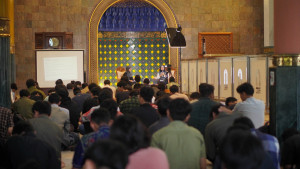
One distinctive feature of the RZIS UGM program is the active involvement of students as volunteers. These volunteers visit the homes of beneficiary families to distribute food packages while monitoring their health and overall well-being.
“We want students to gain firsthand experience in understanding the realities faced by the community. If they identify specific needs, such as wheelchairs, hearing aids, BPJS enrollment, or referrals to UGM Academic Hospital, the volunteers report them to us so we can arrange the necessary follow-up,” said Rahman.
RZIS UGM also adopts an economic empowerment approach in distributing assistance. Rather than purchasing food packages from large retail stores, the organization buys supplies from small neighborhood shops near beneficiaries’ homes. In doing so, zakat funds not only support recipients but also stimulate local economic activity and empower MSMEs.
In addition to managing zakat funds, RZIS UGM is preparing to establish a waqf institution that will receive official legal recognition from the Ministry of Religious Affairs and the Indonesian Waqf Board (BWI). In the future, waqf assets will be utilized to develop student dormitories and a Qur’an Learning Center.
Currently, RZIS UGM also manages three student dormitories located in Pogung Dalangan, Pogung Kidul, and Klebengan. These dormitories are intended for students experiencing financial hardship who require affordable accommodation closer to campus.
Concluding the interview, Rahman expressed hope that more students would become aware of the RZIS UGM scholarship program so that no student would have to delay or discontinue their education because of financial constraints.
“There are still many students who need assistance but are unaware of this scholarship opportunity. We therefore hope that publicity surrounding the opening of the RZIS UGM scholarship program will reach more students so they can make the most of this opportunity,” he concluded.
Author: Jelita Agustine
Editor: Gusti Grehenson
Post-editor: Jasmine Ferdian
Photos: UGM Public Relations and UGM Campus Mosque