


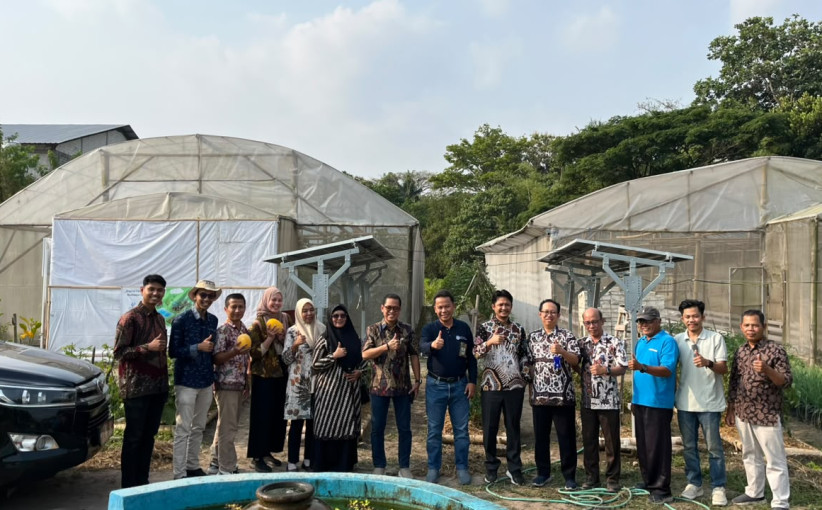
The Faculty of Engineering at Universitas Gadjah Mada (FT UGM) is exploring joint collaboration opportunities with the Regional Development Planning, Research, and Innovation Agency (BAPPERIDA) of Tegal Regency, Central Java. The proposed collaboration focuses on implementing agrivoltaic and smart farming technologies on agricultural land in Tegal Regency as part of the region’s transition toward a green industry.
Dr. Ahmad Agus Setiawan, an agrivoltaics researcher and lecturer in the Department of Engineering Physics at UGM, explained that agrivoltaic technology is an appropriate solution based on renewable energy use. As the Head of the Renewable Energy Laboratory at FT UGM, he emphasized that agrivoltaic development aligns with the government’s strategic efforts to achieve national energy sovereignty.
“We are offering a technological solution through agrivoltaic solar photovoltaic (PV) systems,” said Ahmad
Ahmad explained that combining agriculture with agrivoltaic systems can reduce soil water evaporation, prevent crop dehydration, and improve photovoltaic (PV) panel efficiency. He further noted that the team’s hybrid solar PV design with an agrivoltaic configuration enables more efficient land use for both agricultural production and energy generation.
“We have already implemented this agrivoltaic solar PV system in agricultural fields in Pandowoharjo, Sleman,” he said.
Meanwhile, agroclimatology and smart agriculture expert Professor Bayu Dwi Apri Nugroho explained that smart farming integrates digital technologies into agricultural management. According to him, the system connects every stage of agricultural production, from farmland to products reaching consumers, allowing each process to be traced transparently.
“Everything is connected from upstream to downstream, from land to table. The entire process can be tracked and its transparency verified,” said Bayu.
Bayu added that the smart farming concept integrates various technologies, including sensors, drones, information management systems, precision agriculture, automation, and robotics.
He emphasized that data collected from these technologies should not only be gathered but also analyzed into meaningful information to support decision-making.
“All collected data must be interpreted and understood so it can serve as the basis for informed decisions,” he explained.
Concluding his presentation, Professor Bayu said that precision agriculture aims to provide crops with treatment tailored to their specific needs, making the use of water, fertilizers, and other agricultural inputs more efficient. To support this approach, his team developed a system that integrates weather sensors, soil sensors, monitoring drones, and spraying drones.
The system also includes a dashboard that lets farmers and stakeholders monitor field conditions in real time and receive cultivation recommendations based on field data and local wisdom.
“Technology is only one variable. It should not be viewed as the sole solution. Everything depends on the agricultural ecosystem,” he said.
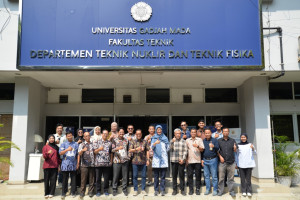
Responding to the presentations, Head of the Tegal Regency BAPPERIDA, Dr. Muhammad Faried Wajdy, said the visit represented a strategic effort to connect university research and innovation with practical regional development needs. He said the Tegal Regency Government aims to transition to a green industry by 2028 through research- and innovation-based development.
“Our initiative is to create a platform that connects university research and innovation with real challenges in the field. We plan to implement agrivoltaic systems to develop integrated horticultural farming in Tegal Regency starting in 2027 through village-owned enterprises (BUMDes) and farmer groups,” said Faried.
He added that collaboration between Tegal Regency and UGM is not new. Previously, UGM’s Community Service Program (KKN-PPM) introduced a solar-powered energy solution in Wotgalih Village, Tegal Regency, which previously had no access to electricity.
Following the discussion session, the delegation visited the Renewable Energy Laboratory (RELab) of UGM’s Department of Nuclear Engineering and Engineering Physics. The visit continued to the agrivoltaic demonstration site at the Food Security Garden managed by the Pandowoharjo BUMDes in Sleman.
Professor Faridah, Head of the Department of Nuclear Engineering and Engineering Physics at UGM, welcomed the delegation and introduced the department’s profile, laboratory facilities, research groups, and various research and innovation achievements.
Author: Agito Sitepu
Editor: Gusti Grehenson
Post-Editor: Priyanandaningrat
Photo: Documentation of FT UGM Energy Laboratory