


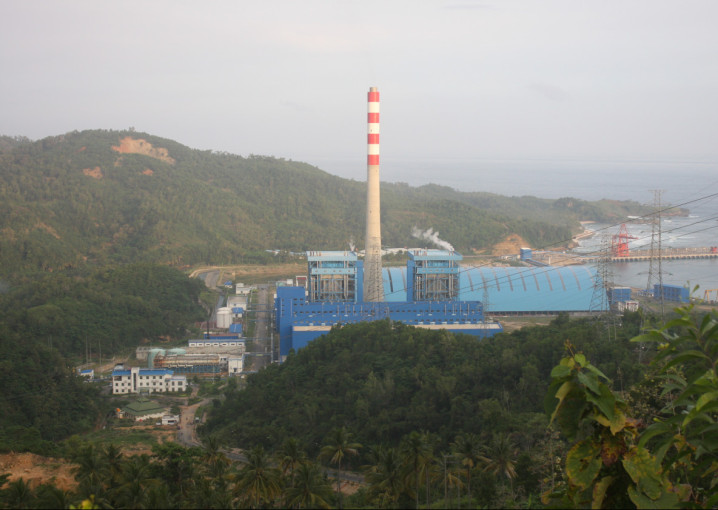
The Universitas Gadjah Mada Community Service Program (KKN-PPM) Karsa Saka 2025 team undertook an innovative project utilizing fly ash and bottom ash (FABA) from the Sudimoro coal-fired power plant (PLTU) in Pacitan. The initiative emerged from the pressing need for safe road infrastructure in the villages of Pagerkidul and Pagerlor, where deteriorating conditions have long hindered mobility and raised the risk of traffic accidents.
“This prompted us to choose FABA utilization as an alternative material for road paving,” said Muhammad Bafaqih Rizal Hunafa, a Civil Engineering Department student from the UGM Vocational College (SV UGM), in an interview on Wednesday, Aug. 27, 2025..
The choice of this program considered not just the availability of PLTU waste, but also its relevance to the local community’s needs.
This alternative material offers the potential for cost-effective and eco-friendly development.
Moreover, the project aligned with the village’s priorities to improve access to schools, markets, and health care facilities.
“We saw a significant opportunity in utilizing this waste to support the sustainable development of the village,” noted Ayu Afdha Fadia, the KKN-PPM team member.
In implementation, the students combined innovation with appropriate technology.
They mixed fly ash and bottom ash with cement, sand, and gravel to create a strong, standardized blend.
This approach also reduces reliance on increasingly costly natural materials.
“This appropriate technology is a new solution that the community can adopt,” explained Aisha Razita Khairani, also from SV UGM.
The program also highlighted the importance of synergy among students, the community, and external partners.
Resource limitations in the field were mitigated through community mutual cooperation, and PLTU support with materials and technical guidance reinforced confidence in the program’s sustainability.
“The community was directly involved, from communal labor to the road paving process,” Khairani added.
Tangible benefits quickly became evident.
Approximately 600 to 1,000 meters of village road were successfully repaired, enabling significantly smoother mobility.
This improvement positively affected economic activity, as traders, farmers, and students gained easier access to their destinations.
“Many economic actors such as traders, farmers, and students now move around with greater ease,” confirmed Vivi Aryanti, another member.
The project’s sustainability is secured as the village government has incorporated the road development plan using FABA into its Local Government Information System (SIPD).
Additionally, a follow-up collaboration with the PLTU for 2025 has been submitted to ensure that the benefits extend beyond the KKN-PPM period.
Support from village officials, youth organizations, and community self-help efforts is crucial for maintaining the initiative’s continuity.
“We hope this innovation continues so its benefits can be more widely felt by the village community,” emphasized Hunafa.
To reinforce the program’s technical justification, the KKN-PPM team conducted a road assessment using the Pavement Condition Index (PCI) method.
The survey results, compiled by Hunafa and Fadia, showed the average road condition at a PCI value of 18.50, categorized as ‘Severely Damaged’.
These findings demonstrate the urgent need for road rehabilitation to facilitate agricultural distribution and access to basic services.
“Based on this assessment, we recommend road rehabilitation using FABA as a more economical and environmentally friendly alternative material,” concluded Hunafa.
Author: Triya Andriyani
Post-editor: Lintang Andwyna
Illustration: Pacitanku.com