


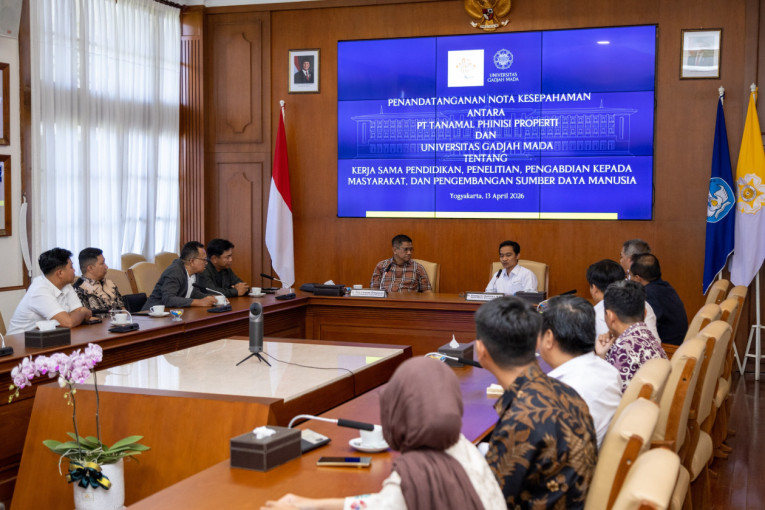
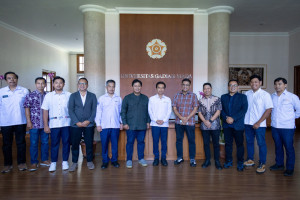
Universitas Gadjah Mada (UGM) signed a Memorandum of Understanding (MoU) with PT Tanamal Phinisi Properti on Monday (April 13) at the UGM Rector’s Guest Room. The collaboration covers education, research, community service, and human resource development. The meeting was attended by leaders from both institutions and was followed by discussions on potential research collaborations.
The UGM Center for Energy Studies (PSE) is planned to serve as the initial driving force in implementing the agreement, particularly in area status assessments and business development. This collaboration is expected to create a shared working space that contributes to national development.
Welcoming the partnership, UGM Vice Rector for Research, Business Development, and Cooperation, Dr. Danang Sri Hadmoko, S.Si., M.Sc., affirmed UGM’s readiness to support its partners’ needs through a multidisciplinary approach. He explained that various fields of study at UGM are interconnected, ranging from science and engineering to social sciences, economics, and law. This integration enables issues to be examined from multiple perspectives, resulting in more comprehensive and applicable solutions.
“At UGM, we are accustomed to working across disciplines, allowing us to address problems holistically and identify the most relevant solutions,” he said.
Furthermore, Danang views this collaboration as an initial step toward more concrete cooperation. He highlighted UGM’s experience in various research projects in Sulawesi as valuable capital to support the company’s needs. These studies cover sustainability issues, coastal area management, and local economic development. This experience has brought UGM closer to the context of the region to be developed.
“We hope this partnership will not remain on paper but will be translated into tangible programs with real impact,” he added.
This perspective was positively received by the President Director of Tanamal Phinisi Properti, A. Eka Firman Ermawan, who considers UGM a suitable partner. He explained that the decision to collaborate with UGM was driven by the need for independent and reliable studies. UGM’s reputation in providing insights for government and industry was a key consideration. For him, trust is a crucial foundation in this partnership.
“We deliberately chose UGM because we want truly neutral studies that we can rely on without any underlying interests,” he stated.
Eka Firman then outlined the challenges the company faced, particularly legal issues in the development area. He noted that land-related issues at the project site are quite complex and often create obstacles. This situation requires support grounded in strong academic research. He expressed hope that UGM could provide clear direction in addressing these challenges.
“Land issues there are quite complicated, so we really need objective legal input that can serve as a solid basis for decision-making,” he explained.
In response, the Acting Head of the UGM Center for Energy Studies, Professor Sarjiya, emphasized that legal issues need to be viewed more broadly. He pointed out that economic and social aspects are interconnected and cannot be separated. A multidisciplinary approach is one of UGM’s strengths in delivering more comprehensive solutions. By involving various fields of expertise, the resulting studies can be more contextual.
“When discussing legal matters, they must be supported by economic and social perspectives to ensure truly comprehensive solutions,” he said.
In line with this, Dr. Agung Satriyo Nugroho, S.Si., M.Sc., from the UGM Center for Energy Studies, proposed strengthening the collaboration through research and innovation. He encouraged joint research and development activities at UGM, a research hub. This scheme is considered capable of accelerating the downstreaming of research outcomes for industrial needs. In addition, the involvement of research centers can enhance the quality of the solutions produced.
“We see an opportunity for research and development activities to be carried out at UGM, enabling the results to be directly developed and utilized,” he concluded.
Author: Triya Andriyani
Post-editor: Zabrina Kumara
Photo: Donnie