


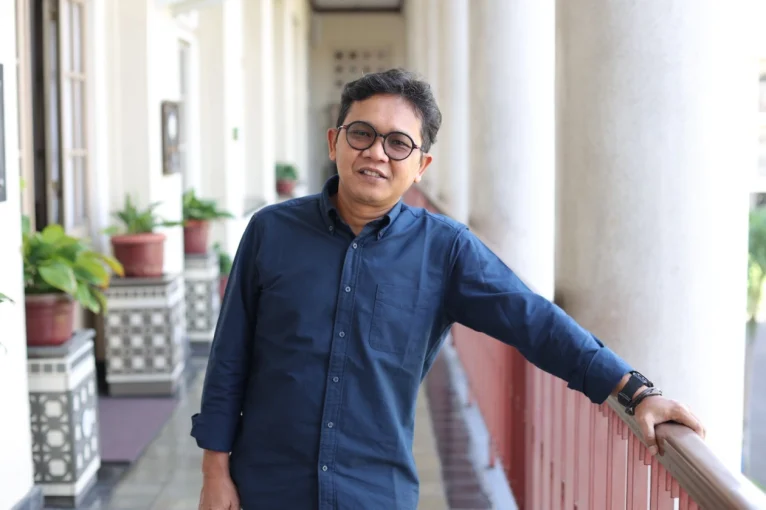
Democracy depends on more than elections to transfer power. Between elections, oversight, space for criticism, and civil society participation also help determine the health of democratic life. When these mechanisms weaken, the issue goes beyond relations among state institutions and begins to affect public trust in democracy. UGM Sociologist Dr. Arie Sujito has identified several warning signs that warrant attention, ranging from weak parliamentary oversight to shrinking space for public criticism.
One issue Arie highlights is the weakening of checks and balances in government. Parliament is mandated to oversee the exercise of power and articulate public interests through its representative and oversight functions. When these functions are ineffective, the public loses one of its institutional channels for ensuring that government policies can be tested and corrected.
“Democracy in Indonesia is increasingly declining, deteriorating, and under stress. This is reflected in the fact that our checks and balances are not working,” Arie said Thursday (October 8).
This situation is also related to public trust in representative institutions. Parliament is expected not only to participate in policymaking but also to exercise oversight when government policies or actions create problems. If this oversight is not evident, public disappointment can turn into distrust of an institution that should form part of the democratic system.
“If parliament cannot effectively balance the exercise of power, then it should come as no surprise that the public increasingly loses trust in it,” he said.
Arie also sees a problem in the relationship between the government and the realities unfolding in society. He questioned whether the various social and economic problems the public experiences are actually reaching the president through government channels. Incomplete information can prevent policies from adequately responding to problems on the ground.
“I am concerned that accounts of what is happening in reality may not be reaching the president. Or perhaps there is simply not enough sensitivity to these issues,” he said.
For this reason, voices from outside the government are important to ensure that these realities are heard. Students, academics, journalists, and civil society groups can provide platforms for criticism while offering alternative perspectives on government policies. Arie cautioned against treating these groups as adversaries simply because they express criticism.
“Do not treat young people as enemies. Do not treat experts as enemies. Do not treat students as enemies simply because they voice criticism,” he said.
Problems arise when criticism is met with restrictions or actions that discourage people from expressing their views. In Arie’s view, such responses risk narrowing public space and denying issues that require correction an adequate forum for dialogue. Criticism should be part of the evaluation process, particularly when government policies directly affect people’s lives.
“If criticism is met with restrictions, intimidation, criminalization, and similar responses, the situation will not improve,” he said.
Arie added that the government needs to respond to criticism by improving policies when problems requiring correction are identified. Public trust cannot be built through one-way communication alone; the government must demonstrate that public input can lead to policy improvements. In a tense situation, such a response becomes even more important to prevent criticism from developing into broader distrust of state institutions.
“Build trust by showing that criticism is heard and can help the government make better decisions,” Arie said.
Higher education institutions also play an important role in this situation. Universities do not exist solely to produce knowledge for academic purposes; they also have a moral responsibility to apply that knowledge to understanding public issues. Arie views intellectuals’ critical thinking as part of this responsibility, including when their criticism is directed at the government.
“Intellectuals have a duty to think critically and draw attention to the situation so that Indonesia can continue to develop,” he said.
In Arie’s view, criticism should not be understood as an attempt to bring down the government. Instead, it can scrutinize policies, identify weaknesses, and create opportunities for improvement before problems develop into larger crises. Therefore, protecting space for criticism is essential to keeping democracy functioning through evaluation and oversight.
“Do not be allergic to criticism, because criticism can also help a nation grow,” Arie concluded.
Author: Triya Andriyani
Post-Editor: Priyananda
Photo: Donnie