


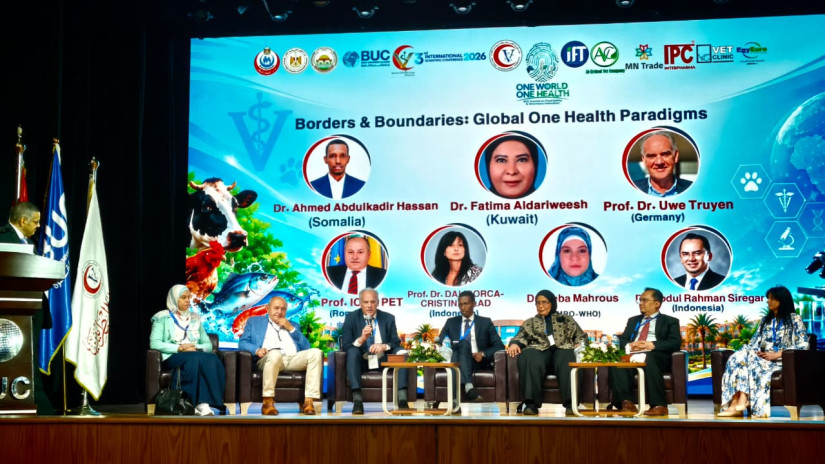
Universitas Gadjah Mada (UGM) continues to strengthen its role in developing academic networks and international collaboration through its participation in the PROACT 2026 Winter School and the 3rd International Scientific Conference “One World, One Health,” hosted by Badr University in Cairo (BUC), Egypt. UGM was represented by Professor Tri Wibawa, Chair of UGM’s One Health initiative, and Dr. Abdul Rahman Siregar. The events took place from October 17 to 21, 2026, in Cairo and Ain Sokhna, Egypt.
As Chair of UGM’s One Health initiative, Tri Wibawa emphasized the need for a collaborative approach to address increasingly complex global challenges. Issues such as zoonotic diseases, antimicrobial resistance, environmental change, and food safety require integrated solutions involving multiple disciplines, sectors, and countries. This highlights the importance of UGM’s One Health initiative participating in PROACT 2026.
“UGM pays considerable attention to this issue and received a very positive response from the conference participants,” he said on Friday (Oct. 30).
In his presentation, Tri outlined several initiatives Indonesia has undertaken to strengthen the implementation of the One Health approach. These include establishing a consortium involving universities and the National Research and Innovation Agency (BRIN), developing educational programs, strengthening interdisciplinary collaborative research, and conducting community service activities.
“We established a consortium involving universities and BRIN. In education, we have advocated that study programs incorporate One Health issues into their curricula, including introducing a One Health concentration in the Master’s Program in Public Health. We have also launched a reference book entitled The One Health Concept in Asian Contexts, published by Springer,” he explained.
In research, his team encourages interdisciplinary collaboration with national and international partners. Meanwhile, community service initiatives include webinars, public education activities, assisted village programs, health promotion through social media, and thematic Student Community Service (KKN) programs.
At the same forum, Dr. Abdul Rahman Siregar, a lecturer at UGM’s Faculty of Biology (Biology UGM) and Indonesia Coordinator for the PROACT 2026 program, served as one of the speakers in an international panel titled “Borders & Boundaries: Global One Health Paradigms.”
The discussion highlighted the importance of transcending geographical, sectoral, and institutional boundaries to address global health challenges.
Tri said one key message emphasized during the discussion was the need for a shared understanding among experts and practitioners on implementing One Health as a collective movement.
“Experts and practitioners need to share a common understanding and platform on how One Health can serve as a collective movement to protect the health of humans, animals, and the environment,” he explained.
He added that this approach requires involvement from various academic disciplines and sectors to ensure health issues are not addressed in isolation. Coordination among stakeholders and cross-border cooperation are also essential to promoting the sustainable implementation of One Health.
UGM’s participation also creates opportunities to build partnerships with international institutions. The event brought together academics, researchers, practitioners, and students from 12 countries across Asia, Africa, and Europe.
PROACT 2026 involves UGM, Leipzig University in Germany, and Badr University in Cairo, Egypt, with support from the German Academic Exchange Service (DAAD).
Tri noted that the international networks established during the events offer further opportunities for collaboration, particularly in education and research.
“There are significant opportunities for cooperation. We will hold regular follow-up meetings to discuss the implementation of One Health in both education and research,” he said.
He expressed hope that these networks would lead to concrete collaborations that strengthen UGM’s contribution to advancing integrated health approaches at both national and international levels.
Through this participation, UGM continues to promote cross-disciplinary and international collaboration in addressing global health challenges, including zoonotic diseases, antimicrobial resistance, environmental change, and food safety.
Author: M. Aidil Syahputra
Editor: Gusti Grehenson
Post-editor: Zabrina Kumara
Photograph: Tri Wibawa Documentation