


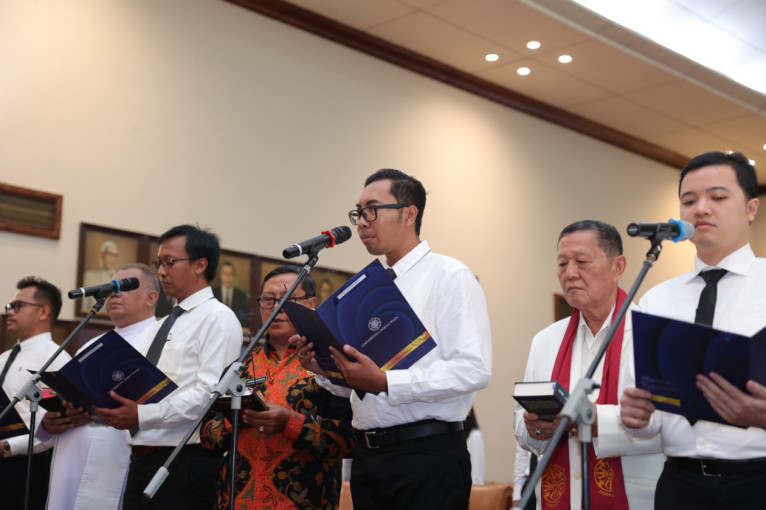
Universitas Gadjah Mada (UGM) held an oath-taking ceremony for university employees and personnel holding functional positions on Wednesday (Nov. 18), in a hybrid format. The event involved 1,465 UGM employees, comprising 168 civil servants and 1,297 employees, as well as 434 individuals holding functional positions, including 396 lecturers and 38 faculty members.
UGM Director of Human Resources Professor Suadi reported that the oath-taking ceremony was conducted in accordance with applicable laws and regulations, as well as UGM Rector’s Regulations, which require every employee and functional official to take an oath in accordance with their respective religions and beliefs. The hybrid format was chosen to ensure that the ceremony remained solemn despite the large number of participants being sworn in.
“This oath-taking ceremony is a testament to our commitment and moral responsibility to God Almighty, our nation, our country, and our institution,” he said.
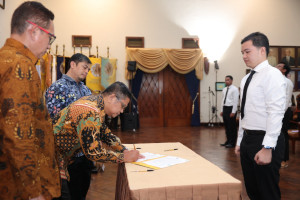
Suadi further explained that the employee oath forms part of efforts to uphold loyalty, integrity, compliance with laws and regulations, and the prioritization of national and public interests.
Meanwhile, the functional position oath reaffirms a commitment to carrying out the responsibilities of the position professionally, upholding professional ethics, and continuously developing one’s competencies.
“A position is a trust that must be accounted for through one’s work, dedication, and contributions to the institution, nation, and country,” he said.
Meanwhile, UGM Vice Rector for Human Resources and Finance Professor Supriyadi reminded participants that taking an employee oath or a functional position oath is an important part of the professional service and career development of UGM’s academic and professional community.
He said that every employee is responsible for internalizing the values embodied in the oath and using them as a foundation for carrying out their daily duties.
“The employee oath and the functional position oath are not merely administrative formalities or ceremonial procedures. Rather, they are declarations of commitment and moral responsibility with profound significance,” he emphasized.
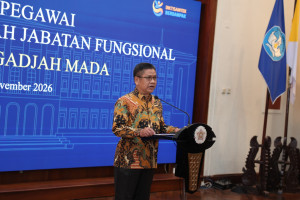
From a human resource management perspective, Supriyadi said that appointments and career development should not be viewed merely as changes in employment status or promotions to higher positions but as opportunities to strengthen individual capacities and expand contributions.
For lecturers, this responsibility is reflected in their commitment to fulfilling the Tri-dharma of higher education—education, research, and community service—while upholding ethical standards and responsible academic freedom.
“For education personnel, meanwhile, professionalism must be reflected in service quality, the timely and accurate performance of duties, innovation, and support for effective, transparent, and accountable university governance,” he explained.
In closing, Supriyadi encouraged all employees to take an active role in their personal development and remain open to change in order to respond to the increasingly dynamic challenges facing the education sector.
He also congratulated all the employees and functional officials who had just been sworn in.
“The oath taken today is not a commitment that ends when the oath-taking ceremony is over. Rather, it must remain present in our actions, decisions, and the way we carry out our daily responsibilities,” he concluded.
Author: Triya Andriyani
Post-Editor: Priyananda
Photo: Firsto