


The gap in knowledge and technical capacity between developed and developing countries remains a challenge in keeping pace with advances in soil science and mapping technology. At the same time, developments in artificial intelligence, remote sensing, and observation technologies offer opportunities to strengthen soil research and mapping capacity in Indonesia.
The Center of Excellence for Inter-University Collaboration (PUAPT) at Universitas Gadjah Mada (UGM) continues to strengthen research and innovation in support of national food security through advances in soil science and mapping technology, as well as research collaboration, knowledge dissemination, and international conferences.
“We bring scientists together to share knowledge and experience and help strengthen the scientific capacity that is needed. More importantly, this capacity needs to be translated into meaningful influence and contributions to policymaking,” said UGM PUAPT Coordinator Wirastuti Widyatmanti during the international Pedometrics conference, held September 14–18 at the Novotel Bali Ubud Resort in Bali. The conference brought together researchers and scientists in quantitative soil science from around the world.
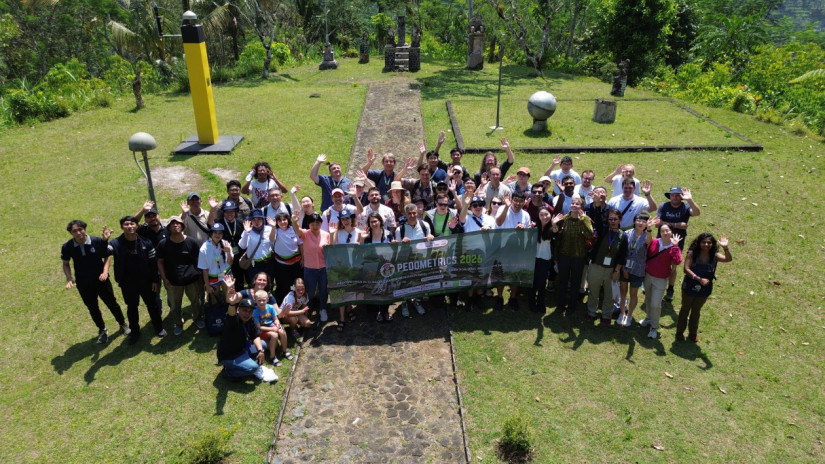
Held under the theme “Intelligence, Integration, and Innovation in Soil Science,” Pedometrics 2026 drew about 120 participants from 19 countries, including Australia, China, Indonesia, the Netherlands, Russia, and South Africa.
This year’s event marked an important achievement for UGM as the Pedometrics conference was held in Southeast Asia for the first time, in collaboration with the University of Sydney.

Alexandre Wadoux, Chair of the Pedometrics Commission of the International Union of Soil Sciences (IUSS), said Pedometrics 2026 was being held at a strategic time amid rapid advances in artificial intelligence. He expressed hope that the conference would provide a forum to discuss new methods, datasets, and applications in soil science, while opening opportunities for new ideas in the future development of the Pedometrics discipline.
“With soil intelligence at the core of this meeting, I hope we will not focus only on incremental developments, but also make room to consider new possibilities. The most important and exciting directions for Pedometrics may not even be part of our current program because they have not yet fully taken shape,” he said.

Dean of the UGM Faculty of Geography and a member of the PUAPT Working Group on Food Security, Professor Muhammad Kamal, said hosting the first Pedometrics conference in Southeast Asia was a strategic opportunity for UGM to contribute to the development of the Pedometrics community while strengthening collaboration among institutions and countries.
He added that hosting Pedometrics aligned with UGM’s commitment to strengthening national research capacity.
“This event serves as an important platform for disseminating research findings while connecting them with a broader national and international research community,” he said.
Kamal also highlighted challenges in soil management arising from climate change and land-use change, including shifts in rainfall patterns, rising temperatures, and increasingly frequent extreme events.
According to Kamal, these conditions require stronger connections among soil science, geography, geospatial technology, remote sensing, and modeling. This aligns with UGM’s commitment through PUAPT to strengthening national research capacity, particularly through the Soil Security Working Group developed by the Faculty of Geography and the Faculty of Agriculture. The group focuses on land and water management, climate change adaptation, regional development, and carbon assessment to support food sovereignty.
“We believe that soil research today needs to become increasingly intelligent, integrated, and innovative to respond to the scale and complexity of environmental change,” he said.
The conference program, held September 15–17, featured keynote speeches, oral presentations, and poster presentations, providing participants with opportunities to present their research findings and discuss developments in quantitative soil science methods and applications.
On the first day, Dr. Siti Sumilah Rita Susilawati from the Geological Agency of the Ministry of Energy and Mineral Resources and Professor Ni Luh Kartini from Universitas Udayana delivered keynote speeches. On the second day, participants heard practitioner perspectives in a keynote speech by Joseph Sudiro from Pertamina Foundation.
In addition to the three speakers, the conference featured six international keynote speakers: George Munnik van Zijl of North-West University, Lin Yang of Renmin University of China, Tom Vanwalleghem of the University of Cordoba, Wartini Ng of the University of Sydney, Jonas Schmidinger of Osnabrueck University, and Colby Brungard of New Mexico State University.
As the final part of the conference program, participants joined a field trip on September 18, 2026, organized in collaboration with Universitas Pendidikan Ganesha and the Center for Volcanology and Geological Hazard Mitigation (PVMBG).
Participants observed the Mount Batur landscape in the morning before visiting Besakih Temple and the Mount Agung Observation Post. They then explored the Mount Kawi area and Kanto Lampo Waterfall to deepen their understanding of Bali’s geological and environmental phenomena.
The organization of Pedometrics 2026 marks an important achievement for UGM in expanding its international academic network. Going forward, UGM is committed to developing this network into sustainable research collaborations with partners from various countries.
“This step is part of UGM’s efforts to strengthen its role in the global research ecosystem and create more opportunities for Indonesian researchers to connect with the international academic community,” Wirastuti said.
This international conference is supported by PT Sinar Mas Agro Resource and Technology (SMART), PT Paragon Technology and Innovation, Pertamina Foundation, and Stellarvision. PEDOMETRICS 2026 is also supported by the European Journal of Soil Science (EJSS), Soil Advances, and Jurnal Sains Tanah as journal partners
Author: Cyntia Noviana
Editor: Gusti Grehenson
Post-Editor: Priyananda
Photo: PUAPT Documentation