


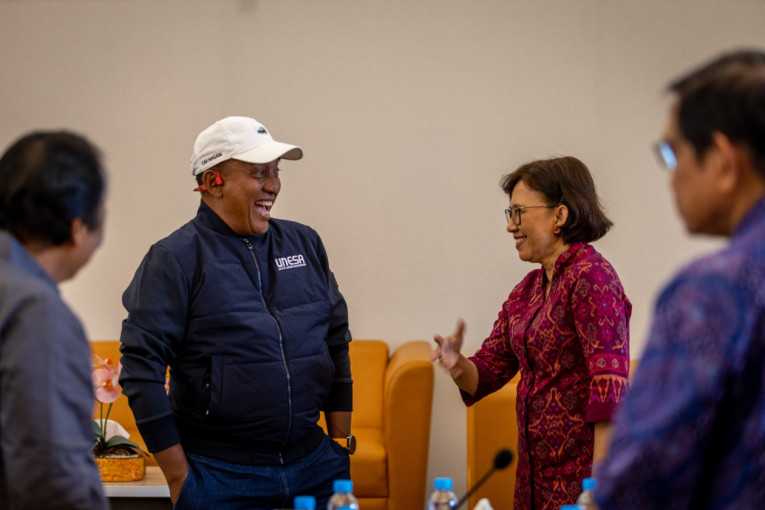
UGM’s Board of Trustees (MWA) welcomed a delegation from the Board of Trustees of Universitas Negeri Surabaya (MWA Unesa) on Tuesday (Jul. 28) at the UGM Central Office. The Unesa delegation was led by MWA Chair Professor Haris Supratno and included board members and Unesa Rector Professor Nurhasan. UGM MWA Chair Professor Tumiran, along with board members, UGM Rector Professor Ova Emilia, and university officials, warmly received the visiting delegation.
Professor Supratno explained that the visit aimed to benchmark UGM’s rector election mechanism. As Unesa recently transitioned from a Public Service Agency (BLU) to a Legal Entity State University (PTN-BH), it is now operating under the same governance model as UGM. He said the university sought to learn how UGM integrates the roles of the Board of Trustees, the University Academic Senate, and the Rector to ensure that the rector election process runs smoothly, securely, and effectively.
In addition, Unesa is considering establishing a university bank, an initiative that UGM has successfully implemented through its Rural Bank (BPR UGM) for many years.
“We hope this visit will benefit us as we prepare for our rector election process and explore the establishment of a rural bank, while also gaining valuable ideas and experiences from UGM,” he said.
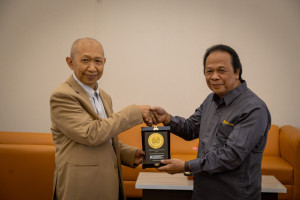
Professor Tumiran welcomed the benchmarking visit and said he was willing to share information about UGM’s rector election mechanism. He emphasized that the election process is governed by the university statute and is based on the principles of democracy, inclusiveness, and productivity.
“UGM’s development shows that democratization has been carried out well, the process remains aspirational, and the atmosphere stays productive after the election. That is what we have experienced, and those are the fundamental principles upheld at UGM,” he said.
In his presentation, Bagus Santoso, Chair of the Internal Commission and Member of the UGM Board of Trustees for the 2021-2026 term, emphasized that the rector election mechanism is founded on the principle of collegial collective decision-making to prevent domination by any single party and to ensure that decisions are made in the best interests of the university rather than personal preferences.
One key feature highlighted was the Nyawiji Forum, an inclusive platform that brings together faculty members, students, education staff, and alumni to gather broad aspirations before prospective rector candidates formulate their programs.
“The most important aspirations are not those that are heard the loudest, but those that determine the university’s long-term sustainability,” he explained.
Santoso added that the rector election mechanism involves a Working Committee responsible for administrative matters, the University Academic Senate for academic screening, and the Board of Trustees for the final selection. According to him, the Board’s primary focus is not merely to identify a qualified candidate, but to select the individual best suited to the university’s strategic needs and mandate for the next five years.
“After the Rector is elected, the Board of Trustees continues to oversee the transition and reunification process to maintain a conducive environment and preserve the unity of the university,” he said.

Addressing the topic of founding a university-affiliated financial institution, BPR UGM President Director Sri Wulandari highlighted that the bank adheres strictly to conservative banking standards. To uphold strong corporate governance and protect the institution’s standing, BPR UGM undergoes detailed regulatory oversight and auditing by several bodies, such as the Financial Services Authority (OJK), Bank Indonesia, the Indonesian Financial Transaction Reports and Analysis Center (PPATK), the Indonesia Deposit Insurance Corporation (LPS), and the Audit Board of Indonesia (BPK).
Beyond generating profits, BPR UGM actively supports the university’s Tri Dharma missions by serving as a practical learning laboratory for Banking students at the UGM Vocational College, allowing them to gain hands-on experience in the banking industry.
The bank also provides financial services for the university community, including employee welfare loans such as low-interest home ownership financing.
“To this day, regardless of who serves as Rector of UGM, there has never been any intervention in BPR’s governance. This is essential to maintaining the bank’s independence from campus influence and protecting the institution’s reputation,” she said.
Speaking on the establishment of university banks today, Wulandari noted that current OJK regulations are significantly stricter than in the past, particularly regarding minimum capital requirements. She suggested that acquiring an existing rural bank facing capital constraints could be a more feasible approach. However, she stressed that such acquisitions must be carried out with utmost prudence through comprehensive due diligence of the target bank’s assets and records.
Author: Jesi
Editor: Gusti Grehenson
Post-editor: Zabrina Kumara
Photo: Donnie