


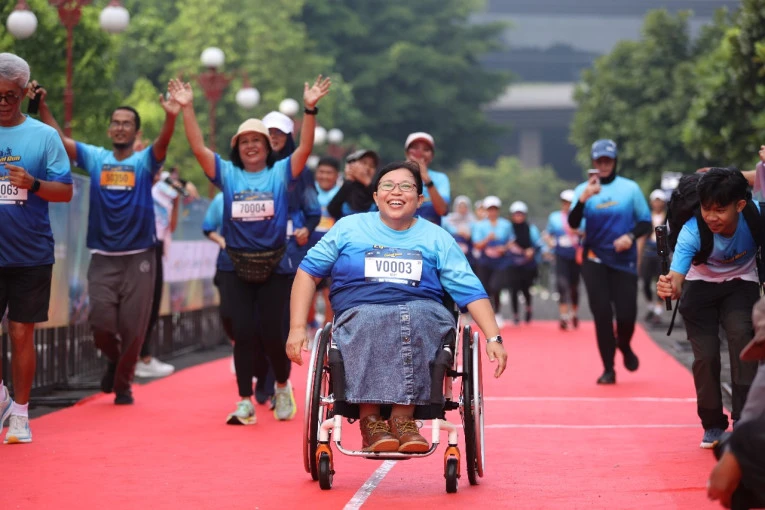
A lecturer at the Faculty of Economics and Business at Universitas Gadjah Mada (FEB UGM), Wuri Handayani, S.E., Ak., M.Si., M.A., Ph.D., has received an international award at the Universitas 21 (U21) Awards for her contributions to advancing inclusive global engagement. The award recognizes her efforts to expand access to higher education for persons with disabilities. It positions Wuri as an academic and advocate who has successfully driven systemic change at the institutional level and within global networks.
The award was presented on April 21 during the Universitas 21 Annual Network Meeting and Leadership Summit at the University of Glasgow, Glasgow, Scotland. In addition to Wuri, three other recipients were honored: Professor Pamela Ronald from the University of California received the U21 Award in the Climate Change category for her contributions in plant genetics to address food security challenges amid climate change.

Emma Etim, a student at the University of Glasgow, received the U21 Leaders of the Future Award – Recent Student for her work exploring environmental responsibility. Meanwhile, Deborah Adeniran, a University of Glasgow alumna, received the U21 Leaders of the Future Award – Recent Alumna for her leadership in healthcare in Nigeria and for founding CancerAid_Africa.

The award received by Wuri, who currently serves as Head of UGM’s Disability Services Unit (ULD), is closely tied to her personal journey as a person with a disability who has experienced discrimination both in academic settings and public services. She explained that these experiences became the starting point for her commitment to advocating equal access to education for persons with disabilities.
“I have experienced firsthand the barriers and discrimination faced by persons with disabilities,” Wuri said on Sunday (May 3).
However, she had a different experience when pursuing her master’s degree at the University of Leeds in the United Kingdom. There, she observed how the education system provides structured disability services through a dedicated disability service unit that accommodates both the academic and non-academic needs of persons with disabilities.
“There is a disability service unit that facilitates all disability-related needs. That experience inspired me to bring a similar service to Indonesia, particularly at UGM,” she said.
Upon returning to Indonesia, she took steps to advocate for the establishment of a disability services unit, particularly following the enactment of Law No. 8 of 2016 on Persons with Disabilities. In 2019, she helped establish the Disability Services Unit (ULD) at UGM. The process was temporarily hindered by the COVID-19 pandemic, but efforts regained momentum in 2023 through workshops, the drafting of academic papers, and university-level discussions. This long journey culminated in the issuance of Rector Regulation No. 19 of 2024 establishing UGM’s Disability Services Unit. In December 2024, the ULD UGM was officially inaugurated.
The tangible impact has been strongly felt by members of UGM’s academic community with disabilities. She noted that since the establishment of the ULD, various reasonable accommodations and facility adjustments have been provided for students with physical, visual, hearing, and mental disabilities. This impact is also reflected in the increasing number of students with disabilities who are accessing services and gaining greater confidence to participate in academic activities.
“They now see that the ULD exists and plays a role, and they are willing to disclose their needs and ask for support,” she said.
For Wuri, the inclusive global engagement award at the U21 international forum represents recognition of the collective efforts of her team and students with disabilities. She hopes the award will motivate her to continue contributing actively toward creating a more inclusive Indonesia.
“It is not just about me; there are many people behind me, including students with disabilities, who continue to place their trust in this work. This motivates me to do even better,” she explained.
Looking ahead, she hopes that ULD UGM can develop into a center of excellence in disability services in higher education. The services are expected to extend beyond students to include lecturers and education staff.
In addition, she envisions ULD becoming a national reference for policy, research, and innovation. She also emphasized that adopting a universal design for learning approach will be a key agenda item, particularly for designing more flexible curricula without compromising learning outcomes.
“Inclusivity is not an endpoint but something that must be continuously pursued. It cannot be done alone; it requires collaboration and synergy from all parties,” Wuri concluded.

UGM Vice Rector, Dr. Danang Sri Hadmoko, S.Si., M.Sc., who attended and represented Wuri Handayani in receiving the award at the U21 international forum in Glasgow, Scotland, stated that this achievement reflects UGM’s strong commitment to being an inclusive university. This commitment extends beyond physical facilities to include policies and systems that support inclusivity.
“She represents UGM’s role as an inclusive university that is welcoming to all, a home for learning, engaging, and building the future. Therefore, the role of UGM’s Disability Services Unit (ULD) is crucial,” he said.
He also highlighted that the award, presented at an international forum in Glasgow, was the result of a rigorous selection process involving hundreds of candidates from various countries. As such, he believes the recognition has a concrete impact on UGM’s global standing. In addition to enhancing its reputation, the achievement strengthens public trust in the institution.
“I believe this is global recognition of UGM’s achievements. It directly contributes to enhancing UGM’s reputation, both nationally and globally. It also strengthens public trust. Internally, this serves as validation that the systems and standards we have developed are globally recognized,” he stated.
He further expressed hope that UGM will continue to strengthen its commitment to inclusivity, including in policy development and research.
“We hope UGM can become a trendsetter and an inspiration, so that the policies and best practices developed here can be adopted by other universities and the government,” Danang concluded.
Author: Cyntia Noviana
Editor: Gusti Grehenson
Post-editor: Zabrina Kumara
Photos: UGM Public Relations and Universitas21