


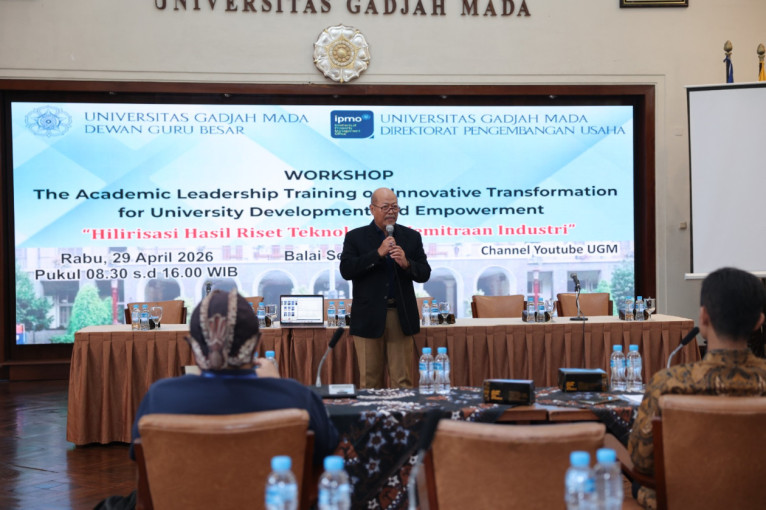
Professors are not only tasked with carrying out the tridharma of higher education, education, research, and community service, but also with producing scholarly publications. Beyond these responsibilities, professors at higher education institutions are also expected to formulate strategic ideas to address issues at the local, national, and global levels.
“Professors must be able to develop strategic thinking to respond to various national challenges,” the Chair of the UGM Professorial Board, Professor M. Baiquni, said during the workshop, The Academic Learning Training on Innovative Transformation for University Development and Empowerment, held at the UGM Senate Hall on Wednesday (April 29).
Professor Baiquni further emphasized the role of professors in safeguarding UGM’s identity and contribution as a national university and a university of struggle, grounded in the values of Pancasila, people-centered development, and culture.
“These values must continue to be internalized by the academic community in every scholarly contribution,” he said.
He also highlighted the importance of professors exemplifying the values and attitudes of national figures such as Sri Sultan Hamengkubuwono IX, as well as earlier UGM academics who made tangible contributions to national development through knowledge and service.
Meanwhile, the Vice Rector for Cooperation and Networks, Dr. Danang Sri Hadmoko, underscored in his remarks the strategic role of professors as academic leaders in addressing global challenges. He noted that the world is currently facing interconnected crises, ranging from climate, energy, and food crises to technological disruptions such as artificial intelligence.
“Universities must view these conditions not only as challenges but also as a wave of opportunities to generate innovative solutions,” he said.
Dr. Hadmoko cited several potential initiatives, including the development of precision agriculture, innovation in superior seeds, renewable energy, and strengthening downstream industries based on national resources. In this context, the approach promoted is a “triple win”: economic growth, environmental sustainability, and social inclusion.
Dr. Hadmoko also stressed the importance of professors as guardians of values, integrity, and the moral direction of higher education institutions, as well as mentors for the next generation of academics.
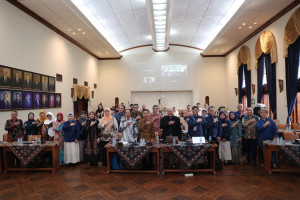
On the same occasion, the Secretary of the UGM Professorial Board, Professor Wahyudi Kumorotomo, explained that the activity is part of the “Altitude” program, which has now entered its fourth phase. The program is integrated with the Professorial Board’s forum of ideas to strengthen knowledge-based leadership capacity.
He noted that the workshop features speakers from government, industry, and academia, including representatives from the Ministry of Education, Culture, Research, and Technology and the Ministry of Industry, as well as industry practitioners.
In addition to discussion sessions, the program will continue with a field visit to the Kendal Industrial Park on May 6. This agenda aims to strengthen synergy among universities, industry, and local governments in promoting the implementation of research and innovation.
Through this activity, UGM expects its professors to build a shared understanding, strengthen cross-sector collaboration, and produce strategic ideas that can be implemented in practice.
“Each professor is expected to have a flagship work that can be synergized into research-based solutions for the wider community,” Professor Baiquni concluded.
This workshop reflects UGM’s commitment to continuously strengthening the role of higher education institutions as centers of innovation, knowledge development, and agents of transformation for national development.
Author: Jelita Agustine
Editor: Gusti Grehenson
Post-editor: Zabrina Kumara
Photo: Firsto