


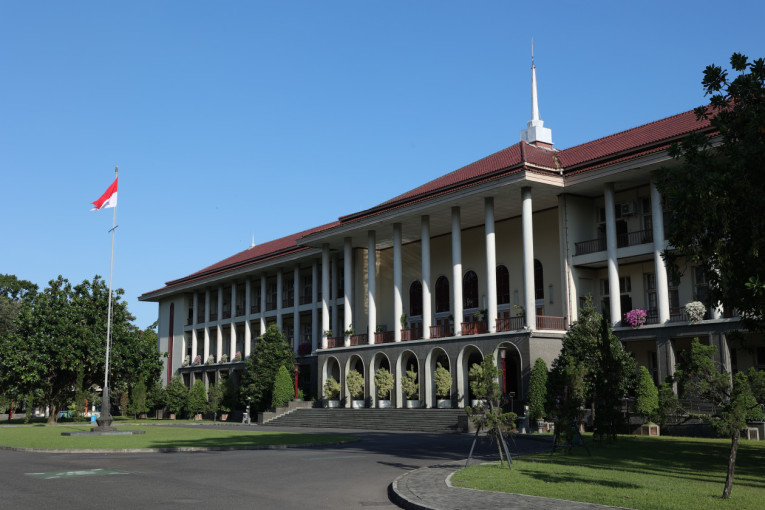
Universitas Gadjah Mada continues to promote the utilization of research outcomes by strengthening intellectual property protection and commercialization. This is reflected in UGM’s achievement of ranking first among Indonesian universities in the number of commercialized patents, with 35 patents generating Rp15 billion in royalties. Institut Teknologi Bandung (ITB) followed with 32 patents generating Rp12.4 billion in royalties, and Institut Pertanian Bogor (IPB) with 30 patents generating Rp10.8 billion in royalties, ranking second and third, respectively.
Director of Patents at the Directorate General of Intellectual Property (DGIP), Dr. Andreansjah, highlighted this achievement as the keynote speaker at the UGM IP Forum 2026, held in the Multimedia Room on the third floor of the UGM Central Building on Thursday (Oct. 1).
At the forum, which brought together regulators, academics, and industry practitioners, Dr. Andreansjah said the achievement indicates the growing maturity of intellectual property management at UGM. In line with the theme “Bridging IP Protection to Market Integration,” he emphasized that patents should not stop at a patent certificate but should be utilized to generate economic value.
“What matters most is no longer whether our innovations have been patented, but how they can be utilized after they are patented,” he said.
He compared a patent certificate to a land certificate, which would not provide optimal returns or value if it were merely kept. In his view, patents must be utilized through business development, licensing, and other forms of commercialization to generate value and benefits for inventors and society.
“Patents must create economic value,” he added.

On the effectiveness of patent utilization in higher education, Dr. Andreansjah said UGM has a strong foundation for developing patent commercialization through the intellectual property management ecosystem.
The Intellectual Property Management Office (IPMO) is an important component in building an ecosystem for patent utilization, covering the processes of creation, protection, and utilization of intellectual property.
Meanwhile, UGM Vice Rector for Research, Business Development, and Cooperation, Dr. Danang Sri Hadmoko, emphasized that obtaining a patent certificate is not the end of the innovation process. A patent grant instead marks the beginning of a major effort to bring research outcomes toward downstreaming and the market. This aligns with the objective of the UGM IP Forum 2026: to accelerate the downstreaming of UGM research by transforming patent protection into market integration.
“As much as possible, we need to utilize these patents for downstreaming and ensure that the products you develop can enter the broader market,” he explained.
Furthermore, Dr. Hadmoko reminded researchers that strengthening intellectual property protection must begin at the earliest stages of the research process. Based on his observations, some researchers have already developed products, found partners, and even established collaborations, but have yet to secure patent protection.
In addition to protection, Dr. Hadmoko emphasized the importance of collaboration among universities, the government, regulators, industry, business practitioners, and the public. Universities have strengths in research and development, while manufacturing and product development through to market entry require the involvement of businesses and industry.
“UGM cannot carry out manufacturing on its own because manufacturing is not the domain of academia. Our role at UGM is research and development,” he concluded.
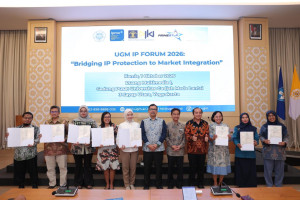
Echoing this view, Chair of the UGM Intellectual Property Management Office (IPMO), Professor Sang Kompiang Wirawan, said UGM continues to build collaborations in intellectual property development. In 2026, IPMO recorded patent achievements involving inventors from various faculties and academic clusters at UGM. In his presentation, the Faculty of Engineering and the Faculty of Mathematics and Natural Sciences (FMIPA UGM) continued to rank highest in terms of patent contributions.
Together with UGM IPMO, Professor Wirawan explained that UGM’s intellectual property management focuses not only on patent protection but also on supporting the downstreaming process. By strengthening IPMO’s functions in regulation, facilitation, legal affairs, curation, education, and data management.
Finally, Professor Wirawan added that strengthening this ecosystem is expected to connect inventions produced by the academic community with the needs of the business sector. Thus, patents do not remain merely protection documents but can continue to develop into innovations that benefit society and generate economic value.
“Our shared spirit is to continue creating and innovating. Let us continue to ensure that inventions can be brought to the downstreaming stage,” he concluded.
Author: Agito Sitepu
Editor: Gusti Grehenson
Post-editor: Jasmine Ferdian
Photograph: Firsto