


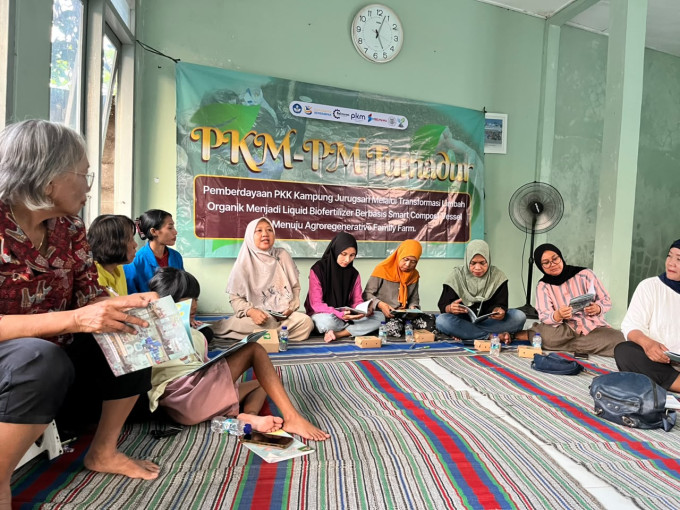
Universitas Gadjah Mada (UGM), through the Tumandur Student Creativity Program for Community Service (PKM-PM) team, has developed an innovation in household organic waste management using a Smart Compost Vessel in Jurugsari Village, Condongcatur, Sleman. The program aims to help residents process organic waste into liquid biofertilizer for enriching home gardens. Through simple technology, locals are encouraged to reduce household waste while increasing the productivity of their family gardens.
The outreach activity, held on June 22, was attended by 16 members of the Jurugsari PKK organization, local community leaders, and representatives of the Condongcatur Village administration. The program is part of UGM students’ efforts to support sustainable environmental practices while strengthening household food security.
The program was implemented by Siti Nur Khasanah, Rayhan Arva Pradipa, Nafi’atush Sholikhah, Vina Ayu Lestari, and Naafianda Ra’uuf Prastya under the supervision of Dr. Miftahush Shirothul Haq from the UGM Faculty of Animal Science (Animal Science UGM).
One of the innovations introduced was the Smart Compost Vessel, a tiered bucket-composting system equipped with temperature and pH sensors to monitor the quality of liquid biofertilizer during composting. The resulting liquid fertilizer is used to improve soil fertility in home gardens, supporting the cultivation of vegetables for household consumption. According to Dr. Haq, the innovation is expected to provide a simple and practical solution for communities to reduce organic waste while increasing its value.
“We hope this innovation will go beyond waste processing and encourage communities to become more self-reliant in strengthening household food security through the use of home gardens,” he said.
Siti Nur Khasanah, leader of the Tumandur PKM-PM team, explained that the program was designed as a collaborative learning process between students and the community. In addition to introducing organic waste processing technology, the team also assisted with the production of liquid biofertilizer for cultivating food crops around the home.
Household waste management can be more effective through changes in community habits regarding the utilization of organic waste. This approach should create a more sustainable waste management cycle at the household level.
“We want people to see that organic waste is no longer something that must be discarded, but a resource that can be reused to help meet family needs,” she explained.
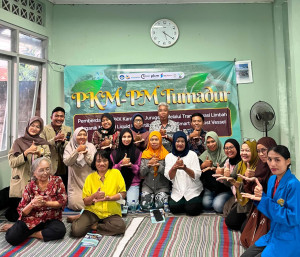
Throughout the activity, participants enthusiastically attended presentations and discussion sessions on the mechanisms of organic waste processing using the Smart Compost Vessel. Various questions were raised regarding the composting process, sensor operation, and methods for applying liquid biofertilizer to home gardens.
Ikhwani, Chair of the Jurugsari PKK organization, appreciated the student team’s preparation and coordination before the program’s implementation. The team’s approach helped residents better understand the benefits of independently managing organic waste.
“We hope this program can continue so that organic waste in Jurugsari can be utilized more effectively and provide tangible benefits for residents,” she said.
The Tumandur Program has also received support from various community groups and local government representatives. Purwoko, Chair of Neighborhood Association (RW) 57 in Jurugsari, stated that the initiative aligns with ongoing environmental development efforts in the area.
Retnaningsih, Head of Joho, noted the innovation introduced by the students has the potential to be developed as part of a community-based environmental management initiative. Similar support was expressed by the Condongcatur Village administration, which encouraged strong communication and collaboration throughout the program.
“This program is highly suitable for implementation in Jurugsari, and we are ready to support its continuation so that its benefits can be sustainably enjoyed by the community,” said Retnaningsih.
Through the Tumandur Program, UGM students hope that communities will not only reduce the volume of household organic waste but also gain economic and environmental benefits from its processing. The assistance provided will continue through various educational activities on waste management and the use of home gardens as sources of household food. This empowerment model is expected to encourage new habits of independent waste management while strengthening household-level food security.
The simple technology-based innovation demonstrates how collaboration between universities and communities can generate practical solutions to environmental challenges. With a sustainable approach, the Tumandur Program is expected to become a community empowerment model that can be replicated in other regions.
Reporter: Nafi’atush Sholikhah
Author: Triya Andriyani
Post-editor: Jasmine Ferdian