


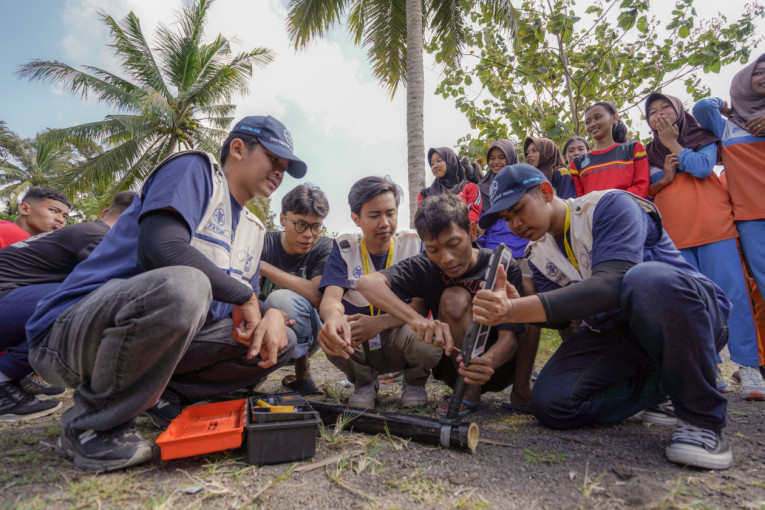
28 students participating in the Universitas Gadjah Mada Community Service Program (KKN-PPM UGM) in Srono District, Banyuwangi Regency, East Java, installed solar-powered streetlights to improve lighting. The program installed eight solar streetlights across Srono and Rejoagung villages.
“There are eight installation points in total, four in Wonosobo and four in Rejoagung,” said M. Farkhan Fauzan, a 2023 Electrical Engineering Technology student at UGM Vocational College (SV UGM), during an interview in Srono Village on Friday (Jul. 31).
Farkhan explained that the initiative was driven by a lack of street lighting in Srono District, particularly in Rejoagung and Wonosobo villages. The improvement aims for road safety, to prevent traffic accidents, and to address other public safety concerns that require sufficient nighttime lighting.
“At night, these roads were completely dark. After the installation, the results have been very satisfying. Several lights have been installed near the Wonosobo River, in Rejoagung, and most recently near the Wonosobo Sport Center field,” he said.
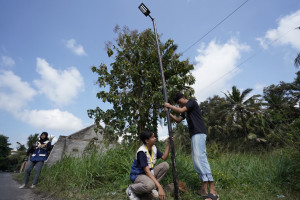
According to Farkhan, each installation cost about Rp200,000, while each solar lamp cost about Rp160,000. The remaining budget covered construction materials: cement, sand, and gravel for the concrete foundations. The streetlights provide optimal lighting for approximately eight hours.
“The lights turn on at 6 p.m. and remain at full brightness until around 11 p.m. After midnight until 6 a.m., the brightness gradually decreases,” he explained.
The solar streetlights have motion sensors that automatically increase brightness when vehicles or pedestrians pass by.
“When an object approaches, the light automatically becomes brighter,” he added.
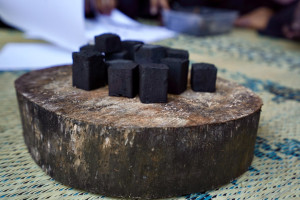
In addition to installing solar streetlights, the KKN-PPM students in Srono District also developed briquettes from coconut husks. The initiative emerged after they observed large amounts of coconut husk waste, even though the material could be processed into valuable briquettes.
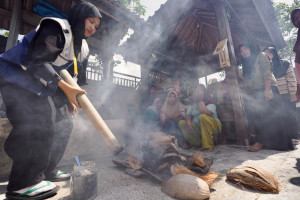
Layla Oktavia, the KKN-PPM coordinator for the Wonosobo subunit, said the project was inspired by the underutilized coconut waste generated by locals. Instead of being discarded, the coconut husks were turned into briquettes as an alternative to charcoal.
“Many residents simply throw away the coconut husks without using them. We wanted to show that they can actually be processed into something more useful with economic value, namely briquettes that can serve as a substitute for charcoal,” she explained.
Layla noted that coconut husk briquettes differ from conventional wood charcoal briquettes in their more uniform shape, as they are molded into small cube-shaped blocks.
To make them, they first burn the coconut husks into charcoal. They then crush the charcoal into powder and mix it with tapioca starch as a binding agent before molding.
“When mixed with water, tapioca starch becomes sticky, so it works well as the binder for the charcoal powder,” she explained.
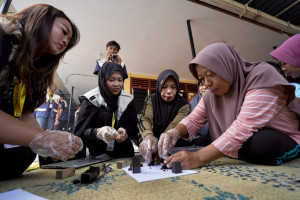
According to Layla, briquettes can also be produced from other types of biomass ash, including burned bamboo.
“Briquettes are not limited to coconut husks. Bamboo can also be used. Essentially, many kinds of ash can be processed into briquettes,” she said.
She added that using coconut husk ash makes production easier because dried husks burn more quickly than coconut shells.
“Coconut shells take longer to burn into ash. Dry coconut husks, on the other hand, burn much faster, making the production process more efficient,” she said.
Suyut Warsito, Head of Lembangrejo Hamlet, said the presence of KKN-PPM UGM students had brought significant benefits to locals, particularly through the installation of solar-powered streetlights.
“The streetlights that were installed have been especially beneficial. Overall, many of the students’ programs have provided real advantages for the community,” he said.
Semi Hartati (54), a resident of Lembangrejo Hamlet in Wonosobo Village, said she had gained new knowledge about producing briquettes from coconut husks. She believes the briquettes could serve as an alternative cooking fuel alongside LPG and charcoal.
“The process isn’t difficult, so they can certainly be used as a substitute for charcoal,” she said.
The Director of Community Service at UGM, Dr. Rustamaji, who attended the field visit to observe the students’ activities in Wonosobo Village, praised the programs carried out by the KKN-PPM participants. During the current inter-semester KKN-PPM period, UGM has deployed 8,178 students across 32 provinces in Indonesia.
“Most of the student projects focus on food security and climate change mitigation,” Rustamaji said.
Rustamaji also expressed his appreciation to regional governments, village administrations, and partner institutions for welcoming the students and providing opportunities for them to carry out meaningful community empowerment programs.
“Our evaluations so far show that all activities have been progressing well,” he concluded.
Author: Gusti Grehenson
Post-editor: Jasmine Ferdian
Photo: Firsto