


The need for energy efficiency in data centers is growing alongside rapid advances in artificial intelligence and rising demand for computing. Cooling systems are essential to maintaining data center performance. To date, data centers have generally relied on air- or liquid-based cooling methods.
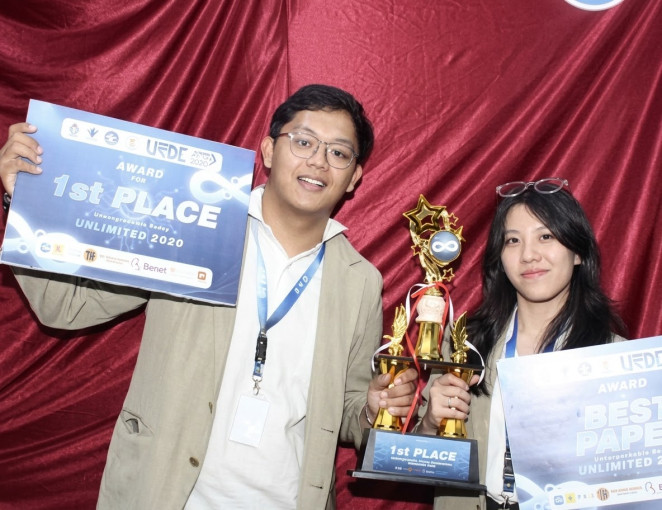
Two Universitas Gadjah Mada students from the MichEri Team, Erick Saputra Rawung from the Mechanical Engineering Study Program and Michelle Carissa Purnama from the Industrial Engineering Study Program, have proposed an innovative concept called “The F.O.R.C.E. Architecture,” a data center cooling system that uses waste heat from Graphics Processing Units (GPUs) as an energy source to operate the cooling system.
The innovation essentially reuses waste heat that would otherwise be released as an energy source for the cooling system. Through the F.O.R.C.E. Architecture, GPU waste heat is used to drive a cooling system based on a LiBr-H₂O absorption cycle. It is designed to fit within a server rack and does not require an electric compressor as its main component. In the proposed design, the system relies on a small micro-pump and is projected to reduce cooling electricity consumption by approximately 95% compared with conventional systems.

The concept won first place and Best Paper at the international UNLIMITED 2026 innovation essay competition organized by the Electrical Engineering Student Association (HME) of Universitas Diponegoro. Held on September 26, 2026, the competition brought together participants from Indonesia, Malaysia, and Singapore.
Erick Saputra Rawung explained that the concept was developed in response to the growing demand for data centers and the accompanying challenge of improving energy efficiency.
“Through the F.O.R.C.E. Architecture, we tried to view GPU waste heat not as wasted energy, but as an energy source that can be reused to support data center cooling systems,” Erick said on Sunday (Oct. 4).
According to Erick, the approach focuses not only on reducing energy consumption but also on integrating energy reuse into the system design from the outset. The proposed innovation adopts a circular economy approach to energy management in large-scale computing environments.
“The heat generated by computing equipment is reused to power the cooling process, allowing energy that would otherwise be wasted to be reused within the same system,” he said.
Michelle Carissa Purnama added that the concept emerged from an interdisciplinary approach combining perspectives from mechanical and industrial engineering.
“We hope this concept will not remain merely a competition entry, but can continue to be developed through further study and testing so that it has the potential to be applied to meet the growing needs of data centers,” Michelle said.
The UNLIMITED 2026 competition provided a platform for participants to propose various innovative ideas to address emerging challenges in society and industry. Competitors from Indonesia, Malaysia, and Singapore also gave the MichEri Team a chance to take its idea for improving data center energy efficiency to an international audience.
For the MichEri Team, Michele said, winning first place and Best Paper was part of developing the concept and gaining experience communicating innovation to participants and judges from diverse backgrounds. The achievement also demonstrates the potential of interdisciplinary collaboration in generating ideas that respond to evolving global technology and energy challenges.
Going forward, the MichEri Team hopes to further develop the F.O.R.C.E. Architecture through additional research and testing, particularly to examine system performance, energy efficiency, and its potential application in data center infrastructure.
The concept is expected to serve as one of the students’ contributions to advancing more efficient and sustainable computing technologies.
Author: Adinda Putri Rahma
Editor: Gusti Grehenson
Post-editor: Jasmine Ferdian
Photograph: MichEri Team Documentation