


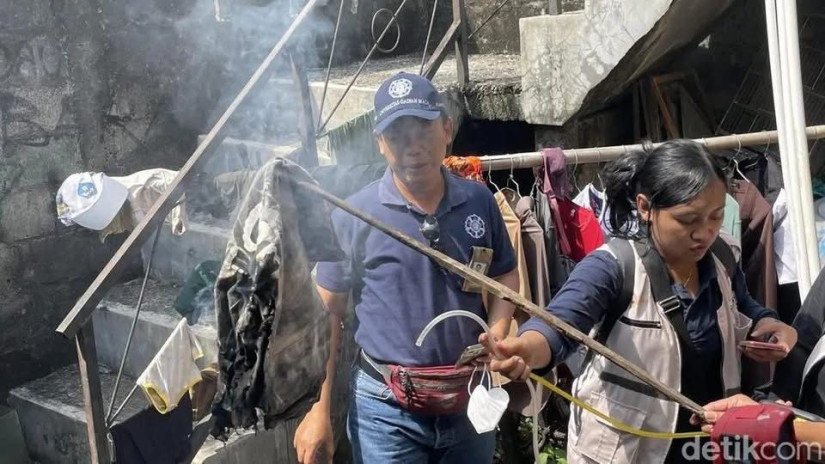
The team from the Center for Entropy Deceleration Studies (PKPE), Faculty of Engineering, Universitas Gadjah Mada (FT UGM), conducted another round of observations and sample collection at Mutfiana’s home, where dozens of fire spots had appeared in Seyegan, Yogyakarta.
The team, consisting of 18 multidisciplinary researchers and academics, collected the final samples at the site on Friday (Jun. 12). The final results indicate that the fire spots were caused by fire residue, with the initial ignition likely triggered by hydrogen gas from chicken-cutting waste.
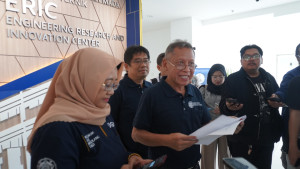
This was conveyed by team representatives during a press conference held at the Engineering Research and Innovation Center (ERIC) building on Sunday (Jun. 13). Several experts representing the team attended the press conference, including Professor Alva Edy Tontowi as team leader, accompanied by Professor Deendarlianto, Professor Leni Sophia Heliani, Dr. Sarju Winardi, and Dr. Saptono Budi Samodra.
Professor Tontowi explained that the team focused on identifying potential natural phenomena that could have caused the fires. This led the team to conduct electromagnetic field measurements, subsurface mapping using ground-penetrating radar and geoelectrical technology, and gas content measurements using a portable gas detector.
“In line with our initial hypothesis, and as stated in our first press release, the team detected hydrogen gas (H₂) at the fire points, which was suspected to be associated with pyrophoric gas originating from chicken waste,” he said in a statement released on Monday (Jun. 15).
To investigate the suspected presence of hydrogen gas, the team examined fire residue on ceramic wall surfaces, wood, and plywood and analyzed the samples using Fourier transform infrared (FTIR) spectroscopy. The final sample collection conducted on Friday (Jun. 12) revealed the presence of PVC (polyvinyl chloride), a substance not commonly found on ceramic surfaces, walls, or plywood.
“When PVC burns, it produces hydrogen chloride gas. The detector identified this gas as hydrogen,” explained Professor Tontowi.
Since the initial observation began on May 30, 2026, spatial analysis conducted using drones and infrared sensors, covering elevations and a 200-meter radius, has shown no thermal anomalies. The cracks discovered in the area were also interpreted as not containing natural gas. Measurements of electric and magnetic fields at the site remained within normal levels.
“As time passed, the team did not find sufficiently strong evidence to conclude that the fire occurred naturally, whether triggered by electromagnetic ignition or self-ignition due to spontaneous ignition,” said Dr. Winardi, another team member.
Further follow-up on the findings from UGM’s expert team has been fully handed over to the Regional Disaster Management Agency (BPBD) of Sleman. With this, the expert team has officially concluded its observation of the fire spots that appeared at a resident’s home in Seyegan, Yogyakarta.
Author: Ika Agustine
Editor: Gusti Grehenson
Post-editor: Rajendra Arya
Photo: Detik and Ika Agustine Documentation