


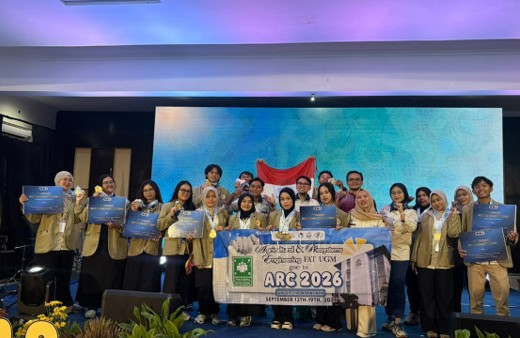
Universitas Gadjah Mada (UGM) students once again achieved an impressive result at the 12th Southeast Asian Agricultural and Food Engineering Student Chapter Annual Regional Convention (ARC 2026). The event was held from September 13–19, 2026, at Universitas Brawijaya, Malang. UGM also received the MSAE Best Overall Award in the Southeast Asian competition.
Students from the Department of Agricultural and Biosystems Engineering (DTPB), Faculty of Agricultural Technology (FTP UGM), secured the achievement, sending 15 students in five teams. The students competed in several categories and received various awards, including Gold Medals, Silver Medals, Bronze Medals, and Runner-Up titles.
In the Interactive Poster Competition, the UGM delegation secured three Gold Medals and two Silver Medals. Additionally, students earned one Gold Medal, one Silver Medal, and a Runner-Up placement in the Roarduino Competition. Meanwhile, in the Creative Vlog Competition, the delegation won one Bronze Medal, two Silver Medals, and one Runner-Up title.
The delegation also earned a Gold Medal in the Cultural Performance category for a performance of the Sabuk Mangir dance by Nazmi Fayza Nazhara, Josh Hafid Bagus Jocky Alfrido, Rendy Dwi Nugraha, Nadhifa Alya Febriana, and Adelia Cantika Dewi.
Students from various higher education institutions across Southeast Asia attended ARC 2026. In total, 144 participants were divided into 48 groups or delegation teams from four countries: Indonesia, Malaysia, Thailand, and the Philippines. Indonesia sent 17 teams with 51 participants, Malaysia sent 27 teams with 81 participants, Thailand sent 3 teams with 9 participants, and the Philippines sent 1 team with 3 participants.
The diversity of participants’ backgrounds made ARC 2026 a dynamic forum for building cross-cultural interaction while introducing various approaches and innovations in agricultural and food engineering from each country. The DTPB FTP UGM delegation was accompanied by four advisors: Dr. Prieskarinda Lestari, S.T., IPM., Dwi Ayuni, S.T.P., M.Sc., Ph.D., Muhamad Khoiru Zaki, S.P., M.P., Ph.D., IPM., dan Bayu Nugraha, S.T.P., M.Sc., Ph.D.

DTPB FTP UGM team leader Alexander Dimas said preparations involved identifying each competition’s requirements, conducting trials and training sessions, and evaluating possible solutions. The team also monitored progress through regular meetings to track progress and identify challenges each group faced.
“In addition, monitoring and meetings were conducted to track the progress and respective challenges of each team,” he said on Thursday (October 1).
The challenges grew more diverse as participants competed in categories with different characteristics. Each category required a specific approach, ranging from technical and analytical skills to communication and quick decision-making. Differences in participants’ backgrounds across higher education institutions in Southeast Asia also required adaptability, including navigating differences in language and behavior.
According to him, communication and teamwork were the main approaches used to address these situations. Coordination took place not only within each group but also among the eight delegation teams and with faculty advisors.
“Being open to the perspectives of participants from other higher education institutions gave us the experience of understanding different approaches to solving problems,” he explained.
He said the achievement resulted from several mutually supportive factors. Preparation, task distribution, evaluation, adaptability, communication, openness, and support from faculty advisors were all integral parts of the process.
“The most important thing is how all members can work as one unit from the beginning to the end of the competition,” he said.
In addition to technical skills, participating in the series of activities also provided students with experience in working with others. The students encountered various perspectives, which required them to build communication skills, respect differences in ways of thinking, and adapt to changing situations.
“Each competition also required us to work under pressure, adapt to changing situations, and remain focused on our shared goals,” he said.
The experience will subsequently be developed through improvements in both hard and soft skills. The students also plan to share their experiences with other students while expanding their networks with other higher education institutions. This plan is particularly relevant as UGM will host the next ARC.
“I hope the experience gained from organizing ARC 2026 in Malang will serve as valuable preparation for students to contribute to the preparation and implementation of the event at UGM,” he concluded.
Author: Cyntia Noviana
Editor: Gusti Grehenson
Post-Editor: Priyananda
Photo: ARC Team Documentation