


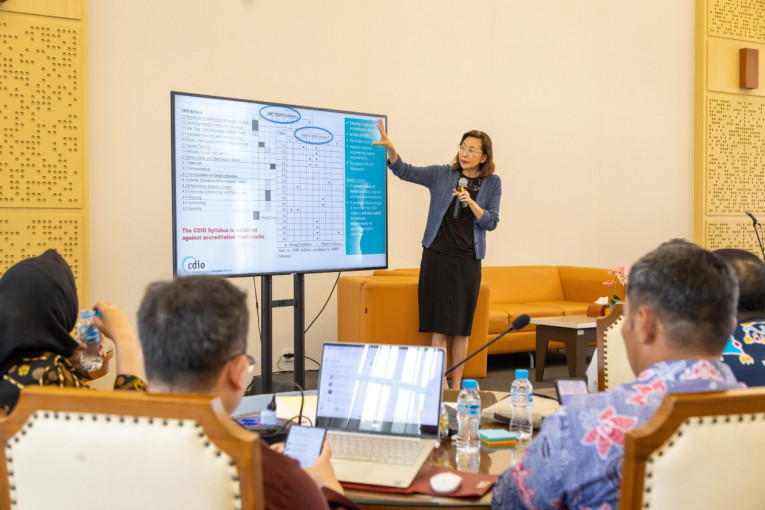
The development of artificial intelligence (AI) is prompting higher education institutions not only to update the technical knowledge included in their curricula but also to ensure that students develop skills that remain relevant amid changes in the world of work. This was the focus of discussions on the second and third days of the ELEVATE Higher Education (HE) Workshop 2: The Modern Curriculum & Graduate Readiness at the UGM Central Office. Held from September 28–30, 2026, the workshop brought together representatives from 11 higher education institutions in Indonesia to discuss curriculum transformation and graduate readiness in responding to changes in the world of work and society.
On the second day, discussions focused on designing curricula that integrate technical skills with human skills. The approach introduced was the CDIO (Conceive-Design-Implement-Operate) framework, which can be used to develop learning experiences based on the needs of the world of work.

Dr. Lim Joo Ghee, Director of the School of Electrical and Electronic Engineering at Singapore Polytechnic, introduced five human skills considered important for students to develop: critical thinking, creativity and innovation, self-directed learning, teamwork, and communication. According to Dr. Lim, students should develop these five skills alongside an understanding of ethics, responsibility, and AI literacy.
“AI literacy does not simply mean understanding the technology, but also includes the ability to use AI, learn with AI, and develop capabilities that go beyond the use of the technology,” he said.
In developing teamwork skills, he also shared his experience in developing teamwork assessments through the Comprehensive Assessment of Team Member Effectiveness (CATME). Under this approach, students assess themselves and their team members based on several dimensions of teamwork. The assessment results are then used to monitor students’ teamwork skill development throughout their studies.
The discussion continued with Assoc. Prof. Muhammad Arifin of Politeknik Negeri Batam, who uses the CDIO syllabus to map graduate competency proficiency levels. Arifin explained that the CDIO syllabus is not a course syllabus or Semester Learning Plan (RPS), but rather an inventory of skills that can be selected and adapted to the needs of a study program. To determine the required competency levels, he explained that Politeknik Negeri Batam developed the Graduate Expected Proficiency Level Survey.
“The survey involves four stakeholder groups: senior alumni, junior alumni, lecturers, and industry or companies,” he said.
The survey maps proficiency levels from level 0 to level 5, ranging from not needed and exposure only to being able to participate, understand and explain, and ultimately apply, innovate, and lead. He explained that the required depth of competency should also be adjusted to each study program’s level of education and characteristics.
“The syllabus is a skill set. CDIO already provides the skills that can be selected,” he explained.
The mapping results are then used as a reference for developing Graduate Learning Outcomes (CPL) and updating the curriculum. Based on Politeknik Negeri Batam’s previous work, industry needs extend beyond technical competencies to skills such as ethics, teamwork, and communication.
“These interpersonal skills are then integrated into learning and the curriculum so that all students have opportunities to develop them. One approach used is project-based learning,” he said.

Director of Politeknik Gajah Tunggal, Dr. Ita Mariza, presented a rigorous learning model that requires students to solve technical problems directly at sponsoring companies’ factories. Unlike public institutions, she explained that industry-sponsored polytechnics receive full funding from companies, allowing all curriculum projects to be designed to directly address industry challenges.
“Students are accustomed to working with a high level of discipline through class hours that resemble professional working hours, from 8:00 a.m. to 5:00 p.m., as well as the requirement to prepare work reports each semester,” she said.
She explained that the curriculum progresses in stages, with the first and second semesters focusing on identifying nontechnical problems, the third and fourth semesters on engineering, and the fifth and sixth semesters on solving production-line problems. In this process, factory managers, from deputy-level managers to plant heads, are directly involved as student mentors.
In addition to technical mastery, behavioral and disciplinary aspects account for 15 percent of the evaluation structure. She also emphasized that the CDIO framework is not limited to engineering but can also be effectively applied to non-engineering disciplines such as education, business administration, and social sciences to address participation and management issues.
“CDIO can also be implemented in education, business administration, and social science. The process is the same: identify the problem, design a solution, implement it, and then evaluate its achievement,” she explained.

Through the second-day session, participants were invited to reflect on the curricula of their respective study programs. Participants were also encouraged to identify the skills most important for graduates, review the skills already being taught, and determine which skills still need to be added and how to improve their development. The discussion covered not only the skills needed in the AI era but also how to map, teach, and measure skills through the curriculum.
UGM Geodesy Engineering lecturer I Made Andi Arsana, Ph.D., emphasized that technical mastery alone does not guarantee graduates’ readiness for the real world. He gave the example of geodesy engineering students who are skilled in calculating coordinates and using and producing maps. However, when faced with real-world issues such as determining Indonesia’s maritime boundaries, they must understand complex legal issues, communication ethics, and uncertainty management.
“Therefore, within the CDIO 3.0 framework, engineering education is no longer focused solely on pure engineering knowledge, but must integrate an understanding of human and social aspects,” he explained.
He also highlighted the importance of nontechnical skills such as teamwork, communication, systems thinking, ethics, and cross-disciplinary collaboration. He emphasized that academic readiness is different from institutional readiness. Producing graduates who are truly ready for the world of work requires synergy among a strong curriculum, faculty readiness, and the institution’s overall readiness.
“Every higher education institution is also encouraged to continuously evaluate what graduates should be able to do, where they can practice these skills, how competency attainment can be measured, and the extent to which the institution is ready to facilitate the process,” he said.
UGM Vice Rector for Human Resources and Finance Professor Supriyadi presented UGM’s strategy for developing a sustainable financing model amid changing needs and challenges in higher education management, and concluded the workshop.
He explained that sustainable higher education financing needs support from revenue diversification.
“Revenue diversification can come from developing partnerships, commercializing research results, philanthropy, and optimizing university assets. These efforts should also take into account the vision, mission, and values of higher education institutions,” he said.
He also urged that financial management should also consider environmental, social, and governance (ESG) aspects. These principles can be applied to investment decisions, procurement, and university asset management.
“In managing facilities, UGM has a policy requiring new developments to maintain open space, accounting for at least 40 percent of the total building area,” he said.
Concluding the series of activities, he expressed his appreciation to all participants who actively took part in the workshop. He hoped the experience and knowledge gained during the program would help participants develop their respective higher education institutions.
“I hope that the exchange of experiences among institutions can provide a foundation for translating what we have learned into curriculum development, resource management, and graduate readiness at each institution,” Professor Supriyadi concluded.
Author: Cyntia Noviana
Editor: Gusti Grehenson
Post-Editor: Priyananda
Photo: Donnie