


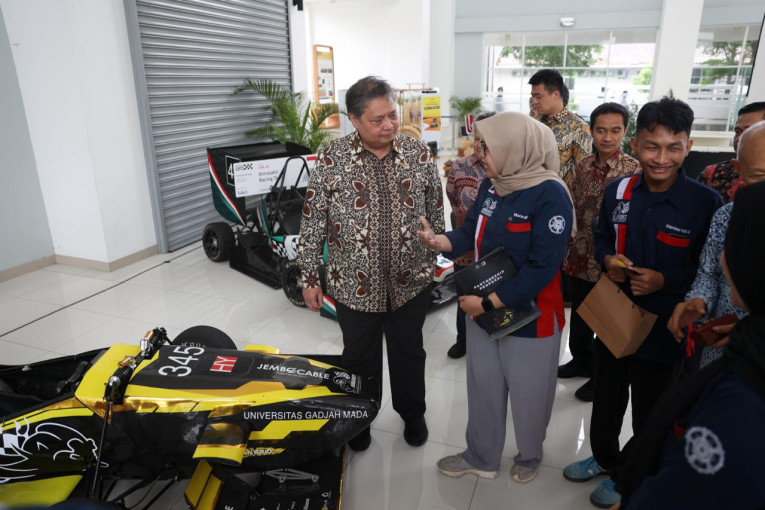
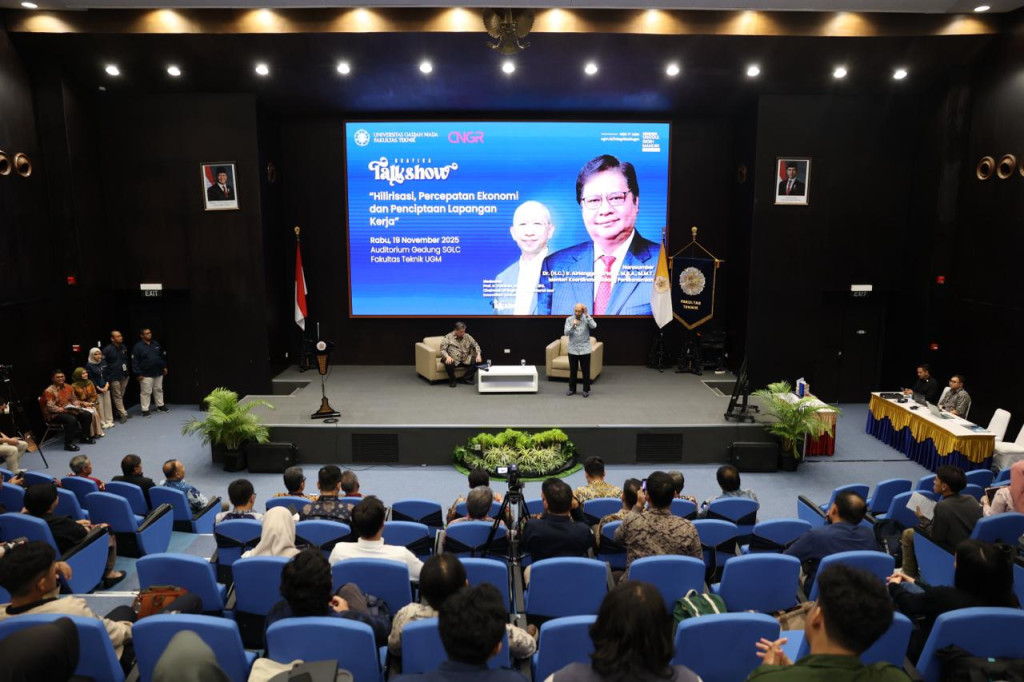
Indonesia’s Coordinating Minister for Economic Affairs, Dr. Airlangga Hartarto, outlined the national downstreaming agenda, strategies for accelerating economic growth, and future talent needs during the Grafika Talkshow. The event was successfully held at the Smart Green Learning Center (SGLC), Faculty of Engineering, Universitas Gadjah Mada (FT UGM) on Wednesday (Nov. 19). On this occasion, the coordinating minister emphasized that downstreaming serves as a vital foundation for Indonesia to advance amid global competition.
“Downstreaming is the key to elevating Indonesia to the next level,” he stated.
Coordinating Minister Hartarto underscored the critical role of collaboration among universities, industry, and the government in accelerating national economic transformation.
He also commended the preliminary research presented by UGM students and lecturers on coal-based fertilizer and battery recycling, which he noted aligns with the direction of the digital and future energy industries.
According to him, nickel downstreaming remains one of the most globally spotlighted sectors.
Indonesia holds a strategic position as three major global nickel industry players have already established research cooperation with several domestic universities.
He expressed hope that similar collaborations can be expanded to ensure higher education institutions remain relevant to industry needs.
Coordinating Minister Hartarto also highlighted the significant demand for skilled workers, particularly welders, who are now among the most sought-after professions internationally.
“The President has set a target of 100,000 welders. The government is prepared to provide funding; what remains is for universities to accelerate their capacity,” he remarked.
He explained that the government is preparing a scheme to deploy 100,000 internship participants across industries, state-owned enterprises (BUMN), and ministries.
Over the next six months, participants will receive compensation equivalent to the regional minimum wage, fully funded by the government.
This scheme is expected to accelerate the absorption of young workers.
During the session, Coordinating Minister Hartarto also discussed an intellectual property (IP)-based credit policy that allows innovative works to be used as loan collateral.
“Starting next year, we are allocating 10 trillion rupiah for IP-based or creative economy credit. This is a major opportunity for universities and startups,” he explained.
He then presented several potential economic quick wins, including strengthening the tourism sector by optimizing Yogyakarta International Airport (YIA) capacity.
Coordinating Minister Hartarto further stressed Indonesia’s need to prepare for the era of semiconductors, Artificial Intelligence (AI), and quantum computing.
“Indonesia is still far behind. Singapore has 450 AI startups, while Indonesia has only 45. This must become a priority for UGM and other universities,” he asserted.
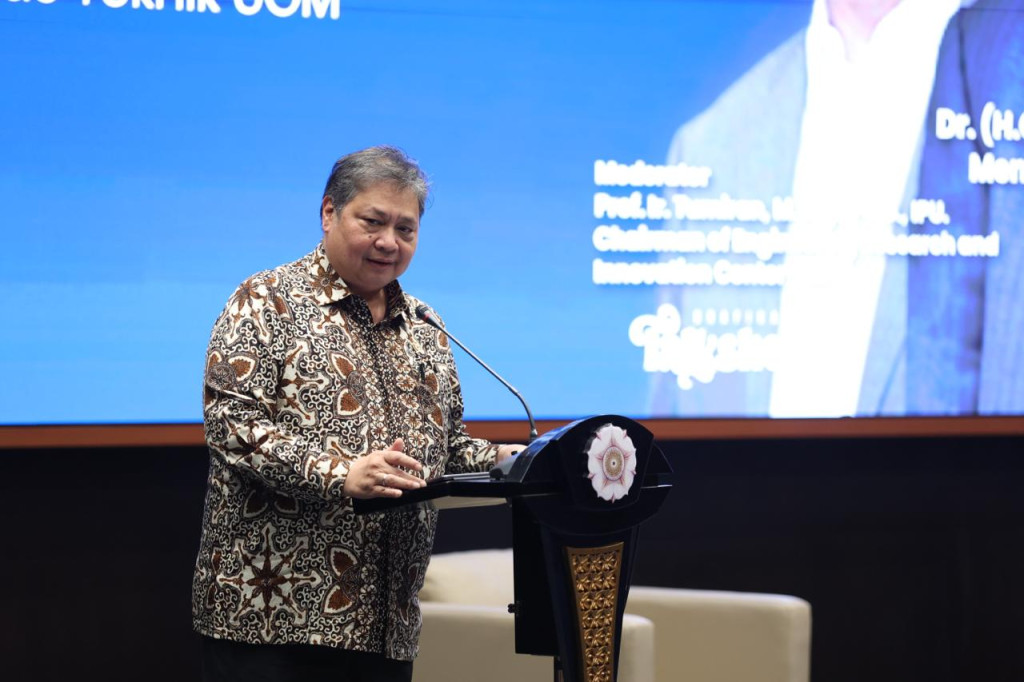
He added that mineral downstreaming, from nickel and copper to rare earth metals, forms a crucial foundation for future industries, ranging from energy and advanced manufacturing to defense technology.
Closing the public lecture, Coordinating Minister Hartarto emphasized that Indonesia needs leaders capable of making swift decisions amid evolving economic targets.
“Going forward, we must reinforce science, technology, engineering, art, and mathematics. Our academic potential must be fully maximized. We want Indonesia to grow by up to 8 percent, and that is only possible if we run, not walk,” he stressed.
In addition to the public lecture, the event included the handover of an ICP-MS Nation 100 laboratory instrument from PT Eco-Energi Perkasa CNGR Indonesia to FT UGM.
The company’s Director, Mr. Chen Hailei, expressed optimism about the collaboration.
“We will continue to strengthen our partnership and create meaningful impact together in the future,” he stated.
UGM Vice-Rector for Research, Business Development, and Partnerships, Dr. Danang Sri Hadmoko, conveyed his appreciation for the support.
“This instrument is a highly strategic step to complement the existing facilities at FT UGM, strengthen research capacity, and enrich the innovation ecosystem,” he affirmed.
Author: Hanifah
Editor: Triya Andriyani
Post-editor: Lintang Andwyna
Photographer: Firsto Adi