


Teuku Jacob is widely known as the former Rector of Universitas Gadjah Mada (UGM). Beyond his leadership role, he was recognized as one of Indonesia’s most dedicated scholars of early humans. His interest in paleoanthropological research stemmed from the asthma he suffered, which made him unable to tolerate the smell of corpses. As a result, he chose to pursue physical anthropology. His lifelong dedication to the field led to significant contributions to human knowledge through the discovery of Homo erectus fossils in Sangiran in 1962 and his work on Homo floresiensis in Liang Bua, Flores Island. Jacob’s findings also helped refute the hypothesis that ancient Javanese humans practiced decapitation as part of cannibalistic rituals.
Dean of the UGM Faculty of Medicine, Public Health, and Nursing (FK-KMK), Professor Yodi Mahendradhata, stated that the intellectual legacy of Professor Teuku Jacob serves as an example of the importance of expertise-based leadership, the role of academics as a public school, and active engagement in promoting world peace. Academics are expected not only to possess strong expertise but also to apply their knowledge to address humanitarian issues. Therefore, future scholars must remain rooted in national concerns while contributing at the international level.
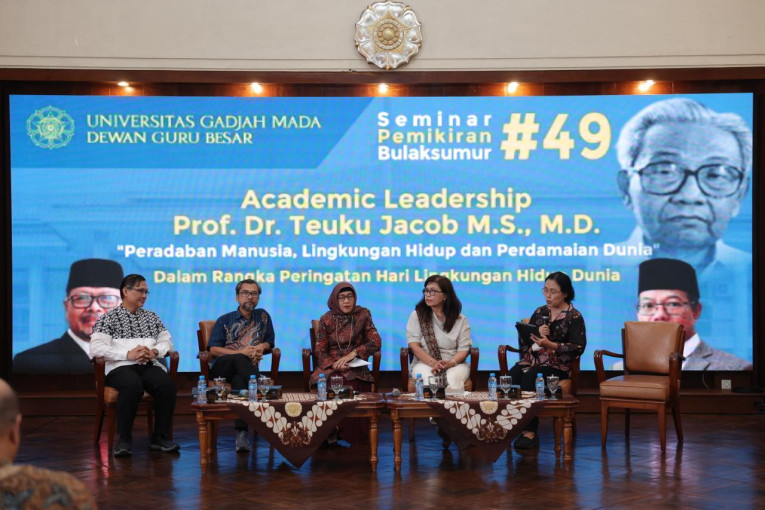
“Teuku Jacob’s greatest legacy is not his position or his laboratory, but the example he set that knowledge must always be dedicated to humanity,” he said during the 49th Bulaksumur Thought Seminar, “Peradaban Manusia, Lingkungan Hidup, dan Perdamaian Dunia: Pemikiran Teuku Jacob” (Human Civilization, Environment, and World Peace: The Thought of Teuku Jacob), held on Friday (Jun. 5) at the UGM Senate Hall.
Chair of the UGM Academic Senate Council, Professor M. Baiquni, expressed concern about modern human civilization, which has not only generated conflict and warfare but also contributed to the degradation of Earth’s ecosystems. He emphasized that science must play a role in reconciling human civilization with the planet’s ecosystems.

Professor Baiquni recalled Professor Jacob’s ideas on advancing peace studies through polemology and on establishing the UGM Center for Security and Peace Studies (PSKP). Major disasters throughout history, from the ancient eruption of Mount Toba to the Aceh tsunami, demonstrate the importance of humanity’s ability to adapt and learn from nature.
“Peace is about living in harmony with ourselves and in harmony with Earth’s ecosystems,” he said.
Meanwhile, UGM Vice Rector for Education and Teaching, Professor Wening Udasmoro, explained that one of the fundamental problems of modern civilization is the persistent separation between nature and culture. Under this worldview, humans are positioned at the center of civilization and are assumed to have the authority to control and exploit nature.
“This dichotomy gives rise to exploitative practices, not only toward the environment but also toward other groups of people who are considered weaker,” she explained.

Professor Udasmoro further noted that in the social sciences, the body is understood not merely as a biological entity but also as a “social body” that reflects the condition of society. The conflicts occurring within society, she argued, suggest that humanity’s claim to being civilized remains open to question.
She also criticized anthropocentric perspectives that place humans at the center and justify the exploitation of nature and fellow human beings. For this reason, she emphasized that Professor Jacob’s ideas remain relevant for understanding the relationship between humans, society, and civilization.
UGM anthropologist and FK-KMK professor, Professor Etty Indriati, presented the development of human civilization from anthropological and evolutionary perspectives. Human evolution has been marked by increased brain capacity, enabling language, abstract thinking, and advancements in science and technology. However, she argued that such progress has not been matched by humanity’s ability to preserve environmental sustainability.
“Humans today are intelligent, but not yet wise enough to care for the environment,” she remarked.
Professor Indriati noted that the world has entered the Anthropocene, an era in which human activity has become the primary driver of environmental change and degradation. She therefore encouraged strengthening ecological awareness through an ecotheological approach that places humans, nature, and God in an interconnected relationship while recognizing nature as an entity with intrinsic value that deserves protection.
“Humans can no longer view nature merely as an object to be exploited, but as part of life that must be protected together,” she said.
Professor of International Relations at UGM, Professor Siti Mutiah Setiawati, highlighted ongoing conflicts in the Middle East as a reflection of the challenges of achieving world peace. According to her, the conflicts in the region are not merely the result of territorial disputes but are also linked to history, identity, religion, and geopolitical interests.
Drawing on Johan Galtung’s ideas, she explained that peace cannot be defined simply as the absence of war or violence. It must be built upon justice, respect for human rights, and state sovereignty. She also argued that academics have a moral responsibility to continue advocating humanitarian values and contributing to efforts toward sustainable peace.
“Positive peace is not merely the absence of violence. It requires justice, respect for human rights, respect for state sovereignty, and the right to self-determination,” she explained.
Former Head of the UGM Center for Security and Peace Studies (PSKP), Achmad Munjid, highlighted the rise of racism and exclusivism in several Western countries, driven by fears associated with the Great Replacement theory. Anxiety among certain groups over growing immigrant populations has given rise to various forms of discrimination and identity-based violence. These conditions, he argued, make it increasingly difficult to build human solidarity, as people become more attached to group identities than to universal humanitarian values.
“What we need to build is human solidarity, not merely group solidarity,” he said.
Munjid encouraged academics and students to cultivate moral ambition in the use of knowledge. Referring to Rutger Bregman’s ideas, he criticized the tendency among top university graduates to focus solely on personal gain and career advancement without creating meaningful social impact. According to him, academics should use their knowledge and talents to promote social transformation toward a more just and prosperous society.
“We need talented people who use their abilities to drive social change, rather than simply maintaining the status quo,” he concluded.
Author: Cyntia Noviana
Editor: Gusti Grehenson
Post-editor: Jasmine Ferdian
Photo: Firsto