


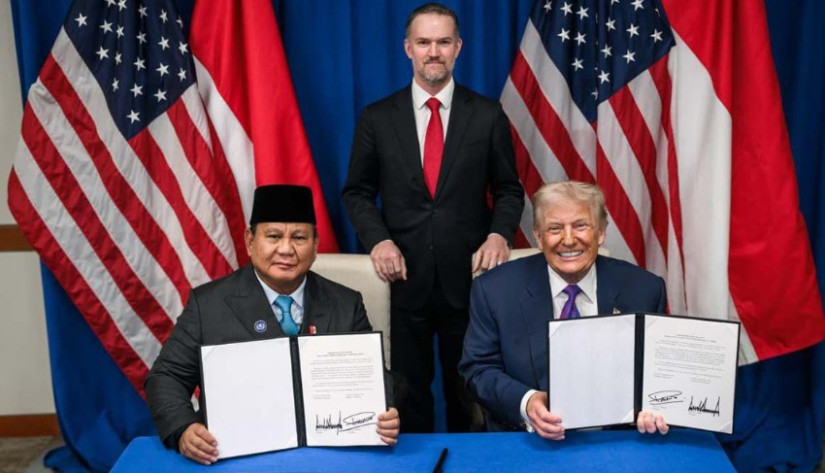
Indonesia has accepted a reciprocal trade agreement with the United States (US) that allows American goods to enter Indonesia without obtaining halal certification. This development has drawn criticism from several Islamic leaders, as the halal status of imported products — including food and its derivatives from the United States — remains in question. Moreover, the removal of import taxes is seen as potentially killing local businesses.
Dr. Nanung Danar Dono, a researcher at the UGM Halal Center, noted that the issue of exempting imported products from halal certification has indeed sparked debate among Islamic scholars, owing to differences in juridical schools (mazhab) practiced in Indonesia.
Nanung explained that, in Indonesia, the Shafi‘i school of thought is most widely followed. According to this school, all derivatives of haram (forbidden) substances — including items such as plates, spoons, or glasses made from bone — are prohibited. This framework also applies to products containing haram ingredients.
“Therefore, in Indonesia, all products are required to hold halal certification,” he stated on Tuesday (March 3).
Under the prevailing regulations in Indonesia, said Nanung, all imported products — especially food — must have halal certification. He explained that halal certification may be issued either by Indonesia’s Halal Product Assurance Agency (BPJPH) or by a foreign halal body that has a Mutual Recognition Agreement with BPJPH. He emphasized that if imported products from the United States are to be considered halal, they must comply with the standards set by the Indonesian Ulema Council (MUI).
“If not, they will not be considered halal by Islamic scholars and MUI,” he said.
According to him, given the unresolved issues surrounding halal status, the trade cooperation agreement between Indonesia and the United States should be reviewed.
“So, if former President Donald Trump insisted on such terms, it needs to be corrected; it cannot be left as is. Even though the agreement has been signed, it must still be corrected,” Nanung explained.
If the bilateral trade agreement is implemented without revision, Nanung urged Muslims not to purchase imported American products that do not yet have clear halal certification. “The impact is that imported US products sold in Indonesia will only be purchased by a small number of people. This appeal is part of a protest against a policy that does not require demonstrations or street protests,” he added.
Nanung also pointed out that allowing American products to enter Indonesia without halal certification not only raises concerns about halal compliance but also affects tax burdens. He explained that under the agreement, all American products entering Indonesia would be subject to a 0% import tax, while Indonesian products exported to the United States would face a 19% import tax — a rate he described as very expensive and potentially harmful to Indonesia’s exports.
“It’s unfair, very unfair,” Nanung said.
Nanung explained that imported livestock products could ultimately threaten local livestock farmers. Because there is no tax on American imports, imported meat becomes very cheap.
“If local livestock businesses collapse, it will be extremely difficult for them to recover,” he stated.
According to him, the trade policy between the Indonesian government and the United States has the potential to destroy livestock and local entrepreneurship. Instead of supporting Indonesian exports to the United States, the agreement could end up crippling thousands of local livestock businesses.
“This cooperation harms our country because Indonesia must fulfill 217 points, while the United States only has 6 points. That is extremely unfair; for a bilateral agreement, it does not respect the sovereignty of our nation,” he concluded.
Author: Fatihah Salwa Rasyid
Editor: Gusti Grehenson
Post-editor: Zahra
Photo: BPMI Setpres